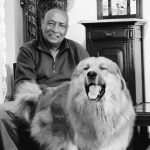
 By: Ganesh Saili
Strangely enough, while it’s true that I have done many crazy things in the days of my youth, somehow it never involved angling, for the simple reason that in these foothills there are no rivers. Though some, like dashing Manvendra Pratap Singh, (who, for reasons of brevity, we call MPS) love fishing. He knows that good things come to those who bait, and loves nothing like a dip in the water. I last saw him haring off to the Mahakali River that flows along the border with Nepal.
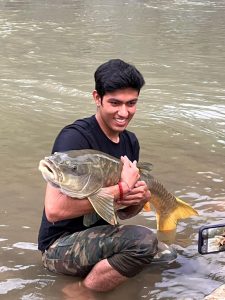
‘By the time we got there the skies had packed up!’ he recalls, adding: ’Despite casting far and wide, it was only on Day Three that I felt a tug – a golden mahseer had grabbed the spoon and taken off down the river.’
‘After half a day’s good fight I landed it and was more than happy to return it to the gushing waters.’
Of course my ‘fishing around’ does involve dates, places or names. Just the other day, I was called upon to help identify a water-colour from the collection of Rahul and Vinita Singh, who belong to a rare tribe of art collectors from Dehradun. (Mercifully, there are still a few around.)
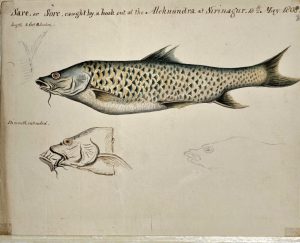
‘Look at this picture of a Himalayan mahseer,’ wrote Rahul. It was captioned: ‘Save or Sore measuring 2 feet 8 inches caught by a hook out of the Alankananda at Srinagar on 15th May 1808.’
‘Who made this image?’ he asked.
To me, the date was a dead give-away. For in the summer of 1808, the Gurkhas were in occupation of Garhwal-Kumaon and there could not have been that many British travellers there.
What-on-earth could an angrez have been doing upstream, fishing?
‘And with enough time left over to sit and paint?’ mulls Rahul, adding: ‘Could he have been an unofficial embassy type?’
Rahul cranks up the search engine like a modern day Sherlock Holmes with all the skills of a forensic scientist: a laptop, a magnifying glass, a notebook, a pencil, and the nail biting skills are all the tools he needs. He plunges into the uncertain waters to strike gold. In the Asiatic Researches Vol. 11, of 1812 he finds that a certain F.V. Raper set out from Hardwar to Gangotri in 1808 on a survey for the source of the Ganga. Arrived in Barahat (or what is today’s Uttarkashi) on 23rd April he found: ‘Many of the inhabitants who attended us expressed much sorrow at these events.’ This is a reference to the Kangra Earthquake that had hit the Himalayan ranges on the morning of 1st September 1803 sending shock waves all the way from the Punjab to Calcutta where it threw the fish out of water from a tank in the Botanical Garden; damaged the upper part of the Qutub Minar in Delhi; and in Allahabad it froze the clock at seventeen minutes past one.
Raper reports: ‘In Barahat two or three hundred people were killed by the falling of the roofs, and a great number of cattle were destroyed.’
‘This is incredible!’ gasps Rahul, awestruck. ‘It mentions THE FISH!’
And sure it does…
‘At this place (Srinagar-Garhwal) we received, and returned, the visits of Hasti Dhal, the former governor, and of Shista Tapah (Thapa), son of Bhatrao Tafah (Thapa) who was in charge of the executive government, during the father’s absence at Cangra (Kangra in Himachal)’. He gives him ‘a fish caught in the Alakananda, where the species is found in great numbers, some of an astonishing size, six or seven feet in length. The scales on the back and sides are large, of a beautiful green, encircled with a bright golden border, the belly a dark bronze.’
‘I’ve had this drawing for years,’ Rahul later tells me, ‘ but had never been able to find anything about the painter. All you had to do was mention the Gurkha’s occupation for the penny to drop, and the rest unfolded rapidly.’
Dear reader, while it’s true that I don’t bait for fish, I do go fishing for facts, and when I feel the tug, I instinctively know it’s time to reel it in.
Ganesh Saili born and home-grown in the hills belongs to those select few whose words are illustrated by their own pictures. Author of two dozen books, some translated into twenty languages, his work has found recognition world-wide.