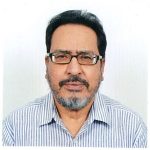
 By BK Joshi
Development is the new god and economic growth the mantra chanted to propitiate it. The beauty about development is that it has no universally accepted meaning. As Humpty Dumpty said ‘it means just what I choose it to mean – neither more nor less’.
As a graduate student pursuing doctoral studies in the mid-seventies of the last century, one question always cropped up in our class-room discussions: What is development? This led to the allied question: development for whom? Many of us felt dissatisfied with the answers available in the dominant discourse on development. As a result it resulted in our questioning the moral basis of the dominant paradigm which equated development with growth. Translated into economic terms it meant economic growth and increased aggregate income at the level of countries and per capita income at the level of individuals. This, incidentally, remains the dominant view even today. Consequently the discourse can be carried out in so-called value-free and objective terms of growth rates and aggregate economic data, with some concession to notions of welfare. As against the dominant view, I have always believed that development is an inherently normative concept; it implies working towards a state that we consider desirable not in terms of numbers and aggregates but in terms of the lives of ordinary human beings. Single-minded pursuit of growth rates and aggregate numbers detracts from the normative basis of the idea. We get so caught up in working towards and measuring growth without giving much thought to what it means for the common people and their daily lives. Are they adequately fed and nourished? Are they adequately clothed? Do they have a decent shelter? (The perennial issues of roti, kapda, makaan). Do their children have access to decent education? Do they and their families have access to proper and affordable medical care? Do they have jobs or other means of livelihood to meet basic needs? Are they leading a happy, fulfilling and rewarding life? Questions like these which should be the ultimate aim and measure of development are generally alien to the discourse.
Prima facie these issues are fairly non-controversial and not likely to invite any opposition. The problem is the failure of the dominant economic paradigm to adequately address and find solutions for them. People in general are not really concerned about the rate of growth, its nuances and its measurement. For them what matters is whether they have the means to provide basic needs and a decent life to their families. In the words of a newspaper columnist: “It is the idea of GDP as a holy grail measure of the health of the overall economy, which is the problem. When a headline GDP number has turned meaningless and irrelevant to a large majority of people, it is puerile to obsess over the minutiae of how it is calculated (Praveen Chakravarty, “Numbers that matter, and don’t”, Indian Express, September 28, 2023).
What then should be our response to the questions posed above? It would be mistaken and short-sighted to abandon economic growth as an objective of development; it is equally mistaken to make it the sole criterion and measure of development. At best it should be one of the objectives, not the whole of it. In short we should give up growth fetishism. Along with growth it is necessary to give equal importance to distribution of income and assets and to fulfilling the above-mentioned needs directly rather than indirectly as outcomes of increased incomes following from economic growth as generally believed. In fact, I am of the view that if we concentrate our attention on these factors, we need not bother too much about economic growth. Economic growth will willy-nilly follow, since resources will have to be found for providing basic needs. In that case primacy will be given to those aspects of growth that have a direct bearing on human welfare and not merely on more production.
The implication of the above argument is the need for a human-centric development process in place of a number-centric process which emphasizes higher growth rates, more production, higher use of natural resources. Recall that the sub-title of E. F. Schumacher’s book “Small is Beautiful” is “The Study of Economics as if People Mattered”. Such a development process would also be ecologically less damaging and more compatible with the idea of sustainable development. It would also lay emphasis on decentralization both in the economic and political spheres as against the centralizing tendencies of contemporary economic and political policy structures under the influence of trans-national economic players, global finance and the market. In short, it would echo Mahatma Gandhi’s views on decentralisation in the economic and political spheres and production for needs rather than greed.
This plea for moral grounding of economic policy harks back to the original understanding of economics as being closely linked to moral philosophy. Adam Smith, generally considered the father of economics occupied the chair of moral philosophy at Glasgow University and in 1759 published The Theory of Moral Sentiments before The Wealth of Nations in 1776, the work for which he is widely known. Economics was dubbed ‘The Dismal Science’ by Thomas Carlyle much later in 1849. I conclude with this quote from The Theory of Moral Sentiments by Adam Smith: This disposition to admire, and almost to worship, the rich and the powerful, and to despise, or, at least, to neglect persons of poor and mean condition, though necessary both to establish and to maintain the distinction of ranks and the order of society, is, at the same time, the great and most universal cause of the corruption of our moral sentiments. That wealth and greatness are often regarded with the respect and admiration which are due only to wisdom and virtue; and that the contempt, of which vice and folly are the only proper objects, is often most unjustly bestowed upon poverty and weakness, has been the complaint of moralists in all ages.
(BK Joshi is former Vice Chancellor, Kumaon University and currently Honorary Director, Doon Library & Research Centre.)