Book Launch of Sanjeev Chopra’s ‘We the People of the States of Bharat’
By Arun Pratap Singh
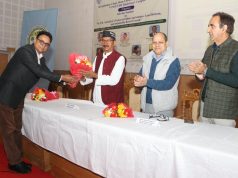
Dehradun, 13 Nov: On the first day of the Sixth Edition of Valley of Words Literature Festival held in Dehradun yesterday, one of the books that were launched was ‘We the People of the States of Bharat’, written by retired senior IAS officer and the curator of Valley of Words Literature Festival, Dr Sanjeev Chopra. The session was chaired by Chancellor of Ashoka University, Prof Rudrangshu Mukherjee, an eminent historian himself while noted journalist Shekhar Gupta held conversation with the author Dr Chopra.
 The book covers the events that led to integration of India as a union after independence, and the reorganisation of states on a linguistic basis. The session began with Dr Mukherjee highlighting the fact that integration of more than 500 princely states into the Union of India after the independence was tortuous even at stages a bizarre process, and it was a very deft political exercise led by the then Home Minister Sardar Patel, helped ably by VP Menon who was then Secretary to Government of India under ministry of States.
Dr Chopra pointed out that at present it seemed improbable that Congress and RSS could be on one page on various national issues, but indeed in the pre independence era and in earlier years of independence, they were indeed on a common page on various issues of national importance. Creating states on a linguistic basis was one such issue. Both Congress and RSS were on the same page on issues like merger of Hyderabad and Goa, Daman & Diu into Union of India too.
Chopra also pointed out that there was no state in India since Independence that had not seen its boundaries getting changed or re-aligned. The reorganisation of states had been a continuous process which had continued till the present times with Telangana being the latest state to be carved out. He conceded that for the integration of India post-independence, much of the credit ought to go to the then Home Minister Sardar Patel who was decisive and was not opposed to even military engagement in order to achieve the objective.
Chopra also revealed that due to constant engagements and events happening at Lal Bahadur Shastri National Academy of Administration would keep one so engaged but the reprieve came in form of Covid. It was then, he could spend some valuable time at the Library and conduct research in respect of this book. He also informed that at one time, there was a proposal to merge West Bengal with Bihar as a single state. While this proposal was praised by the English press, the local language press in both the states were vehemently opposed to this. Both Mukherjee and Shekhar Gupta conceded that they were not aware of this proposal.
The speakers also agreed that the partition was a brutal exercise in which millions were killed but the partition was only the beginning of the challenges towards integration of Union of India and reorganisation of the states. Even after the reorganisation of states on a linguistic basis, there were other challenges. For example in Punjab, choosing the script for the Punjabi language remained a major issue for sometime. Mukherjee pointed out that different kinds of Bangla languages were spoken in Bengal and there was a conflict between them.