 By Hugh & Colleen Gantzer
Today is NAVY DAY. On this day in 1971, our Naval Chief Admiral SM Nanda stopped the Indo-Pakistan war dead in its tracks. In a brilliant and unconventional move, his ships launched a missile attack on Karachi. The stunned Pakistanis scrambled their Air Force in pursuit of IAF Bombers presuming that it was an attack from the air. But by the time they realised the truth, our missile ships were on their way back home. This, once and for all should have established the imperative necessity to develop India’s sea power. Sadly, however, that lesson was ignored while our main rivals, the Chinese silently built up their Navy into the largest Oceanic force in the world.
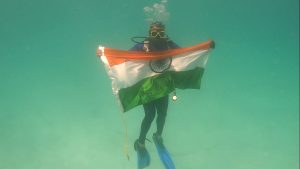
underwater.
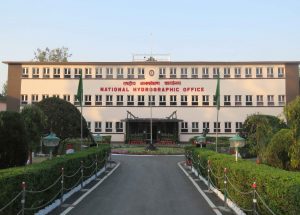
But it is not too late to correct that. And the correction must start in an organisation based in Dehradun: The National Hydrographic Office. This is the throbbing heart of a very special Branch of Naval personnel whose job is to keep a 24×7 watch on the sea lanes of the world. The Hydrographers of the Indian Navy are the specialist map makers of the otherwise trackless ocean. Inspite of their best efforts, however, the surface of the Moon has been better mapped than the under-water possessions of India. Here are a few startling facts about the enormous areas we own but have failed to map and protect.
India’s exclusive economic zone, stretching out to sea from our mainland and islands covers a staggering area of around 2.02 million square kilometres. All this territory belongs to India by law. In contrast, not one square centimetre of the Moon covered by our six-wheeled Moon Rover belongs to India. SO, SHOULD WE NOT SPEND AT LEAST AS MUCH MONEY TO PROTECT WHAT IS OURS ON EARTH RATHER THAN INVESTING IT ON WHAT IS NOT OURS ON THE MOON?
We own our Continental Shelf. A continental shelf is a submerged extension of a continent that thrusts out from the coast line to a drop off point called shelf break. Ours is estimated to cover an area of around 350,000 square kilometres. This region is vital for various economic activities, including fishing, mineral extraction, and exploration of natural resources.

We call this region Inner Space. In the exploration and use of this space we are still at the primitive Hunter-Gatherer Economy and yet this primitive economy earns us Rs 1.75 Trillion. We need to move to the Herding and Farming Level. We should be able to breed and herd the marine life the way we do cattle. We should also be able to harvest the enormous kelp gardens into edible food. To do all this we must set up an Indian Inner Space Authority. Our main competitors, the Chinese, do not recognise any difference between Civil, Commercial and Military Authorities. We could replicate this system within our democratic framework by placing some of our oceanic development activities under the command of the Defence Services as we have done in the Border Roads Organisation. We should, therefore, place the fledgling IISA under the Chief Hydrographer of the Government of India.
The prime task of the IISA is to be the trainer of people referred to as Aquanauts. Our initial recruitment to this organism should be from strong swimmers drawn from 3827 fishing villages. This will ensure that the customs and traditions of the Aquanauts have deep Indic roots. Their mission should be to make it easier for humans to survive in an underwater environment. At present free swimming divers depend on scuba. This Self-Contained Underwater Breeding Apparatus is unwieldy because it draws on breathable gasses in containers strapped to the backs of divers. Fish do not do this. They have gills which filter the oxygen out of the water in which they swim. Whoever invents artificial gills for human divers will become a millionaire. There are many other secrets employed by sea creatures which we need to discover and adapt to our use. The Horseshoe Crabs and some other species have blue blood because it contains a protein called Hemocyanin which transports oxygen.
Could this protein be used to enhance the effectiveness of an artificial gill system? Octopuses have 9 brains: one in each arm and a central coordinator. These creatures are enormously equipped and flexible. Could we, using artificial intelligence develop underwater Octonobile to help our Aquanauts move rapidly through their oceanic depth? Then there is the mystery of the migration of sea turtles and salmon from the far reaches of the ocean back to their original hatching grounds. What system of navigation do they use? It is certainly a very accurate method. Could it be a sensitivity to the magnetic web that surrounds the earth? If we could discover this, our Aquanauts would be able to navigate the depths of the ocean with exquisite precision.
Whales, the world’s largest animals, live on tiny sea creatures called plankton which they filter out of sea water, ejecting the waste water. Could we breed plankton in vast quantities in our bays and estuaries to serve as an endlessly renewable food source? All the poultry in the world has been selectively bred from our Indian wild fowl. All our other farmyard animals and domesticated pets have been created from wild creatures.
Can we not do the same thing for plankton?
We now come to a matter that deserves to be treated separately: Inter Species Conversation. We are not talking about mere communication but conversation. We believe that we have reached a stage in communication technology that will allow us to have conversations with whales, dolphins and orcas. These oceanic mammals were once land-living creatures. They are still mammals that breathe air, give milk to their young and live in social communities. They are also highly intelligent, second only to humans. They often do community fishing by erecting bubble nets to herd fish together for easier harvesting. They seem to be eager to cooperate with humans.
They have even been known to save drowning humans by raising them to the surface of the sea and then buoying them up to the shore. We believe that with modern communication technology coupled with artificial intelligence, our Aquanauts will be able to converse with whales, dolphins and orcas. That may open enormous reservoirs of knowledge of what is still the Secrets of the Sea.
It would also be a fitting continuation of the initiative of Admiral SM Nanda which we commemorate, today, on NAVY DAY.