 By Kulbhushan Kain
I met someone at a social gathering recently. The moment she realised that I had been associated with schools, she started complaining, “What’s happening in schools these days? Children are glued to their computers all the time. They don’t go out to play, they get too much homework, their concentration spans have decreased, they have no interest in reading books, they don’t want to write. They seem to be only good with digital gadgets…”
The above points are well taken. Unfortunately, the lady was once again flogging a dead horse. The malaise is not schools but to a large extent the disappearance of playing fields. If I were a schoolboy in Dehradun, today, I would never have been able to play sports that I used to with such passion and gusto as I did in the 60s because the playing fields have simply disappeared. I would have had no alternative but to be glued to the computer!
We learnt a lot on the playing fields. Unknown to us at that stage was the fact that play is the foundation of learning, creativity, self-expression, and constructive problem-solving. It taught us how to wrestle with life and make it meaningful. I remember coming back from school, having lunch and rushing off to one of the many playing fields in Clement Town, and returning in clothes soiled in different shades of dirt. Next to my house, just opposite Ustad Vilayat Ali Khan’s house was a beautiful field – with a small lake on its side. We played on it with unobstructed views of the Himalayan mountains in the background! The lake and the playfield have long since disappeared and a clutter of buildings has replaced it. Even Vilayat Khan’s house no longer exists.
Further down the round there used to be a field next to Saint Patrick’s Novitiate. It was here that Bro Dunney spotted my love for cricket and soon I was playing cricket for school and clubs. As one moved towards Bharuwala, we found a number of playing fields. There used to a field opposite a cinema hall called “Victory Cinema”. We used to play matches there regularly with the Army. There was also a field opposite the Post Office –it was a field surrounded by beautiful and tall Eucalyptus trees, and was within the premises of the Air Force Selection Board. We played matches against the Air Force there. Sadly, both the fields have disappeared. The field opposite the Victory Cinema now has what looks like a multi-storeyed housing colony.
My favourite field was the one at Bharuwala next to the mounted Dakota aircraft – an icon of the area. It was here that I honed not only my skills at sports – but also made lifelong friends and learnt lifelong lessons. It was a beautiful field –slightly elevated which dipped at one end into a small ravine. It was difficult to retrieve a cricket ball or a football if one hit them hard enough for them to roll down its slope. Once again, it’s sad to see that not an inch of the playing field remains.
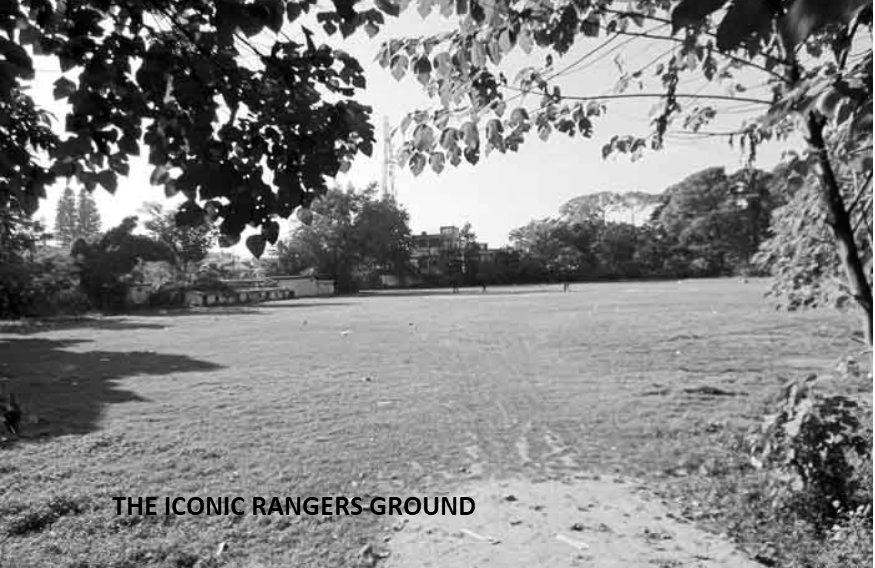
The tragedy of the disappearing playing fields continues. The Ranger’s College Ground opposite St Thomas’ School where I played a number of matches is now some kind of a “mela” ground –largely unkempt and untidy. The Parade Ground was a multipurpose field – used for playing, fairs, circuses, rallies. Now, I can’t see anyone playing matches there. There used to be a number of playing fields in Raipur and Prem Nagar where we used to play matches. Now they no longer exist.
I am aware that schools have preserved their playing fields. Some schools have a policy of not building anything on virgin land. That’s good news. But the facilities for playing on those fields is by and large restricted to students of the school. The public and neighbourhood fields have all disappeared. It has robbed the children of playing after school hours – for free.
Playing sports is the foundation for bonding relationships and fostering tolerance. It’s where we learn to trust and where we learn about the rules of the game. Play increases creativity and resilience, it teaches us about the generation of diversity—diversity of interactions, diversity of behaviour, diversity of connections. It teaches taking risks which is really important because it teaches hazard assessment, it teaches delayed gratification, it teaches resilience, it teaches confidence. When kids get outside and practice bravery, they learn valuable life lessons.
I learnt two important lessons on the playing fields of Clement Town. One was kindness. In a match against the Army, I was out first ball caught by Brigadier Katoch. I was in tears! A first ball duck is worse than dying! Brigadier Katoch could sense my disappointment. He called me back to bat again! I know that the rules of the game don’t allow it – but his kindness showed through. Thats why I remember him till today.
In another match against the Air Force, Group Captain Nehru tempted me with a flighted ball. I fell for the bait. After the match he took me aside and said, “Young man, be careful when tempted!”
Nehru Sir – I haven’t forgotten your advice!
Those and many more were invaluable lessons which gyms, books, preaching, teaching and computer games can’t teach you.
I can understand why playing fields have disappeared. However, we must never forget what Erika Christakis wrote – “When we deny children play, we are denying them the right to understand the world.”
Playing sports was the primary way of learning about life. It will continue to be.
But where are the fields?
(Kulbhushan kain is an award winning educationist with more than 4 decades of working in schools in India and abroad. He is a prolific writer who loves cricket, travelling and cooking. He can be reached at kulbhushan.kain@gmail.com)