DLRC Discussion
Garhwal Post Bureau
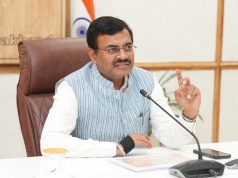
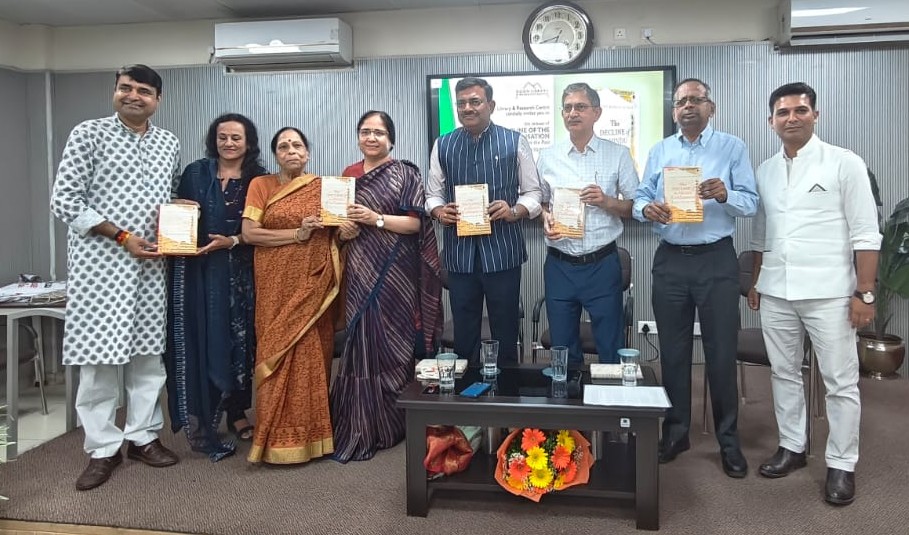
Dehradun, 21 Jun: Doon Library and Research Centre organised an academic event on Saturday featuring an extensive discussion, review, and deliberation on the widely acclaimed book, ‘The Decline of Hindu Civilization: Lessons from the Past’. The author of the book and Secretary of the Union Public Service Commission (UPSC), Shashi Ranjan Kumar, IAS, shared his research, the conceptual framework of the book, and his perspectives on the historical evolution, achievements, and challenges of Indian civilisation.
The programme witnessed the participation of a large number of academicians, historians, researchers, students, literary figures, journalists, administrative officers, intellectuals, and informed citizens of the city.
The Chief Guest at the event was Anand Bardhan, Chief Secretary, Government of Uttarakhand, while Prof Surekha Dangwal, Vice-Chancellor of Doon University, delivered the keynote address.
The programme was presided over by N Ravi Shankar, Director, Doon Library and Research Centre.
The event commenced with the welcome of the dignitaries and the ceremonial lighting of the lamp. This was followed by an introduction to the author and a brief overview of the book and its significance. The audience displayed keen interest in both the subject matter of the book and the author’s extensive research.
In his address, Shashi Ranjan Kumar emphasised that history should not be viewed merely through the lenses of glorification or grievance; rather, it should serve as a source of learning to improve the present and shape the future. He remarked, “The past cannot be avenged; it can only be understood.” According to him, the purpose of history is not to create social discord but to strengthen the processes of self-awareness and introspection.
He explained that the book is divided into four major sections—Peak, Decline, Defeat, and Causes. The work is based on extensive research, authentic historical sources, archival records, travel accounts, and comparative studies. He noted that understanding the long history of Indian civilisation requires not only an examination of political events but also a deeper study of social structures, intellectual traditions, economic systems, and cultural currents.
Highlighting the global contributions of India’s knowledge traditions, Kumar observed that India has made significant contributions to mathematics, the decimal system, the concept of zero, astronomy, medicine, surgery, philosophy, literature, music, and aesthetics. He stressed that understanding both the rise and decline of civilisations is essential, as such experiences provide valuable lessons for the future.
Chief Guest Anand Bardhan praised the book, describing it as not merely a work of history but a serious intellectual document that enables readers to understand the evolution of Indian civilisation. He stated that objective and in-depth study of history helps society better appreciate its roots, achievements, and challenges.
He particularly lauded the efforts of Doon Library and Research Centre, noting that the institution has emerged as an important hub for intellectual and cultural dialogue in Dehradun. Through its regular programmes on literature, history, culture, music, art, environment, folk traditions, and contemporary social issues, it has established itself as one of the leading intellectual platforms in the state. He observed that such initiatives not only enhance knowledge but also strengthen the culture of healthy dialogue and critical discourse in society.
Keynote speaker Prof Surekha Dangwal remarked that history has been interpreted from different perspectives over time. She observed that, after Independence, many aspects of Indian history received limited discussion, whereas today there is a need to understand history through a broader, balanced, and multidimensional perspective. According to her, the study of the rise and fall of civilisations offers important lessons for contemporary society, and this book represents a serious contribution in that direction.
She further noted that the book would be particularly valuable for researchers and students because it presents historical facts and analysis in a systematic manner. In her view, it opens new avenues of discourse for readers interested in the study of Indian civilisation.
One of the highlights of the programme was the interactive discussion and question-and-answer session. Academicians, researchers, students, journalists, and literature enthusiasts raised numerous questions concerning the book’s themes, historical sources, causes of civilisational decline, India’s knowledge traditions, and their relevance to contemporary society. Shashi Ranjan Kumar responded in detail, elaborating on various chapters of the book, his research methodology, and its conclusions. The interactive nature of the session made the event highly engaging, insightful, and intellectually enriching.
On the occasion, the guests were welcomed with bouquets. On behalf of Doon Library and Research Centre, the Chief Guest, the keynote speaker, and the author were honoured with mementoes, books, and commemorative tokens.
A large number of distinguished citizens from diverse fields attended the programme, including senior administrative officers, university and college faculty members, researchers, writers, historians, journalists, advocates, social workers, artists, cultural practitioners, book lovers, and students from various educational institutions. Many eminent citizens of Dehradun actively participated in the discussion and expressed deep interest in the book and its themes. The auditorium was nearly full, and the audience remained enthusiastically engaged throughout the event.
The programme was compered by poet Shrikant Shri and Kunal Uniyal.
In his presidential remarks, N Ravi Shankar stated that the mission of Doon Library and Research Centre is to strengthen the culture of study, dialogue, and intellectual discourse in society. He expressed confidence that the institution would continue to organise meaningful and high-quality programmes on literature, history, culture, environment, folk traditions, and contemporary issues in the future.