Book Review
 By Yauvanika Chopra
=========
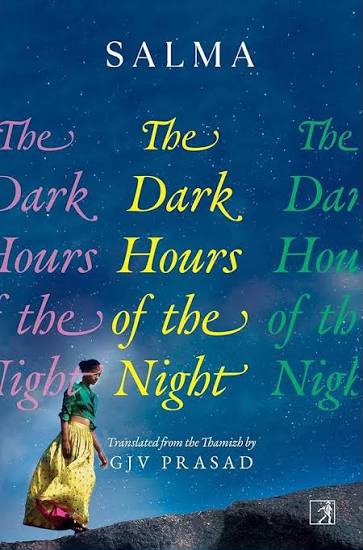
The Dark Hours of the Night
Salma
Translated from the Tamizh by GJV Prasad
Simon & Schuster India
VBA SHORTLIST 2026
=========
On an early evening of Ramzan, in a village in Tamil Nadu, two young girls wait for a crescent moon in a sky that is mostly clear, mostly the colour of the faded blue sari which one’s mother uses to dry vadagam. There is a small cluster of clouds which looks to Rabia like the foam which collects under the washing stone. In another corner towards the south is one single little cloud, separate from the rest, which looks as if it is sulking — waiting, away from the others. Rabia feels a little pang of pity for the solitary cloud, and then laughs quietly at her own flight of fancy.
If Mathina, sitting next to her, had known about this thought, she would have laughed too. Not because she doesn’t love Rabia — she does, with all her heart — but because it is such a characteristically irrepressible expression of her best friend’s whimsical sensitivity. The friendship between Rabia and Mathina provides consolation for every potential sorrow, and there are no lies between them — except those few necessitated by circumstance or ordered by their mothers.
Rabia is from a prosperous, conservative family mired in complex relationships. She could perhaps be seen as our protagonist, but this is not truly a book about any one single person. There is Rabia’s mother Zohra — proud, proper — and Zohra’s mother Ameena — protective over her mother Kathija, who walked with a limp ever since a grindstone fell on her foot in childhood; protective over her daughter Firdaus, who inherited Kathija’s beauty and feels love sinking into her frozen life as roots that unfurl over her body. There is Zohra’s sister-in-law Raima, whose opinions are not valued although she knows the world; Zohra’s maidservant Fathima who acts on her desire; Zohra’s inexplicable companion Mariyayi whose love for one man is endless. These are not truths that Rabia sees — she frequently misses layers in conversation because her attention is focused on chocolate rather than the gossip-news which visitors also carry — but through Rabia, we see Firdaus Chitti through a different lens, and we know that Wahida Akka hums cinema songs instead of tasbih prayers.
This densely-peopled novel by Salma was originally published in Tamizh in 2006 as Irandam Jaamangalin Kathai. For it to have been met with resistance at that time rhymes with the history of the court case against “obscenity” in 1944 which Ismat Chughtai had to go through for her short story “Lihaaf”. To depict women’s realities in artistry is thus rendered vulgar because it departs from sanitized convention in representing women — women who will be women, with their own shadows and joys.
Salma’s skilful depiction of human psychology and the vivid erotic, as exemplified in this book, have previously been translated by Lakshmi Holmstrom as The Hour Past Midnight, published by Zubaan in 2016. GJV Prasad’s translation style in this edition, focusing on a deliberately Indian English inflection, refracts the original in a way that is both immersive and effective. The truths of relationships — especially when fraught by gender — become a kaleidoscope of patterns across perception.
Take young Ahmad, who also loves Rabia with all his heart, but cannot let this reflect as ease. He has his own rivalry at perceived injustice from Mathina, and consequently Rabia: “They had sneered at him so much for having taken a few coins to learn how to cycle. Now, they would be astonished if they saw him riding with such style! Let’s see how they make fun of me after this, he thought.” Ahmad has to get ahead of the girls; he has to make fun of them before they can slight him; his taunts are mostly about the colour of their skin and their general incompetence. Rabia is bothered by these unjustified cruelties. “Why did he act like this? There were so many things she could learn from him, so many games they could play together. But she couldn’t do any of it because he was always making fun of her. She could have caught dragonflies, butterflies and bees with him. He knew how to ride a bike, make kites…”
These differences of experience and understanding remain in adult marriages too. “Who is moral in this town, tell me?” asks Karim Machan rhetorically of his wife Zohra when she brings up a moral quandary of marriage which would affect their niece Wahida, “Men will be men. It’s wrong only when women behave like that.” And because some men will be men in these strange and stifling ways, even the worries that Karim has in common with his wife are not actually shared with his wife. “He firmly believed that sharing his confusions with her would be giving her too much respect… All the same, he tossed and turned in bed all night. When Zohra asked him what the matter was, he shut her down, saying ‘Nothing.’”
Karim’s brother Kadar has a similar question for his wife Raima when she raises the same concern, and he similarly holds no real expectation of an answer: “Is there a pure man in this entire world?” But Kadar cannot eventually avoid the regret of having dismissed Raima’s valid concerns: “His guilt for having completely ignored Raima’s opinion had troubled him for some days, and he had struggled to cope with it. Even if he did nurse a complaint against her, how was he justified in ignoring her so completely?” Kadar and Karim also realise, in an odd symmetry, the distance they have kept from their daughters. Quite without intention, they seem to have become fathers with little idea about the interior or exterior worlds inhabited by Wahida and Rabia.
Those worlds with their beauty and oppressiveness are expressed in Salma’s voice, brought to new dawn through GJV Prasad, in a keen meditation on constrained choice versus unavoidable naseeb. The mask of religious sanction is drawn back, and an unthinking human impulse of preserving power is revealed to be spreading out behind its curtain. There is much to recognize in the wry narration of these young girls as they wait to come of age and dream about food whilst also trying sincerely to focus instead on the penance of experiencing hunger which they know to be the religious purpose of fasting. They make every effort to follow their mothers’ advice even when it is contradictory and confusing: hold shame as honour; accept inequality of freedom as natural; repress what is difficult to understand. And yet — despite it all — there are those who insist on altering what the world has deemed to be their unalterable destinies: “What made her so daring a woman? Just this body and its needs?”
(Yauvanika Chopra was Associate Director at the New India Foundation and earlier an editor at Speaking Tiger.)