 By Atul Rawat
“Papa, get ready to vote!” My daughter appeared excited over the phone.
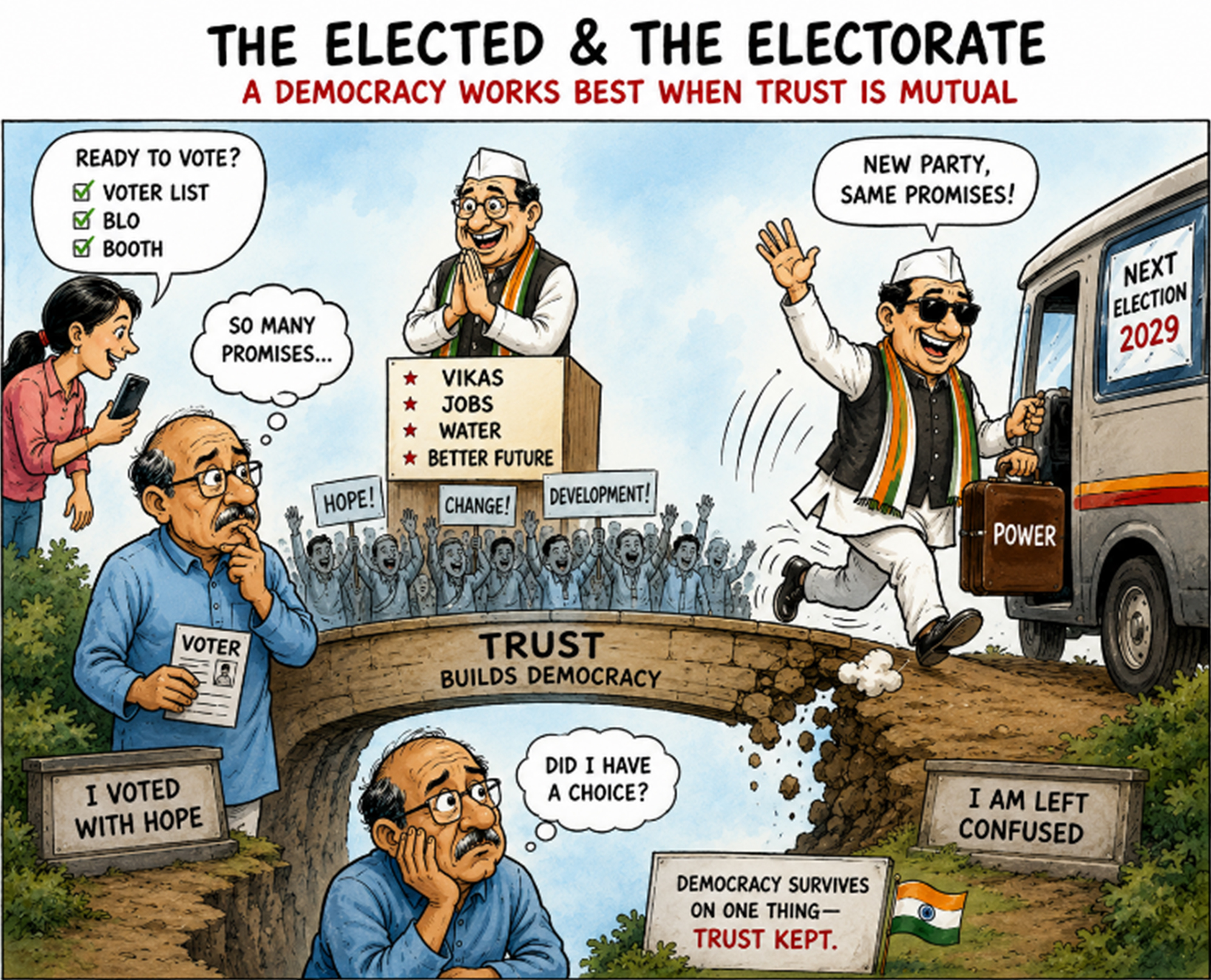
“Have you checked your name on the voter list?” “Do you know your Booth Level Officer?”
“Have you located your polling booth?”
Over the barrage of questions and instructions, she genuinely appeared excited! Before I could answer the first question, three more had already arrived. I realised this wasn’t a conversation. It was a pre-election audit.
“Papa, don’t you know? We are the largest democracy in the world!”
I smiled.
“Yes, beta… and apparently you are the Chief Election Commissioner of our family.”
Well, being the world’s largest democracy is a badge of honour every Indian proudly wears, I mused. From Independence in 1947, to the adoption of our Constitution in 1950, to the first general election in independent India in 1951-52, our democratic journey has been extraordinary. Every five years, this great festival of democracy returns with remarkable regularity.
In fact, elections have become our favourite national season.
If there isn’t a Parliamentary election, there is an Assembly election. If not an Assembly election, there is a Municipal election. If not a Municipal election, there is a Panchayat election. Somewhere in India, someone is always folding hands, promising development and discovering long-lost affection for us common citizen.
Every year, millions of young Indians turn eighteen and proudly join the electorate.
Every year, an equally enthusiastic crop of aspiring politicians joins the race to become “public servants”—a designation that regularly transforms into “public celebrities” immediately after the results.
Campaign season is fascinating. Roads that have been ignored for five years suddenly become important enough to deserve inspection. Street lights begin functioning. Potholes are treated with more urgency than ever before.
Politicians develop astonishing stamina. They visit temples, mosques, churches and gurudwaras with equal devotion, attend weddings of people they have never met, mourn relatives they never knew existed, and somehow remember every citizen by saying, “Aap to apne hi hain.” Women suddenly become the most important citizens of the country.
There are Manifestos galore. Every promise is bigger than the previous one. Employment for all. Free electricity for all. Monthly stipend for the needy. Free this and free that – subject, of course, to electoral success.
The electorate smiles knowingly. We have heard these promises before.
Yet, hope remains democracy’s most renewable resource. So, we stand patiently in long queues, ink our finger with pride and cast our vote. Upload our pics on the social media and feel proud of having done our democratic duty.
And soon enough, the results arrive. One side celebrates as though the civilisation has just been saved. The other behaves as though the civilisation has ended. Television studios declare winners, losers, kingmakers, giant killers and political Chanakyas—all before lunch.
This is where the real test begins. The voter assumes that the elected representative will now stop doing election politics and begin doing governance. Unfortunately, politics often refuses to take retirement. Governance quietly moves into the capable hands of bureaucrats while politics continues at full speed. The electorate returns to potholes, electricity bills, overflowing drains, traffic jams and pending applications.
The elected returns to television debates, strategy meetings and the next election. After all, in modern politics, campaigning seems to be a full-time profession interrupted only occasionally by governance.
Then comes the plot twist. Halfway through the term, our representative suddenly discovers that his ideology has evolved overnight. He crosses over to another political party. Yesterday’s ideological enemy becomes today’s beloved leader. The speeches remain identical. Only the party scarf changes colour.
One begins to wonder whether political ideology is now available in reversible fabric.
The voter watches in disbelief.
“Weren’t you warning us against this very party six months ago?”
Apparently, yesterday’s disaster becomes today’s destiny after a suitable press conference.
Now the electorate is left thoroughly confused. The trust that was carefully deposited in one political account has been transferred elsewhere without the account holder’s consent.
The voters, wonder if the meaning of democracy is merely to conduct elections. Our forefathers envisaged that the trust between the elected and electorate is sacred. Every vote is more than a mere mark on the ballot paper. It is a sacred socio-political contract. When that trust is casually discarded, something deeper than political allegiance is lost.
Citizens begin questioning not merely the politician but the very value of participation. And that is dangerous for any democracy. Sometimes I wonder who really wins this great political tournament. Certainly not the voter. Political parties gain numbers to form the government and leaders become ministers. Television channels gain TRPs. Social media gains hashtags.
Only the citizen seems to gain another lesson in political adaptability. Perhaps political football is even more competitive than the FIFA World Cup. At least in football, players do not switch teams during half-time and start celebrating the opponent’s goals.
As I looked at the indelible ink on my finger after voting, one thought stayed with me. The ink will disappear in a few days, but the trust behind that ink should last for five years. Perhaps that, more than anything else, is the true test of a mature democracy.
For elections can produce governments. Only mutual trust can produce good governance.
Jai Hind!