
By Colonel Satish Singh Lalotra (Retd)
Come the months of July to September and India witnesses the complete onset of the South West monsoon. It brings in its wake a plethora of events that are closely intertwined with the religious beliefs of countless millions of Hindus. The ‘Trinity of Gods’ (Brahma, Vishnu & Mahesh) assiduously worshipped by the faithful lot of India represent the Creator, Saviour and the Destroyer of the world. Out of this Trinity of Gods, it is the Destroyer (Lord Shiva) that attracts the maximum attention, worship, and consequent efforts by His millions of believers to assimilate and emulate His teachings and beliefs in this mortal world of ours.
As the legend goes in the Hindu beliefs of myriad kinds, the month of ‘Sawan’ is derived from the ‘Shravan Nakshtra’ (constellation) which is a powerful story of sacrifice and divine intervention. During the churning of the ocean (Samudra-Manthan) by the various ‘Devas’ (Gods) to get ‘Amrit’, a deadly poison, called ‘Halahal’ emerged, threatening all life forms on this earth of ours. Since the world was to be saved, Lord Shiva drank all the poison and his throat turned blue due to the poisoning effect on his body. Lord Vishnu then appeared on the scene and did his ‘Jal Abhishekh’ to ensure his prosperity and longevity in life. All this occurred in the month of Savan and hence all importance of this month of monsoon’s connection with the Destroyer (Shiva). Maybe it is the ‘rebel within me’ quality of Lord Shiva that announces his personification in us human beings as we go about worshipping him in our daily chores, battling the vicissitudes of our existence and survival on this terra firma.
Monsoons also signal when all over the Indian sub-continent the great pilgrimages to Amarnath as also to the mother of all yatras, i.e., Kaliash Mansarovar start off in all their religious fervour. Can anybody forget the irresistible ‘Kanwariyas’ who undertake the gruelling annual ‘Kanward yatra’ by collecting the holy water of Ganga from places like Haridwar, Gaumukh, Gangotri, etc., to offer at famous Shiv temples of Aughadnath at Meerut and Kashi Vishwanath temple of Lord Shiva traversing thousands of kilometers of highways and roads braving hazards to their lives and limbs? Without a care in the world they trudge on to their holy destinations with many of them losing their precious lives en route.
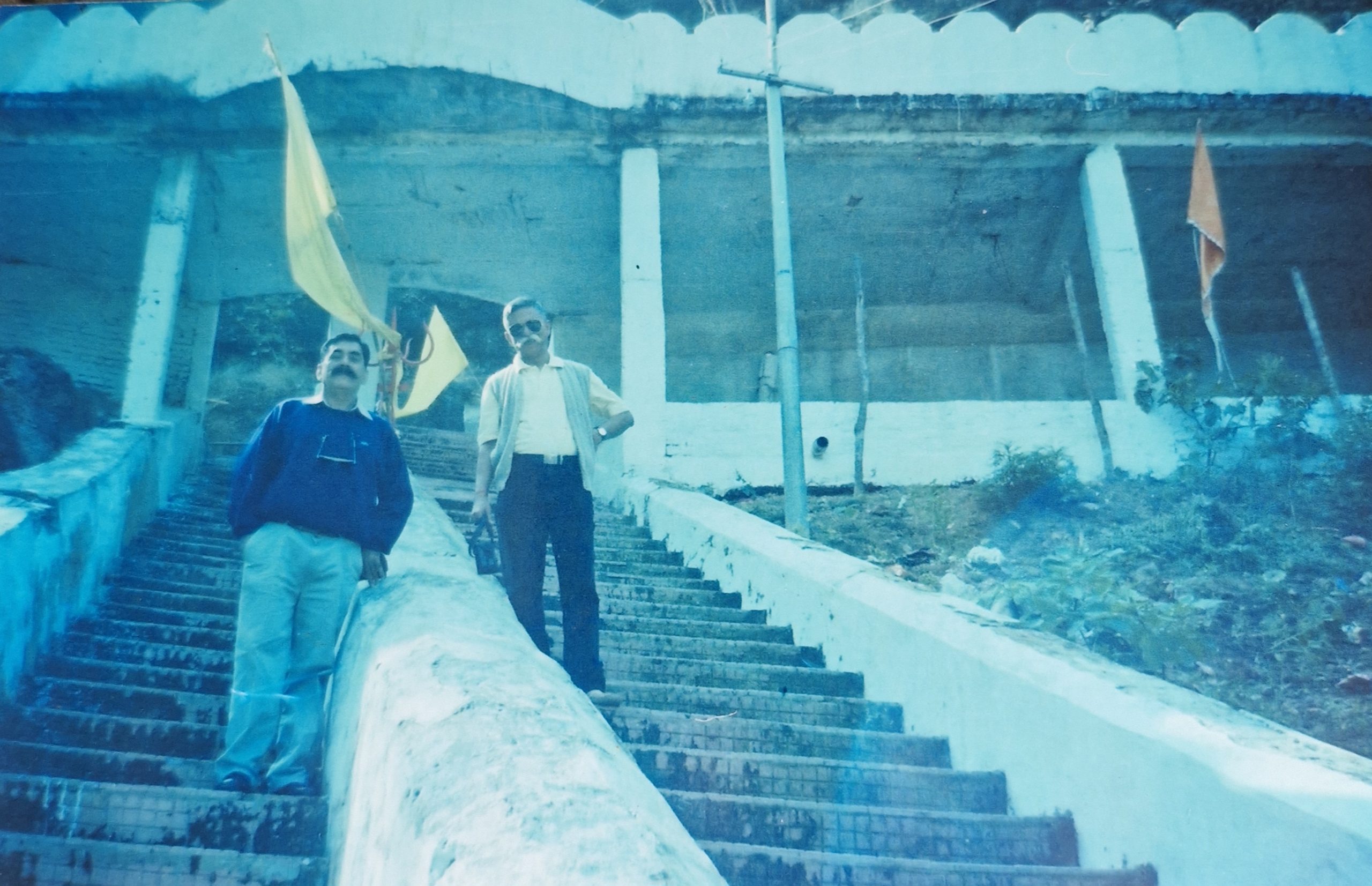
Amidst all these celebrations which have Lord Shiva as centre of attraction, there are still many myths which are associated with this Hindu God that lie buried deep into the hinterland of India. One such holy abode of Lord Shiva that has unique setting in terms of landscape, its remoteness, the way of its formation and the only known ritual of bathing the Shivling in Vermillion (Sindoor) in addition to holy water is located at a nondescript place called ‘Khatama’, a forest village about nine kilometres from village Jamani in tehsil Itarsi of Madhya Pradesh. The cave like temple is built by cutting a rock at a height of about one thousand two hundred and thirty feet (1230 ft) which has a flight of about 70 odd steps leading to its precincts. The plan of this so called cave–temple is simple in its architecture which consists of a ‘Mandapa’ based on four pillars with a square ‘Garbha-griha’ in the centre that enshrines a ‘Shivlinga’ and a Nandi idol in its front. An ambulatory passageway has been carved by cutting the rock on all four sides. This state protected monument can be ascribed to the 10-11th century A.D.
I have had the opportunity and time to explore this unique pre-historic cave temple cum monument way back in 2011 while still in service and posted at Itarsi (MP) at one of the country’s premium proof firing establishment, going by the name of ‘Central Proof Firing establishment – ‘CPE Itarsi.’ Located at a distance of about 18 kilometres from the district headquarters of Hoshangabad in the midst of Satpura hills, this ancient cave temple cum monument dating back to 10th century CE was known to the majority of local employees of CPE Itarsi who used to make a beeline there during the auspicious month of Savan (Shravan) as also on Mahashivratri, where a massive fair used to take place in the month of February/March every year, drawing all and sundry including celebrities from far and wide.
On learning about its pre-historic fame dating back to the 10th century CE, along with the then Deputy Commandant of CPE Itarsi, I also went to this holy place to check out its glorious historical past as also to pay obeisance at the cave temple. Though there are a dime a dozen Shiv temples dotted all over the sub-continent, there are very few which are nestled deep into the forests of Satpura jungles, cut out of rock caves and patronised by the tribal chiefs and Rajas of Satpura–Vindhyachal. This cave temple was earlier under the jurisdiction of the royal family of ‘Makrai’ going by the title of ‘Shah of Makrai’.
These Makrai Rajas were basically of the ‘Gond’ tribe and used to practice the animistic religion that had its basis of worship in natural objects like the sun, moon, rivers and such like natural resources. Even today, the vast swathes of Satpura Mountains are abode to a plethora of tribes like the Gonds, Korkus, Baiga and Bhils that form a major chunk of tribal concentration in India. It will be quite interesting to know for the readers of this article that Lord Shiva is the only Hindu God that is worshipped by the tribal population of Satpura mountains known by the name of ‘Bada Dev’ or big God. May be the very demeanour of Lord Shiva including the serpent around his neck and sitting cross-legged on the hide of a leopard made the tribal people associate him with their animistic Gods. Whatever may be the alluring features of this Hindu pantheon to make the tribal people gravitate towards his very being, the entire complex of this cave mountain temple is still looked after by the ‘Adivasi Seva Samiti’ or tribal welfare organisation of the area, which is quite unusual for the upkeep of a Hindu temple. Thus cementing the eternal bond between Lord Shiva and the dwellers of these mountains of Satpura.