
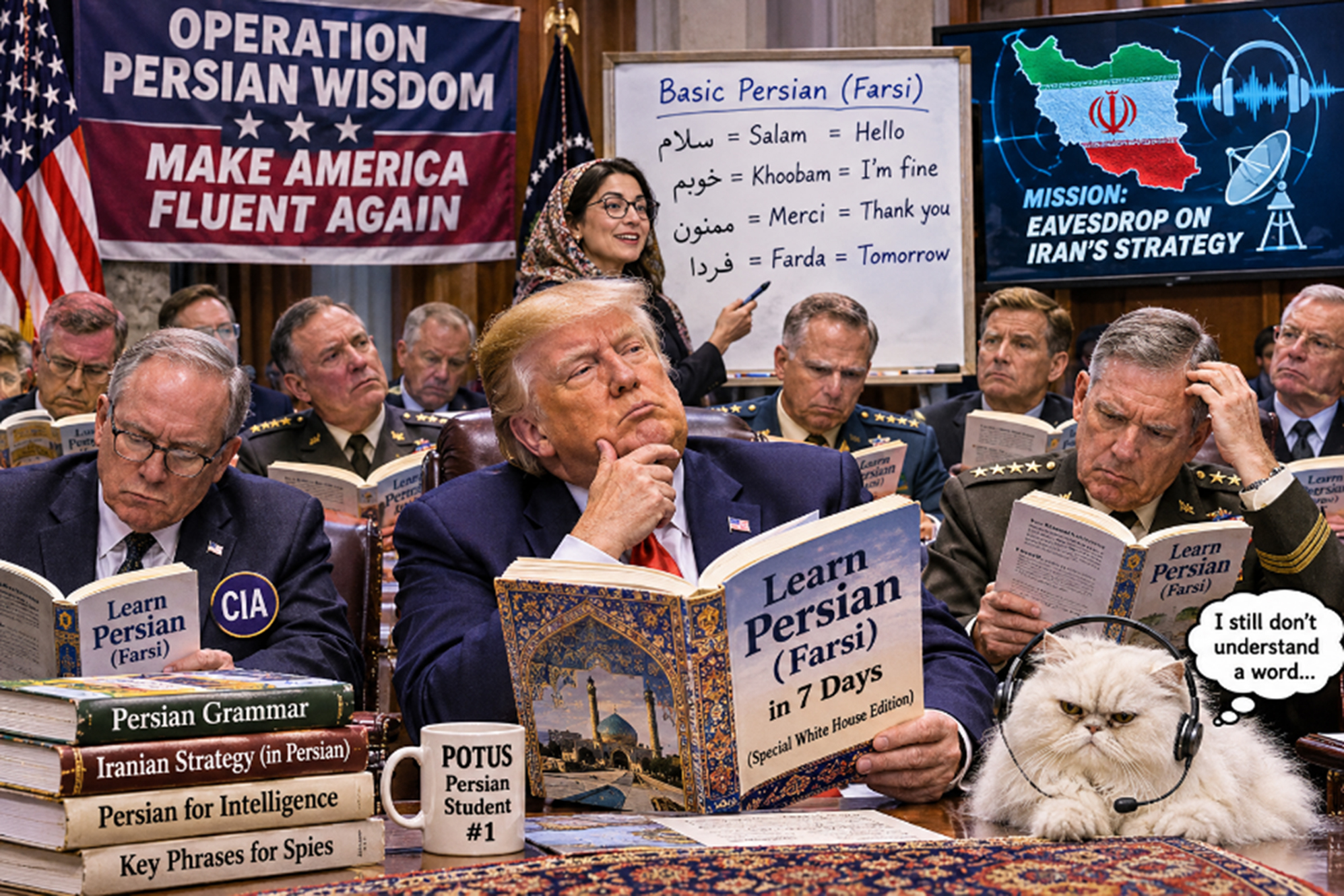
When Donald Trump decided that America’s Greatest Intelligence Failure was a Linguistic One
 By ALOKE LAL
It began, as many historic decisions in Washington do, with Donald Trump watching television. A commentator was explaining that Iran’s strategic thinking remained difficult for American intelligence agencies to penetrate.
Trump was outraged.
“Why?”
“Because, Mr President,” explained his National Security Adviser, “the Iranians conduct much of their confidential communication in Persian.”
“Persian?”
“Yes, sir. Also called Farsi.”
Trump leaned back.
“Beautiful name. Very beautiful. Sounds expensive. Persian carpets. Persian cats. I’ve seen them. Tremendous carpets. The cats, not so tremendous. Too much hair.”
He paused. “Why don’t we speak Persian?”
“Because, sir, our official working language is English.”
“That’s the problem with this country. Nobody thinks outside the box. We’re spending billions on satellites, surveillance, cyber intelligence, spies. Billions! And nobody thought of learning Persian?”
The National Security Adviser informed POTUS that the CIA had already employed hundreds of language specialists.
Trump waved him away. “Specialists! That’s the problem. Too many specialists. Nobody knows anything. I want everybody to learn Persian. Starting tomorrow.”
And thus was born Operation Persian Wisdom, the most ambitious linguistic military exercise since the Tower of Babel.
The Presidential Classroom
At precisely nine the following morning, the CIA Director, the Secretary of Defence, the Chairman of the Joint Chiefs of Staff, and several four-star generals assembled in the White House Situation Room.
On the wall hung a large banner: MAKE AMERICA FLUENT AGAIN.
Trump entered carrying a notebook. “I’ve already started learning,” he announced. “I’m way ahead of everybody.”
He turned to the CIA Director. “Say something in Persian.”
The Director hesitated. “Salam.”
Trump beamed. “Excellent. What does it mean?”
“Hello, Mr President.”
“That’s all? One word just for hello? Very inefficient language. In America we say hello, hi, hey, howdy. Tremendous variety.”
The Chairman of the Joint Chiefs ventured a question. “Sir, what level of proficiency are we aiming for?”
“Total proficiency. Complete. The best proficiency anybody has ever seen.”
“Conversational, operational, or native-level?”
“Presidential-level. Higher than native.”
Nobody knew what that meant; the Pentagon immediately classified it as a new proficiency category.
The Intelligence Breakthrough
An emergency intelligence briefing was called.
“Mr President,” announced the CIA Director, “we have intercepted a conversation between two Iranian officials.”
“Wonderful. What are they saying?”
The Director adjusted his spectacles. “One said, ‘Haal-e shomaa chetor ast?'”
Trump leaned forward. “Sounds threatening.”
“It means, ‘How are you?'”
“Obviously code.”
The Director continued.
“The other replied, ‘Khoobam, merci.'”
“Merci?” Trump interrupted. “French! They’re working with France. I knew it!”
“Sir, ‘merci’ is commonly used in Persian to mean thank you.”
Trump slammed the table. “So they’re using French words inside Persian conversations? That’s deliberate camouflage. Very clever. Not clever enough.”
He turned to the Secretary of Defence. “Put France on the watch list.”
“Sir, France is a NATO ally.”
“Even worse. They know our secrets.”
A classified memorandum was issued: Iranian use of French vocabulary may indicate sophisticated multinational linguistic cooperation.
The State Department requested clarification. The White House refused on grounds of national security.
The Pentagon Goes to School
Within a week, the Pentagon had established the Strategic Persian Language Command.
There were deputy directors for pronunciation, assistant directors for vocabulary, and a special task force for difficult consonants.
Four generals were assigned to the word khodahafez, meaning goodbye. One general insisted that the word sounded like a missile. Another thought it was the name of an Iranian naval commander. A third recommended destroying it before it could be deployed. The fourth, a Marine, suggested they simply say “bye”. This was rejected as defeatist.
Meanwhile, the CIA had commissioned a thirty-million-dollar artificial intelligence system to translate Persian conversations in real time.
During its first demonstration, it translated a discussion about the price of tomatoes into: “Strategic red objects experiencing upward movement.”
The Pentagon went on high alert.
“Red objects?” demanded the Secretary of Defence. “Missiles?”
“Possibly.”
“Upward movement?”
“Launch preparation.”
“How many?”
“Unknown.”
Within minutes, American reconnaissance satellites were searching Iranian vegetable markets for missile silos.
A junior analyst suggested that the conversation might actually concern tomatoes.
He was transferred to the Department of Agriculture.
The President’s First Persian Speech
Trump decided that the best way to demonstrate American linguistic superiority was to address the Iranian people directly.
“I will speak to them in their own language. Nobody has ever done this before.”
The State Department gently pointed out that many American presidents and diplomats had addressed foreign audiences in their languages.
“Not like me,” Trump replied.
A speechwriter prepared a simple Persian greeting.
Trump practised it for eleven minutes.
At the press conference, he approached the microphone.
“Salam!”
A few reporters smiled. Trump looked delighted.
“Very good response. They love me already.”
He continued with a sentence intended to express friendship between the American and Iranian peoples.
Unfortunately, he had mixed up two words.
Instead of saying, “I extend my hand in friendship,” he announced something perilously close to, “My carpet is very pleased to meet your grandmother.”
The Iranian media erupted in laughter.
Trump declared victory.
“Look at the reaction! Millions laughing. Nobody gets that kind of engagement. The greatest diplomatic speech in history.”
Tehran Responds
In Tehran, Iranian intelligence officials were astonished.
“Is this serious?” asked one.
“Apparently the entire American defence establishment is learning Persian.”
“Why?”
“To understand what we’re saying.”
There was a long silence.
Then the Iranian intelligence chief smiled.
“Excellent. From tomorrow, all confidential meetings will be conducted in English.”
His deputy looked alarmed. “But the Americans understand English!”
“Precisely. They won’t be expecting it.”
The next morning, American listening stations intercepted an Iranian military conversation.
“Good morning, General.”
“Good morning. Shall we review our operational priorities?”
“Certainly.”
The CIA analysts were baffled.
“They’ve stopped speaking Persian!”
“Impossible!”
“They’re speaking English!”
“Why?”
The Director thought deeply.
“Obviously a deception operation. They want us to think they’re speaking English.”
“But they are speaking English.”
“Exactly. Very sophisticated.”
An emergency meeting was convened at the White House.
Trump listened carefully.
Then he smiled.
“See? It’s working. They’re frightened. We’ve forced them to abandon their own language.”
The Secretary of Defence nodded enthusiastically.
“An unprecedented strategic achievement, sir.”
“Nobody has ever defeated a language before,” Trump declared. “We have.”
The Congressional Inquiry
A Senate committee demanded to know why hundreds of millions of dollars had been spent teaching Persian to officials who already had access to professional translators.
The CIA Director explained that the programme was intended to improve strategic comprehension.
“How many officers are now fluent?” asked a senator.
“Fluency is a complex concept.”
“How many can conduct a conversation?”
“That depends on the conversation.”
“Can they order lunch?”
“With appropriate linguistic support.”
“Can they understand an Iranian military briefing?”
“Not without translation.”
“Then what has the programme achieved?”
The Director straightened. “Senator, we now possess the world’s largest collection of classified Persian flashcards.”
The committee adjourned for lunch.
The Final Examination
Trump personally supervised the graduation ceremony.
Each officer received a certificate declaring him Strategically Conversant in Persian.
The President decided to conduct a surprise test.
He turned to the Chairman of the Joint Chiefs.
“General, suppose an Iranian commander says ‘Farda’. What does it mean?”
“Tomorrow, sir.”
“Very good. And ‘Emrooz’?”
“Today, sir.”
“Excellent. And ‘Dirooz’?”
The General hesitated.
“Yesterday, sir.”
Trump applauded.
“Fantastic. We now understand the Iranian past, present and future. Complete intelligence dominance.”
The assembled generals rose in a standing ovation.
The President announced that Operation Persian Wisdom had exceeded every target.
Tailpiece: The Ultimate Intelligence Failure
Three months later, a highly classified CIA report reached the President’s desk.
Subject: Iranian Strategic Communications — Critical Discovery.
It revealed that Iranian officials, aware of American efforts to intercept their conversations, had adopted a revolutionary new communication method.
They were meeting face to face. Without mobile phones. Without microphones. Without electronic transmissions. And sometimes, without speaking at all. They simply wrote notes on paper and passed them around.
Trump was furious.
“Paper? They’re using paper?”
“Yes, Mr President.”
“Unbelievable. We have the greatest technology in the world, and they’re using paper!”
He immediately summoned the CIA Director.
“I want every senior officer trained to read handwriting. Starting Monday.”
“English handwriting, sir, or Persian?”
Trump paused. “Both. And cursive. Especially cursive. Very dangerous. Nobody can read it anymore.”
The Pentagon prepared another budget.
The CIA ordered ten thousand notebooks.
And somewhere in Tehran, two Iranian generals sat across a table, drinking tea.
One whispered, “Do you think the Americans will ever understand us?”
The other smiled.
“Of course.”
“When?”
“When they stop listening.”
Meanwhile, in Washington, the President had just discovered that Persian cats did not understand Persian either.
He ordered an investigation.
The White House declined to comment on whether the cats were cooperating with Iranian intelligence.
(Aloke Lal is a former DGP, author of six bestselling books, painter and TEDx speaker. He is the festival director of the Crime Literature Festival of India.)