From the Himalayas, For the Himalayas:
By Prof Durgesh Pant & Dr Darshana Joshi
The Himalayas are the birthplace of rivers, the keepers of glaciers and the spiritual anchor of millions. Today, the Himalayas stand at a dangerous tipping point as landslides snap lifelines, flash floods swallow entire villages, glacial lakes burst through fragile valleys and forest fires burn for days without stopping. These are the new normal across Uttarakhand and other mountain states, where young women in the Himalayan belt face the greatest risk of being left behind. These Himalayan women hold the deepest, most intimate knowledge of how these mountains live and break. If history has taught us anything, it is that the women of the Himalayas have been protectors, organisers, innovators and the moral heartbeat of mountain resilience, and today their daughters and granddaughters are stepping forward not only with courage but with science. In the 1970s, in villages of what is now Uttarakhand, rural women wrapped their arms around trees to stop them from being felled, birthing the Chipko movement. Led by women like Gaura Devi, Chipko began as an act to protect forests that meant water, fodder and life, and grew into a symbol of ecological resistance. Today, every girl in these hills who dreams of using science to protect her community stands on the shoulders of those giants, inheriting a legacy that says ordinary mountain women can shift the course of global imagination.
That legacy is being re-scripted in lecture halls, labs and field sites across the Himalayas. A new generation of Himalayan women geologists, remote-sensing experts and climate scientists is mapping landslide-prone slopes, studying fragile rock formations and building models that can predict where the next disaster may strike. In ISRO, IITs, the Forest Research Institute and UCOST-supported labs, women researchers are working on everything from slope stability and eco-engineering to climate-resilient forestry, tackling some of the most complex challenges facing humanity from a Himalayan vantage point. Beyond the labs, Himalayan women are also proving that science for society can transform livelihoods and resilience.
Take Nidhi Pant, who hails from Rudraprayag and co-founded S4S Technologies to tackle food waste, farmer distress and climate risk together. Using patented solar-powered food processing systems, her venture helps thousands of small farmers and women micro-entrepreneurs convert “spoiled” produce into high-value, long-shelf-life ingredients, increasing incomes while cutting emissions and waste. Her work, recognised globally with honours like the Earthshot Prize, is a powerful reminder that young women from Himalayan districts are designing solutions that touch global supply chains, climate goals and the everyday resilience of low-income families. Climate change affects everyone, but its impact is not equal. In Uttarakhand, young women are often the first to face disruptions in education, safety, mobility and livelihood as roads wash away, water sources shrink and men migrate further for work. Disasters deepen these inequalities, even as these young women shoulder the work of rebuilding homes, caring for the vulnerable and keeping communities functioning, which means they hold a kind of intelligence the global climate community desperately needs. They know which slopes crack after early snowfall, which springs dry first, which villages lose connectivity every monsoon and which hamlets are one cloudburst away from tragedy.
When a young woman from Pithoragarh learns geospatial mapping or machine learning, she can combine that lived cartography with data to predict landslides or design safer evacuation routes with a precision few outsiders can match. Over the last few years, Uttarakhand has started building the scaffolding to help thousands of such girls rise together. Under the visionary leadership of Prof Durgesh Pant, the Uttarakhand State Council for Science and Technology is seeding an ecosystem of access, opportunity and imagination that stretches from primary schools to remote hamlets and university labs. It is an ecosystem that treats young women in STEM not as beneficiaries, but as central architects of the state’s disaster-resilient future, investing in their curiosity and their capacity to solve problems for their own communities.
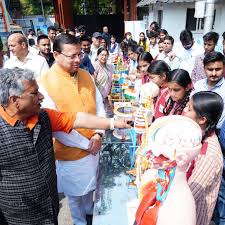
Champawat is now emerging as the site of India’s first Women Technology Park in the Himalayas. Here, technologies are not showcased behind glass; they are placed directly in the hands of rural women, who learn to turn challenges like pine needle litter into briquettes and clean-energy solutions that generate both income and safer forests. In these workshops, environmental science becomes entrepreneurship and climate risk becomes an opportunity to innovate at the grassroots, proving that mountain women can simultaneously protect ecosystems and strengthen local economies. Across the state, the vision is equally bold: a tinkering lab in each of Uttarakhand’s 95 blocks, ensuring that a girl in a government school in a far-flung valley has the same chance to tinker with circuits, sensors and robots as a child in a big city. Alongside this, the state is working towards one science centre in every district and has already gifted the country its fifth Science City in Dehradun, a space where children from mountain villages can stand under planetarium domes, walk through interactive galleries and see themselves as future inventors, not visitors on the margins. From these labs, centres and science cities, the next generation of innovators will emerge from places the world least expects. Along winding mountain roads, Labs on Wheels are now becoming a familiar sight, carrying microscopes, models and experiments to schools that have never had a functioning lab. In village after village, teachers speak of girls who had never touched a test tube before now confidently leading experiments and asking, with quiet determination, what science can do for their village.
The message these initiatives send is simple yet radical: world-class science does not belong only to big cities; it belongs in the smallest mountain school where a girl dares to ask a new question. Along winding mountain roads, mobile science lab vans – Labs on Wheels – are now becoming a familiar sight, in village after village, teachers speak of girls who had never touched a test tube before now confidently leading experiments and asking, what science can do for their village. The message these initiatives send is simple yet radical: world‑class science does not belong only to big cities; it belongs in the smallest mountain school where a girl dares to ask a new question. It is within this transforming landscape that initiatives like Kalpana – She for STEM find their true power, running in partnership with UCOST and higher‑education institutions across Uttarakhand, are creating a new generation of mountain technologists and young scientists. They give girls what they often lack: a community of peers, mentorship, hands‑on problem solving, exposure to labs and research, confidence to speak in public and pathways into careers they have never seen before. This is where the lineage from Chipko to ‘She for STEM’ becomes visible. The Chipko women protected forests with their bodies; their granddaughters are learning to protect them with data, sensors and satellite maps to apply their skills in mountain districts. The courage is the same, the love for the land is the same; only the tools have evolved, becoming sharper, more data‑rich and more connected to global scientific practice.
At the same time, Uttarakhand’s emerging role as a hub for science, technology and disaster management is carrying these mountain voices to national and global forums. The state is developing global platforms like the World Congress or Summit on Disaster Management that focus on strengthening climate action and disaster resilience. Increasingly, these events carry sessions on mountain ecosystems, community‑based disaster risk reduction and grassroots innovation, opening space for young researchers and practitioners from the hills – many of them women – to share their work and shape global agendas. Imagine woman from Bageshwar sharing the stage with global experts in climate modelling, not as case studies, but as co‑authors of resilience strategies for mountain regions worldwide. The future of science and resilience will be shaped by those living on the frontlines of climate crisis, including mountain women who understand the whisper of rivers, the language of forests, the cracks in the earth and the pulse of their communities. When their insights merge with STEM education, something extraordinary happens; science becomes human, technology becomes rooted and innovation becomes local and therefore effective.
The world is waiting for the ideas generated by young women of the Himalayas. We shall create classrooms and programmes that nurture courage, curiosity and technical excellence, because a girl who learns STEM today strengthens a village tomorrow. Let’s bring mountain voices to the centre of climate planning, because without them, resilience strategies will always remain incomplete. The Himalayan woman equipped with STEM education, is ready to redefine how India and the world confront climate risk. She stands on the shoulders of giants and yet she climbs higher, carrying with her not only the memory of forests once hugged into safety, but also the code, equations and instruments that will build a more just, resilient and compassionate future for all.
(Dr Darshana Joshi is a physicist, educator, and Founder–CEO of VigyanShaala International. A first-generation learner, her journey from a Delhi government school to a PhD at the University of Cambridge shaped her commitment to widening access to science. Through VigyanShaala, she has built pathways for thousands of young people—especially girls from underserved and rural communities—to access STEM education, research, and leadership opportunities across India). (Professor Durgesh Pant is a leading architect of the Himalayan voice at the frontiers of science and public policy, with over 36 years of leadership in shaping Uttarakhand’s science and technology ecosystem. As Director General of UCOST, he has taken science beyond laboratories into classrooms, villages, disaster prone regions, and innovation ecosystems. A pioneer of science-led governance, he integrates cutting-edge research, indigenous knowledge, and community innovation to advance climate resilience and sustainable development in the Himalayas. He is widely respected as a mentor and institution builder, ensuring that Himalayan voices shape national and global conversations on science and resilience).