 By Dr Anoop Virendra Kathait
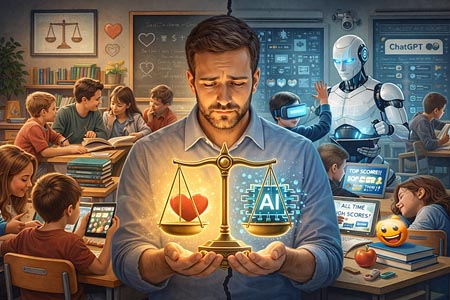
India is swiftly embracing Artificial Intelligence in education. Smart classrooms, AI tutors, automated valuations, and learning apps are considered as indicators of progress. But amid this technological enthusiasm, a fundamental question is being ignored: what is the point of reaching the peak of technology when our value system is in free fall?
Education was never meant to produce fast, efficient machines wrapped in human bodies. Its true purpose is to shape responsible, ethical, and socially mindful individuals. When values collapse, technology does not uplift society—it magnifies its flaws. AI can provide answers, but it cannot teach honesty. AI can improve efficiency, but it cannot build empathy. AI can assist learning, but it cannot create character.
Today’s students can search for information in seconds, yet struggle with patience, discipline, and accountability. Knowledge sits in their pockets, but wisdom is missing from their behaviour. Exams can be cleared with AI support, but life’s real tests—truth versus temptation, effort versus shortcuts—can only be passed through values.
We are already witnessing the consequences. Academic dishonesty, misuse of digital tools, cyberbullying, declining respect for teachers, and growing intolerance in classrooms are no longer isolated incidents. They are symptoms of a deeper crisis. Technology is advancing faster than conscience—and that is when it becomes dangerous. A value-driven student will use AI to learn better. A value-less student will use AI to cheat smarter. That difference defines the future.
Consider a simple but powerful example: a student scores exceptionally well using AI-assisted learning, yet publicly disrespects teachers, ignores elders, avoids responsibility, and lacks basic civic sense. Can such a student truly be called educated? Certificates measure competence, but behaviour reveals education. Success without values is not achievement—it is delayed failure.
Today’s parents struggle to provide the best gadgets, fastest internet, and most “advanced” schools for their children. This is understandable. But a bitter truth and question arise: are we upgrading our children’s values along with their electronic devices?
A child does not go to school alone. He carries the culture of his home—its language, attitudes, and priorities. If teachers are criticised at home, respect disappears at school. If discipline is mocked, rules become enemies. Technology learns its ethics first inside the house. Children now use AI to complete projects, write essays, and solve problems. But if the same child lies easily, avoids hard work, blames others for failure, or becomes aggressive when separated from a screen, society is raising a serious red flag. Technology has increased capability, not character. Character is built only through daily values practiced at home.
Before implementing AI systems in schools, we must first implement strong value systems—respect, discipline, ethical thinking, accountability, compassion, and dignity of labour. Teachers must remain mentors, not machine operators. Schools must remain centres of learning, not testing grounds for every new trend driven by showmanship.
History reminds us that civilisations do not collapse due to lack of innovation, but due to moral decline. Societies with limited technology and strong values survive longer than those with advanced tools and hollow ethics. Let us modernise education—but not strip it of its soul. Let us adopt AI—but anchored firmly in ethics. Because the future does not belong to the smartest machines, it belongs to the most grounded humans. The need of moral education in syllabus is as the need of a constitution for a prolific and responsible citizen.
This article does not reject AI-based education; rather, it points to its potential future impacts and the concerns that may arise. Setting clear boundaries for teaching and learning reflects our responsibility toward human values—so that artificial intelligence does not surpass human and emotional intelligence. The solution to this challenge is not disapproval, but a careful balance. Teachers, students, and parents—all three must work intentionally and positively. Only through this collective effort technology should remain a supportive tool in education, not a replacement for human thoughts.
(The author is an educator, critic, poet and short story writer living in Dehradun)