‘Pickled in life’ murmured a soldier as he saw General Rolo Gillespie’s body, preserved in rum, being sent for burial on Meerut’s consecrated ground. He patted the coffin, adding almost as an afterthought: ‘And now pickled in death!’
Two centuries ago, on October 31st 1814, the Battle of Kalinga Hill took place near a small hillock, or just a mere spur, south-east of Rajpur, where two invaders, the British and the Gurkhas, met each other for the first time.
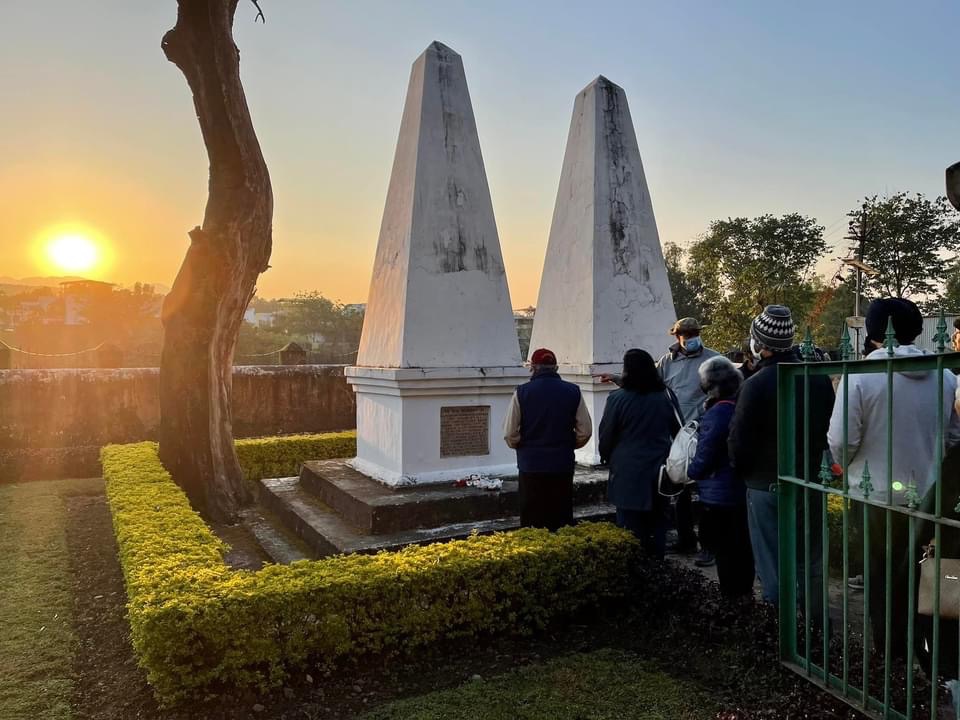
Built on the banks of the river, you cannot miss the war memorial. It is unique in the annals of the brave as it celebrates both the victor and vanquished!

Pic courtesy: Rahul Kohli.
Sadly, the waters are silent and can’t tell these tales. Ironically, it was these very waters that held the key to the crucial battle of Nalapani. With the monsoon over, the river had been reduced to a trickle, but continues to bare its boulder-strewn teeth.
‘In the end is my beginning,’ said the poet. And the British ended up doing what would have been best at the start. But hindsight does tend to make wisemen of us all! But once the dogs of war are afoot, the first victims are good sense, vision, and reason.
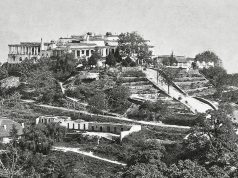
The Gurkhas had taken their position in a hastily constructed fort atop Kalinga hill, very steep, except to the south, and a dense Sal forest now covers the sides. The fort was built of boulders, more of a stockade than a fort that was still incomplete, and the men scrambled to finish the job.

Pic courtesy: TK Manoj Kumar.
Soon after, Bulbhadra Singh, the Nepalese Commander, received a summons from Col. Mawby. He tore it up and sent back word that ‘it was not customary to disturb one after sunset’ and that the Colonel would see him soon enough.
On the morning of 31st October, some 3000 British surrounded the place with two twelve-pounders, four-five-and-a-half-inch howitzers, and four-six-pounders. General Gillespie’s plan was made to distract the enemy’s attention by advancing from opposite directions. But it did not work. Of course, the defenders of Kalinga had not been sitting idle. They had ensured that no part of the wall could be scaled without ladders and all stockades were firmly in place. The entrance was well protected by the primitive grape-shot guns.
Gillespie, sword in hand, cheered his troops on, but on getting within thirty yards of the wicket, the men sulked and refused to stir a step further. There they stood doggedly, stubbornly allowing themselves to be shot down. They were not afraid, but it is said that they hated their Commanding Officer. Soon after, Gillespie was shot through the heart and his aide-de-camp, Lt. O’Hara, died by his side. A retreat was immediately ordered.
So intense was the firing from inside the fort that of the reserve alone, every single soldier in the front rank was either killed or wounded. The few who did reach the gate were received with a shower of arrows, even stones, as well as bullets. The Gurkha women were conspicuous among the defenders.
The blame for this inglorious repulse lay squarely on General Gillespie’s impatience. He overlooked the strength of the enemy’s position. If only he had momentarily thought it out, he might have simply blockaded Kalinga and starved out the garrison with little or no loss to his own forces.
It would only be a month later that the Gurkhas withdrew from the fort. The valiant Bulbhadra is reported to have exclaimed ‘To capture the fort was a thing forbidden, but now I leave it of my own accord.” The fort of Kalinga was completely demolished. Nothing remains except memories of the valiant warriors.
Two modest obelisks, standing side by the roadside. They are the only memory of this battle. One celebrates Sir Rollo Gillespie, and those who perished with him; the other is a tribute to a spirited adversary, Bulbhadra and his lion-hearted followers.
The outcome day gave birth to twin developments: the arrival of the descendants of the honourable East India Company to Garhwal and the setting up of the Sirmur (which later became the valiant Gurkha Rifles.)
Ganesh Saili, born and home-grown in the hills, belongs to those select few whose words are illustrated by their pictures. As the author of two dozen books, some translated into twenty languages, his work has found renown worldwide.