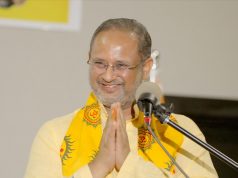
Interview with David Joseph Hilton & Patricia Hilton
 By Sunita Vijay
Hilton’s School is a landmark institution of Dehradun, founded in 1975 by E Hilton. Standing tall for nearly five decades with the noble aim of educating young minds, the school celebrated its Golden Jubilee this year with immense joy and pride. Today, the reins of the institution are ably held by David Joseph Hilton as Principal and his wife, Patricia Hilton, as Chief Coordinator. A candid conversation with the distinguished educationist couple on a bright winter afternoon proved to be both heart-warming and enlightening. For them, education is not just about learning facts, but about shaping character. They believe a school is not merely a place of instruction, but a living space where children learn to respect nature, understand responsibility, and grow into thoughtful human beings. Every child is seen as a seed – unique, full of promise, needing care, patience, and the right environment to flourish.
Meeting two devoted partners who seamlessly share professional responsibilities, uphold the values of a clean and green environment, and remain deeply committed to nurturing young minds, was truly inspiring. David Hilton, President of the Frank Anthony Public Schools, is a respected educationist whose grounded and focused leadership has earned him numerous awards in the field of education. Patricia, an eminent educationist, influencer, and social worker, has been widely honoured for her distinguished service to education and currently serves as Vice President of the All India Anglo-Indian Education Institution.
Both are committed Rotarians and truly a match made in heaven. Their deep mutual respect and harmonious partnership are clearly reflected in both their personal and professional lives.

The Journey….
As partners in life and education who have led this school for so many years, how does it feel to see it complete fifty glorious years of shaping young minds? What values do you wish to pass on to your students?
Patricia: We assumed responsibility for the school from David’s mother after returning from the Gulf in 1985. Over the years, we have witnessed many changes. Children today are somewhat different; they are influenced by technology and the internet, have easy access to mobile phones, and many receive unconditional parental support even in their wrongdoings. But still children are children. We are here to nurture and guide them. We love them deeply.
David: As a couple, we share two guiding principles: education and service. Service through our organisation is something we strongly believe in and want to inculcate in our children. Another important value is environmental consciousness, especially with respect to our Doon Valley. We are deeply sensitive to this and consciously integrate these concerns into our educational core values, encouraging children to imbibe a clean and green environment, both in mind and in spirit.
As partners, we have seen the school started by my mother as a small primary institution. Step by step, with immense hard work and many sacrifices, we built it into what it is today: a full-fledged school up to Class XII, nurturing over 1,100 students.

Harbinger of a Green Future
David and Patricia are fond of gardening and wildlife. They believe that gardening provides the best life skills. A wall dedicated to pictures of birds stands as a testament to their love for greenery and plants.
You invited Vandana Shiva, a tireless defender of the environment. Her speech was inspiring and impactful. There was a mention of jointly creating a ‘Garden of Hope and Healing’ on the school campus.
David: Well, incidentally, this was already planned. My mother, the founder of the school, was a passionate gardener, and so am I. I had already decided that we would give each student a packet of seeds to take home and plant as a garden. We are now taking this initiative one step forward. As I am closely associated with Anglo-Indian schools pan-India, during the upcoming conference in Kolkata in January, I will be sending each school packets of seeds to plant a Garden of Hope in their campuses, in partnership with Vandana Shiva’s organisation.

Two peas in a pod
This adorable couple works in perfect tandem, seamlessly managing both the school and their home. David’s love for cooking, and his impressive culinary skills, have convinced Patricia that all boys should learn to cook to ensure a happy marriage. As we sipped tea and enjoyed a mouthwatering, home-baked plum cake, I explored the values they wish to pass on to their students. Both shared remarkably similar views on education, reforms, and the changes society is witnessing in students and their attitudes today. They readily acknowledge these changes as part of evolution and the far-reaching influence of science and technology.

A Legacy of Love for Dehradun Runs in the Veins
Like many other places, Dehradun is undergoing change. What changes have you observed in students, teachers, parents, and the city? How do you perceive these changes?
David: Dehradun is no longer the small town it once was. However, when we compare parents and students from elsewhere, we still perform better in many respects. We have not abdicated our core values, we remain special. Having clear weather almost every day is truly a luxury, and we are grateful to the Almighty for the privilege of being part of this state.
Teachers, I feel, remain largely the same at heart. Their commitment and dedication continue to be unwavering, and many have served this institution for long tenures, a testimony to their deep attachment to the school and to the spirit of service.
Post-COVID, teaching has evolved, with the ability to go online, leading us to adopt a hybrid approach. However, the teacher’s presence in the classroom remains irreplaceable. Today, we complement traditional teaching with smart boards, interactive panels, and the latest amenities to enhance the overall learning experience.

Curriculum vs Real Education
To what extent does literacy alone fall short of creating truly educated individuals? According to you, what is the difference between producing high achievers and nurturing good human beings?
David: In today’s educational framework, the school curriculum is a necessity, especially with the emphasis on Board examinations. However, this alone does not constitute complete education or the holistic development we envision for our children. We consciously expose students to social service, environmental awareness, sports, and various cultural activities. We recently centred our celebrations around 25 years of statehood, while also reinforcing the understanding that we live in an incredible country: a mosaic of diverse traditions, people, and languages, yet bound together in unity.
Our foremost priority is to nurture good human beings. Academic achievement is incidental to that larger goal. When we focus on values, responsibility, and opportunities to serve, we witness remarkable transformations in students. Equally important is investing in continuous teacher training, enabling educators to adapt to evolving changes in education.

Mental health issues in kids
Mental health challenges among children are rising, yet many go unrecognised, leaving students to suffer silently. Most schools have only one counsellor handling an overwhelming number of students. Does this model allow for effective support, and what practical steps can schools and society take to address this issue?
David: I believe teachers are the best counsellors. They deal with kids. They observe them from close quarters. Most issues are resolved on campus. There are certain other specific problems related to behavioural matters and learning issues. We are working to ensure that this type of facility and resource is available in our city to support children in need.
Patricia: It’s important to listen to them when they want to speak. At times, we shut them down. They come to me, and I let them speak. Results are miraculous. Most of the time, merely listening to their problem is a solution. There are things that they can’t share with their teachers or parents, but my presence as a motherly figure on campus helps. Even parents come to me to discuss various issues. We are there to help.
Influence of Social Media
Today, social media and online platforms often seem more rewarding than years of academic effort, leaving many students questioning the value of school. What modern incentives could encourage serious engagement with education, and how can schools compete with these seemingly faster paths to success?
David: One of our initiatives is employing a teacher as Media Head, who addresses these issues, ensuring that children post meaningful or appropriate content, providing guidance to the school, and developing rapport between students, the school, and parents.
But can a school truly monitor everything? We can talk to, guide, and advise students, yet I am surprised at how adept even younger students are at using social media.
I agree it seems like an easy path. We need to consider how best to assist. The influence of society is growing, and we are conscious of it.
Role of Anglo-Indian Community in school education
Many of Dehradun’s most well-known schools were shaped by Anglo-Indian educators and administrators who brought with them distinct teaching styles, institutional ethics, and cultural traditions. How would you describe the influence of the Anglo-Indian community on the character and quality of education in Dehradun and what might we lose if that legacy fades?
David: Anglo Indian education post-independence has been one of the greatest contributions to society and national development, producing leaders in administration, politics, and business. Our greatest contribution is the use of English, which has given India a significant edge, particularly in science and technology. Anglo-Indian schools are known nationwide for providing high-quality education. Nurturing great writers, artists, and administrators, and shaping modern Indian education as we know it today.
We are not an affluent school; our clientele is mostly middle class, and that is deliberate. We are not targeting the ‘creamy layer’. We aim to educate across all sections of society. The area where the school was built was originally a farming community, and many were first-generation learners. Initially, it was challenging, but it is now easier. Our results have been good, not always brilliant, but we have had brilliant students who are excelling in their respective fields. The school alumni are impressive. The real challenge is supporting first-generation students, and we believe we have succeeded by not differentiating based on family background. That, to us, is true service.
By blending academics with values, responsibility, and compassion, we strive to raise not just successful students, but good human beings, aware of the world around them and mindful of their role within it.
Pics: Satpal Gandhi & Mohtshim Khan