 By Ashish Singh
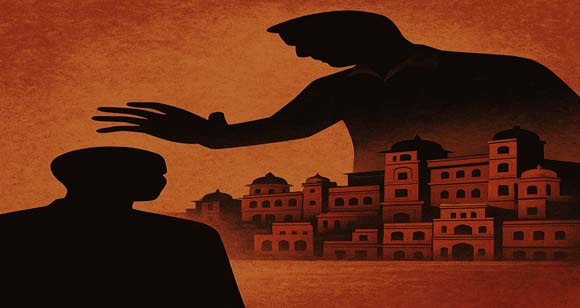
In many parts of Uttar Pradesh, the story of everyday life is quietly rewritten by actors who never appear on a ballot or in a government file. These are the dalals, the intermediaries who survive in the shadows between legality and crime, absorbing the cracks of a weak state and turning them into their own corridors of power. Their rise transforms not only markets and services but the very texture of a common person’s existence, altering how people seek help, resolve disputes, access welfare and survive the uncertainties of daily life.
When a dalal begins to dominate a locality, the first casualty is clarity. A citizen no longer knows where the state ends and where the dalal begins. The gate to any public service becomes a blurred zone in which a stranger whispers that nothing moves without “someone who knows the system”. The line between a helper and a handler fades. A man looking for a simple document, a widow trying to secure her pension, a family seeking urgent medical attention—each finds themselves nudged into a labyrinth where the dalal stands at every corner, collecting small payments that eventually swell into a parallel revenue order. Slowly, the rules that ought to guide a public office become irrelevant; what matters is the unseen tariff fixed by those who orbit around it.
Over time, this network becomes self-reinforcing. A dalal who begins as a convenience provider becomes an information broker. He knows who paid, who complained, who resisted, who can be pressured. Such intelligence becomes a form of soft coercion. The common person, already anxious about instability, becomes dependent on this informal channel. This dependency breeds fear, and fear breeds silence. People stop asking why things are slow or unfair. They simply try to avoid trouble by paying a little more, bowing a little deeper, or accepting delays that mysteriously vanish the moment a dalal steps in.
The moral landscape also shifts. When a dalal’s activities start mirroring the methods of crime syndicates, the distinction between service and exploitation collapses. A man may go to him for help but return feeling indebted, watched, or compromised. Neighbours whisper about how certain people suddenly gain influence. A schoolteacher, a shopkeeper, an unemployed youth—all may find that the dalal’s network reaches into their daily decisions. This is where the UP saga grows darker: when the normalisation of middlemen becomes the normalisation of intimidation. It is not overt violence; it is the slow corrosion of dignity.
The effects accumulate across society. Trust in institutions withers. Citizens stop expecting fairness and begin negotiating for survival. A generation grows up believing that connection outweighs competence, that access is earned through proximity to informal power rather than rights. When such beliefs take hold, democratic accountability weakens. The everyday injustices a common person faces—extra charges, unexplained delays, favours that feel like threats—feed a larger pattern in which institutions become brittle and corruptible.
In this landscape, a dalal is not simply a character but a symptom of a deeper malaise. His rise signals that the state has left vacant spaces, and those spaces have been filled by actors who profit from public vulnerability. The tragedy of the common people is not only that they pay the price but that they gradually internalise this disorder as the natural order of things.
The saga of UP is, then, not only about crime or corruption. It is a story about how parallel systems embed themselves in the psyche of ordinary people. It is a quiet rewriting of their expectations, their grievances, and eventually their sense of what is possible. When intermediaries become indispensable, they also become unchallengeable, and a society that begins by tolerating them ends up being shaped by them.
This is the silent tragedy of the common person in such regions: not that they are defeated outright, but that they are slowly taught to live as though defeat is the normal condition of life.
(Ashish Singh is a social and political scientist.)