 By Rajat Aikant Sharma
The Inherited Town
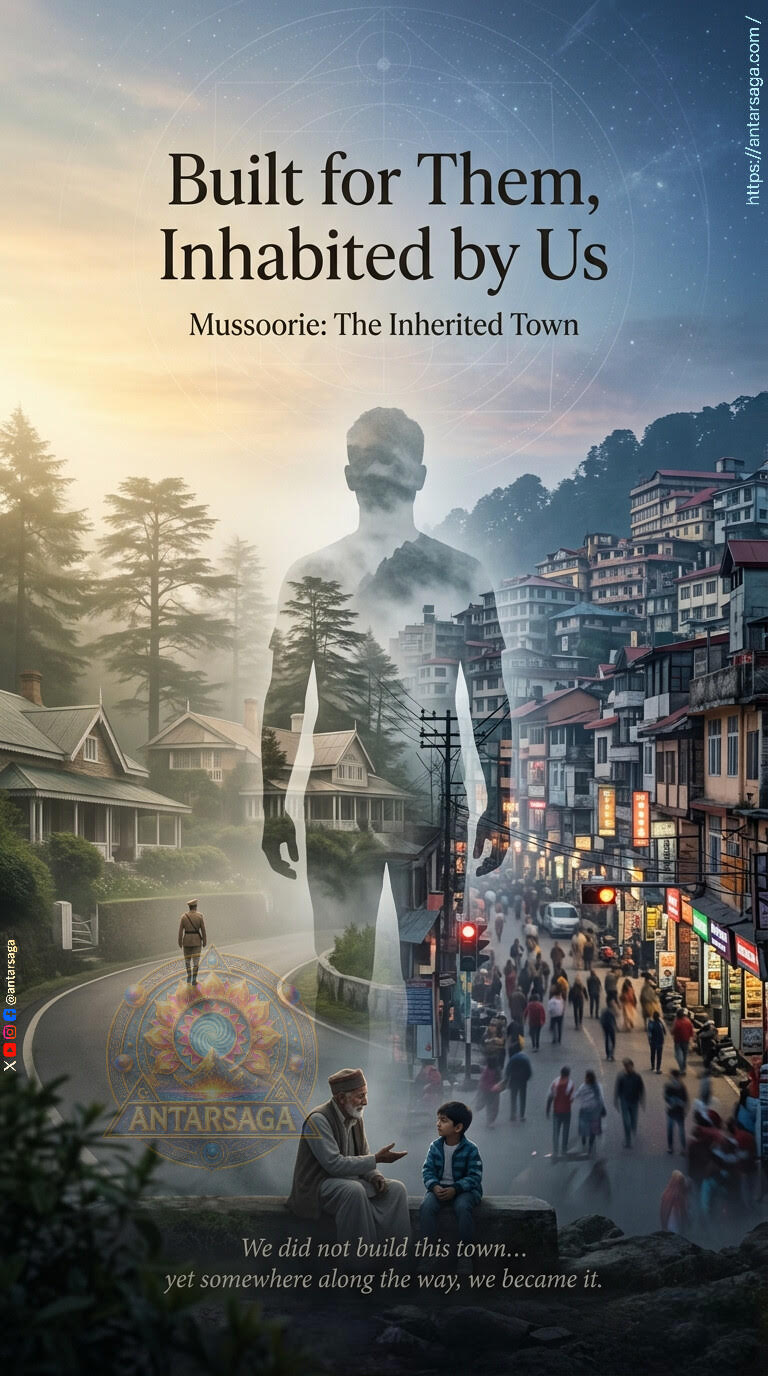
Long before Mussoorie became a crowded escape, it was something quieter—almost sacred. When Frederick Young first walked these ridges in the 1820s, what he saw was not a town, but a climate. A refuge.
The plains below were heavy—with heat, with disease, with epidemics that moved silently through dense populations. And above them, like a natural remedy, rose these hills. Places like Landour were not merely settlements; they were convalescent spaces—where soldiers and officers came not to fight, but to recover. To breathe again.
Mussoorie, in its earliest imagination, was not built for living. It was built for healing.
Everything about it reflected this purpose. The bungalows stood apart from each other, preserving silence and privacy. The roads curved gently—not for speed, but for ease. Churches like Christ Church Mussoorie and old schools were not crowded institutions, but quiet anchors in a landscape designed for rest. It was a town shaped around breath.
And yet, even as this Mussoorie existed, another one was quietly growing alongside it.
Workers, traders, and local villagers arrived—not to heal, but to support those who came here for healing. They built small shops, modest homes, and lives within the gaps of a town that was never designed for them. This second Mussoorie was not planned. It was lived into existence.
One was designed. The other was endured.
Then came independence. The British left, but Mussoorie did not transform—it simply remained. The buildings, the institutions, and the roads were inherited. Places like Woodstock School continued, the churches stood still, and the estates slowly changed hands.
But we never truly redesigned the town for ourselves. We adapted ourselves to what was left behind.
There is something quietly philosophical in this—the way a form outlasts its original purpose, and a different life pours into it. The vessel remained colonial. The spirit that filled it was entirely ours. And the town became both at once: a borrowed shape holding an unborrowable life.
Over time, the purpose shifted further. A seasonal retreat became a permanent settlement. A low-density design began to hold a high-density life. A place built for recovery began to carry pressure.
Walk through the town today, and you will feel two energies coexisting. On one side, the quiet dignity of old bungalows, the calm of pine-covered slopes, the stillness of churches and heritage spaces. On the other, the urgency of markets, the compression of new constructions, and the restless movement of a town trying to keep up with itself.
One is inherited stillness. The other is earned survival.
Both are real. And if you stay long enough—past the noise of the Mall Road, past the season’s first crowds—you begin to sense that they are not opposites. They are the same place, breathing in two different rhythms. The stillness did not leave. It went deeper.
The older residents of this town still carry stories—of winters when the town would empty, of quiet Mall Roads, of voices that echoed instead of collided. Their memories are not nostalgia. They are living proof that a different Mussoorie existed—and that its essential nature has not entirely gone.
To remember this place as it was is not to grieve it. It is to recognise it—to see through the noise to what was always here. The hills did not change. The promise did not leave. What changed was the weight we placed upon it.
And now, quietly, the responsibility shifts to us.
To listen.
To remember.
To pass it on.
The children growing up in Mussoorie today will inherit not just its roads and buildings, but its direction. If they grow up knowing only congestion, they will normalise it. But if they grow up hearing stories of balance, silence, and grace—if they grow up understanding that this place once healed people simply by existing—perhaps they will seek to restore something of that in their own time.
Not by rejecting the present. But by refining it.
Mussoorie was never meant to hold this many lives. And yet, it does.
Which means the question is no longer what Mussoorie was built for— but what we choose to make of it now.
This town was once a cure. Today, it is a container—of memory, migration, survival, and hope.
We did not build Mussoorie.
But perhaps that is the point. We did not build it—and yet, over generations, we have become it. Its silences are in us. Its stories are in us. The town is not a place we merely inhabit. It is something we carry. And what we carry, we can also—slowly—restore.
Somewhere between the silence it was built with,
and the noise it now carries—
lies the possibility of its next chapter.
And the possibility has always been us.
(Rajat Aikant Sharma is a writer and photojournalist exploring culture, history, and human stories. Beyond print, he creates digital content, posters, and social campaigns that extend his editorial voice into the world of influencer engagement and brand storytelling.)