 By Rajshekhar Pant
The charm of William Blake lies in his ability to look at the world as a child would—with curiosity, wonder, and a disarming innocence. It is a way of seeing that does not last. With age comes discipline; with discipline, restraint; and with restraint, the quiet burial of curiosity under the acceptable weight of social behaviour.
The manner in which we see the world shapes our dreams. In childhood, dreams are unstructured, without hierarchy—anything may become an ideal: a bird in flight, a man singing at the wheel of a truck. Later, we acquire more respectable ambitions—romantic, ideological, suitably bookish. Whether they are fulfilled or not is incidental; what matters is that they remain believable… believable at least to ordinary men.
But why speak of the ordinary man at all? In times like these—when surgical operations on the past, the refurbishment of history, and necromantic rituals over a dead “golden age” stroll about hand in hand with a gym-sculpted nationalism. A well-maintained “golden age”, even if deceased, commands more respect than a living citizen. The ordinary man learns quickly: step aside, lower your gaze, and do not obstruct the movement of importance. He adapts. He survives. He becomes irrelevant.
Let us speak of something else.
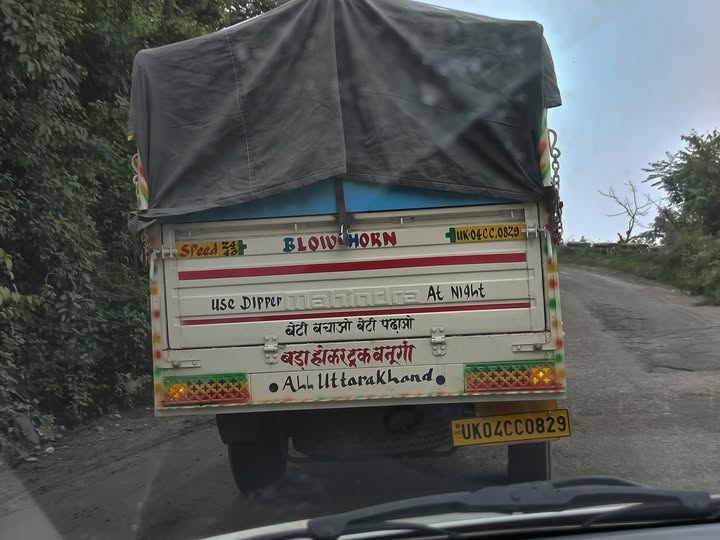
On a mountain road, a pick-up truck ahead of me refuses—or is unable—to give way. On its rear is written: “I will grow up to become a truck.”
It is a modest aspiration, and unusually honest. The vehicle declares its inadequacy and its ambition in the same breath. One suspects constraint—financial, perhaps structural—but also a certain clarity. The dream has been externalised, made public, almost contractual.
After a bend, the road widens. The pick-up, still in the process of becoming, allows me to pass.
Speed liberates the mind. It wanders, irresponsibly. What do our leaders dream of? The older trajectory—footpath to bicycle to pick-up to truck—still exists, though it now appears unnecessarily slow. A more efficient model has emerged: one arrives as a truck and upgrades quickly—fighter aircraft, missile, occasionally both.
I am reminded of university acquaintances whose early accomplishments were limited to intimidation, disruption, and the strategic abuse of authority. They matured, as systems permit such people to mature—into local power, then legislative office, and finally into anecdote. Having lived briefly but vividly, they left behind something more durable than achievement: a template. For the next generation, aspiration no longer requires progression. One may begin as a missile.
Whether Parliament has any meaningful relationship with dreams is unclear. What is evident is that those who enter it are rarely short of them. The dreams are large, frequently combustible, and often well-articulated. Once, they may have concerned poverty, dignity, self-reliance—terms that retain ceremonial value. Some of these dreams failed, some dissolved, others adapted themselves to circumstance with admirable flexibility.
There was perhaps a time when becoming a truck required patience—when scale followed effort. That time appears to have passed. Acceleration has replaced transition.
It is fortunate that objects do not remember. If chairs possessed memory, the silence of the old Parliament—now formally elevated in name—might have been less composed, more argumentative. It is equally fortunate that the practice of editing official records was institutionalised early. Memory, after all, is most efficient when curated.
The new Parliament building is large. It accommodates scale comfortably. Trucks fit easily; so do aircraft and missiles. Provision has been made—not merely for presence, but for projection. Even before its routines were settled, a preview of its functioning had already been released, suggesting a confidence that precedes performance.
By the time I reach my destination, the day has exhausted itself. Stray dogs, having spent hours asserting themselves noisily against passing movement, now sleep in clusters, unclaimed and unrestrained, their backs against a boundary wall. They appear, at last, unambitious.
The ordinary man, still present in some residual form, offers a final clarification:
“Capitalism is not only a system. It is a skill set. To succeed, one must know how to sell—and how to be sold.” The rest of us were reassigned long ago. We belong to what may be called the ensuing past.
Night will arrive on schedule.
The question is not of darkness,
but of how long the lamps can afford to continue.
(रात तो वक्त की पाबंद है ढल जाएगी,
देखना ये है चराग़ों का सफ़र कितना है।)
(The author is an amateur filmmaker, a photographer, and a writer, who has written over a thousand writeups, reports, etc., published in the leading newspapers and magazines of the country. He can be reached at pant.rajshekhar@gmail.com)