Ache of the Heart for Things Gone
 By Aloke Lal
Last night, Dehradun returned to me—not as it is, but as it once was, and perhaps as it could be again.
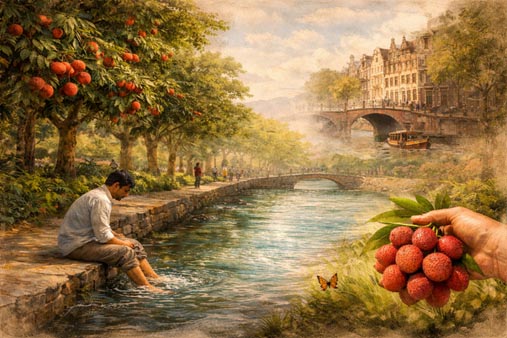
I found myself walking along the East Canal. The water was alive—clear, restless, whispering against its stone edges. I paused, as one does in childhood, without reason or urgency, and slipped my feet into the gurgling current. It was cold, playful, familiar. The kind of touch that does not merely cool the skin, but awakens something deeper—an inheritance of memory.
The litchi trees were back too. Laden, generous, bending slightly under the weight of their ripeness. I reached out, and in my hand rested a small cluster—sun-tinted, fragrant, impossibly real.
And then I woke up.
It is easy to dismiss such dreams as indulgence, as a retreat into what has been lost. But nostalgia, when it is honest, is not an escape—it is a compass. It does not chain us to the past; it reminds us of what gave a place its soul. In a world that is forever accelerating, memory becomes a quiet act of resistance. It insists that continuity matters, that identity is not expendable.
Dehradun was never merely a city. It was an experience—of shaded walks, of orchard-scented air, of canals that carried not just water, but a sense of rhythm to everyday life. These were not luxuries. They were the very texture of living.
There is a precedent, and a powerful one at that. The Catharijnesingel Canal of Utrecht in the Netherlands was once erased under the pressures of modernity, replaced by a road that seemed, at the time, inevitable. Decades later, through civic will and persistence, the water returned. What had been lost to apathy was restored through collective memory and civic courage. Today, this canal is not only a functional waterway but a cherished heritage of the ancient city.
The story offers more than inspiration—it offers a template.
(Image created by the writer using generative AI)
Can Dehradun dream as Utrecht once did? Can its people look beyond the inevitability of concrete and reclaim the quiet dignity of water and green? Cities, after all, are not only shaped by planners and policies, but by the persistence of those who refuse to forget.
Hope, like nostalgia, begins in the imagination. It begins with a vision—of canals flowing again, of litchi trees returning to line the avenues, of a city rediscovering its gentler self.
Perhaps the dream was not an illusion after all. Perhaps it was a reminder.
And perhaps, if enough of us choose to remember—and to act—the next time we walk along the East Canal, it will not be in sleep.
(Aloke Lal is a former Director-General of Police, best-selling author and painter. He is the founder festival director of the Crime Literature Festival of India)