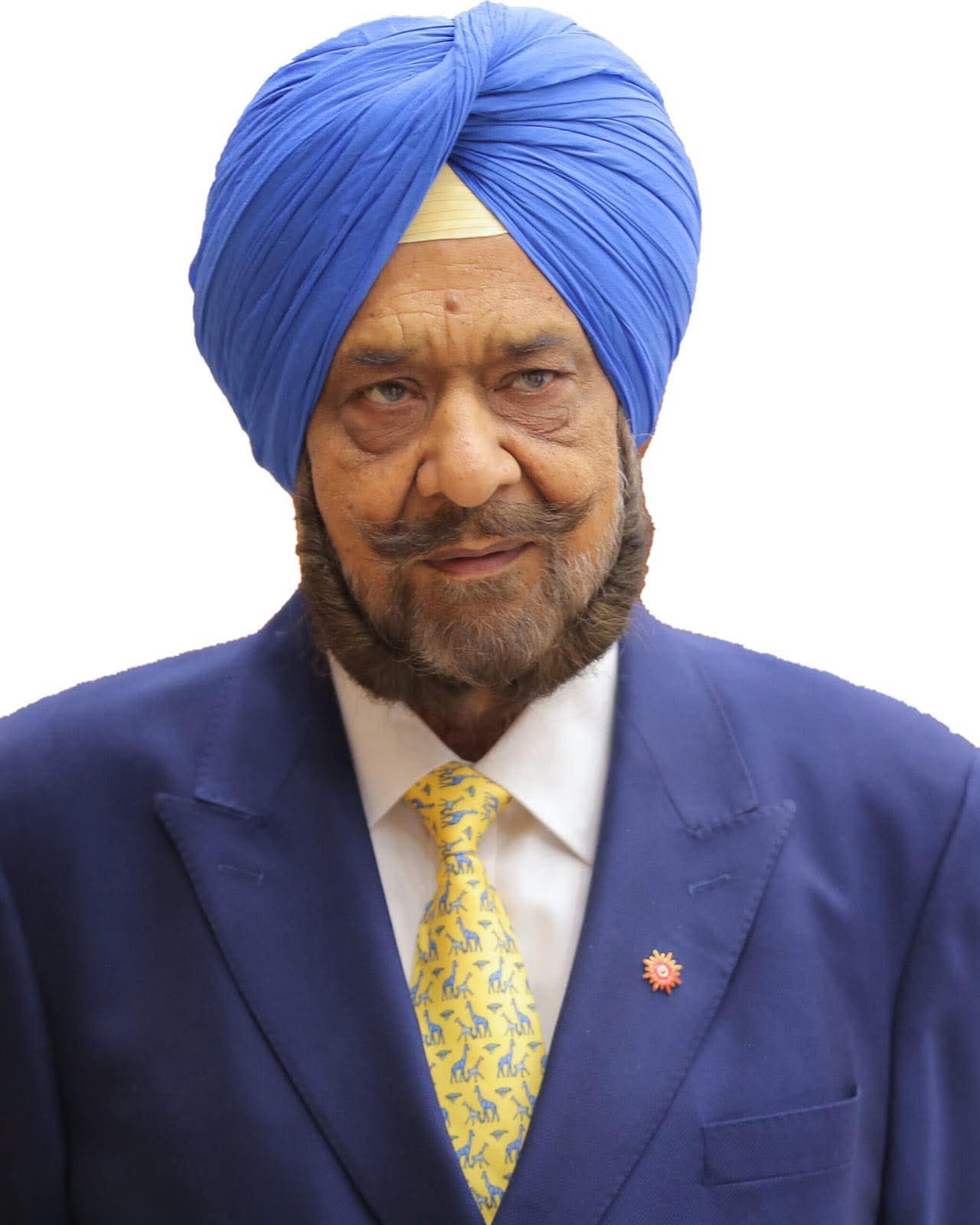
Tribute to Raja Randhir Singh
By Kulbhushan Kain
Some people you meet and forget. Some people you meet and remember. And then there are those rare, luminous human beings you meet and wish — with a quiet ache that never quite leaves you — that you had found them sooner.
Raja Randhir Singh was that kind of man.
I came to know him much later in my life than I would have wished. But from the very first time I sat across from him, I knew I was in the presence of someone extraordinary not because of the titles, the medals, the Olympic blazers, or the princely lineage – though all of that was real and remarkable. I knew it because of the way he made you feel. Seen. Heard. Valued. As if you were the most interesting person in the room, when in truth it was always him.
I still remember the afternoon I went to meet him at his residence and stopped to ask for directions at a modest neighbourhood kirana store. When I mentioned the name “Raja Randhir Singh”, the shopkeeper- a simple man in shorts with a long white beard — smiled immediately.
“Raja Sahib from the Patiala family,” he said. “Bahut acche insaan hain. Subse pyaar se milte hain.”
That, in six words, was the most complete portrait anyone ever painted of Randhir Singh. A man from one of India’s most celebrated princely families, who had stood on Olympic podiums, shaken hands with world leaders, and shared meals with the greatest athletes the twentieth century produced-and yet was remembered, most fondly, by the man at the corner shop for the warmth with which he greeted everyone.
That was his gift. And it was the rarest one.
To list Raja Randhir Singh’s achievements is to risk making him sound like a record book rather than a human being. And he was so much more than a record book. But the record must be stated, because this country does not always honour its own with the attention they deserve.
He represented India in five Olympics. Five. He competed in four Asian Games, winning individual Gold, Silver and Bronze. He served as Secretary General of the Indian Olympic.
Association for twenty-seven years. He was Secretary General of the Olympic Council of Asia. He was the Founder General Secretary of the Afro-Asian Games Council. He was the recipient of the Arjuna Award, the Maharaja Ranjit Singh Award, and the Olympic Order in Silver — one of the highest honours the international Olympic movement bestows.
He came into shooting almost by accident -enrolled for the junior nationals in clay-pigeon shooting at sixteen by his maternal aunt, without being asked, during a hunting trip to his grandfather’s estate in Uttar Pradesh. He emerged a champion. He did not stop competing for India for thirty-one years.
When I asked him once what separated Olympic champions from the rest of us- those extraordinary physical specimens of the human race- his answer surprised me with its gentleness.
“In the Olympic village everyone is a champion,” he said. “So you will see Steffi Graf, Carl Lewis, Edwin Moses walk past or having breakfast across the table. Many athletes don’t even know each other. A wrestler from Iran, a boxer from Cuba -they are all very nice and modest human beings. They are just like you and me. They specialise in sport – you are a champion in your own way in writing!” Such a kind man –even with his words.
He knew most of them personally. Sebastian Coe. Sergey Bubka. Gary Sobers, whom he took to a friend’s house in Sydney during the Olympics for a quiet meal — because Gary, he told me with a chuckle, was being chased by too many people at the stadium and preferred to watch the Games from the comfort of a living room.
He had that quality- of making the extraordinary feel intimate, and the intimate feel extraordinary.
What the official record cannot capture is the man at the dining table. Because it was there- over food, over conversation that ranged from music to education to cinema to culture. It was here that Raja Randhir Singh was most fully himself.
He was an excellent cook. He was writing a book on food. Hariprasad Chaurasia was among his closest friends. He adored Amitabh Bachchan – “a wonderful gentleman,” he said, with the same simplicity that he brought to everything. He had strong views on education — why, he once asked me, can we not start schools in the afternoon? We never run hundred metre races in the morning. And on culture, he asked, “Why do we copy the West so blindly? Why can’t schoolgirls wear salwar kameez, and boys wear kurta pyjamas?”
Every conversation with him was a door into a room you had not known existed. That is why, when I wrote about him some years ago, I described the experience of meeting him as entering a library with thousands of books — wanting to read all of them, unable to decide where to begin.
Today, that library has closed its doors for the last time.
For the past year, I knew he was unwell. I wanted to go and see him. Life intervened, as it does. Friends advised me not to- he was frail, they said, too weak for visitors. I listened, and I waited, and I told myself there would be another time.
There was not.
Every time we chatted, I would tell him, “Sir, come back soon so we can have a meal together.” And he would say, yes. That meal will remain, now, one of the great unfinished conversations of my life. I will carry the absence of it for a long time.
Raja Randhir Singh leaves behind a legacy that Indian sport will not easily replace. He leaves behind friendships that spanned continents and decades. He leaves behind the memory of a man who wore his royalty lightly and his humanity heavily – which is, in the end, the only kind of royalty worth having.
He leaves behind tearful eyes in Dehradun, in Delhi, in Patiala, in the corridors of Olympic committees across Asia, and in a kirana store in the neighbourhood where a shopkeeper in shorts once told me, without knowing he was delivering an eulogy: “Bahut acche insaan hain.”
(thaa)
The tense has changed today. But the truth of those words has not.
At seventy-nine, Raja Randhir Singh ran his last race.
I had written an article and called him “Run Dhir Singh” He ran it, as he ran everything, with grace.
Continue to run, Sir. Wherever you are now, continue to run.
(Kulbhushan Kain is an award winning educationist with more than 4 decades of working in schools in India and abroad. He is a prolific writer who loves cricket, travelling and cooking. He can be reached at kulbhushan.kain@gmail.com)