 By Ravi Singh Negi
Civic Sense is the necessary virtue of a cultural civilisation but is missing in practice by most of the citizens in India. It is very common to see people littering here and there on roads and the roadside or even in front of the neighbour’s gate. You can also find people throwing litter on the road while traveling in a car or public transport. Another very common scene which you can see during the morning walk – people bring their dog tied up in a chain, always ready to pounce on other passersby and is freely permitted to poop or piss in front of another’s gate. Not following traffic rules causing public inconvenience is another big nuisance by our citizens.
A very common scene after a Bhandara, after distribution of Prasad along the roadside, or near roadside eating joints, a lot of filth including paper/plastic glasses, plates, etc., can be seen, which is left to be cleaned by government employees. Ironically, these are not only the people from illiterate or backward backgrounds but are literate and of proud high social status, missing good manners in practice. It is not a surprise when many of these same people behave differently when they are abroad or in a forced situation to follow rules.
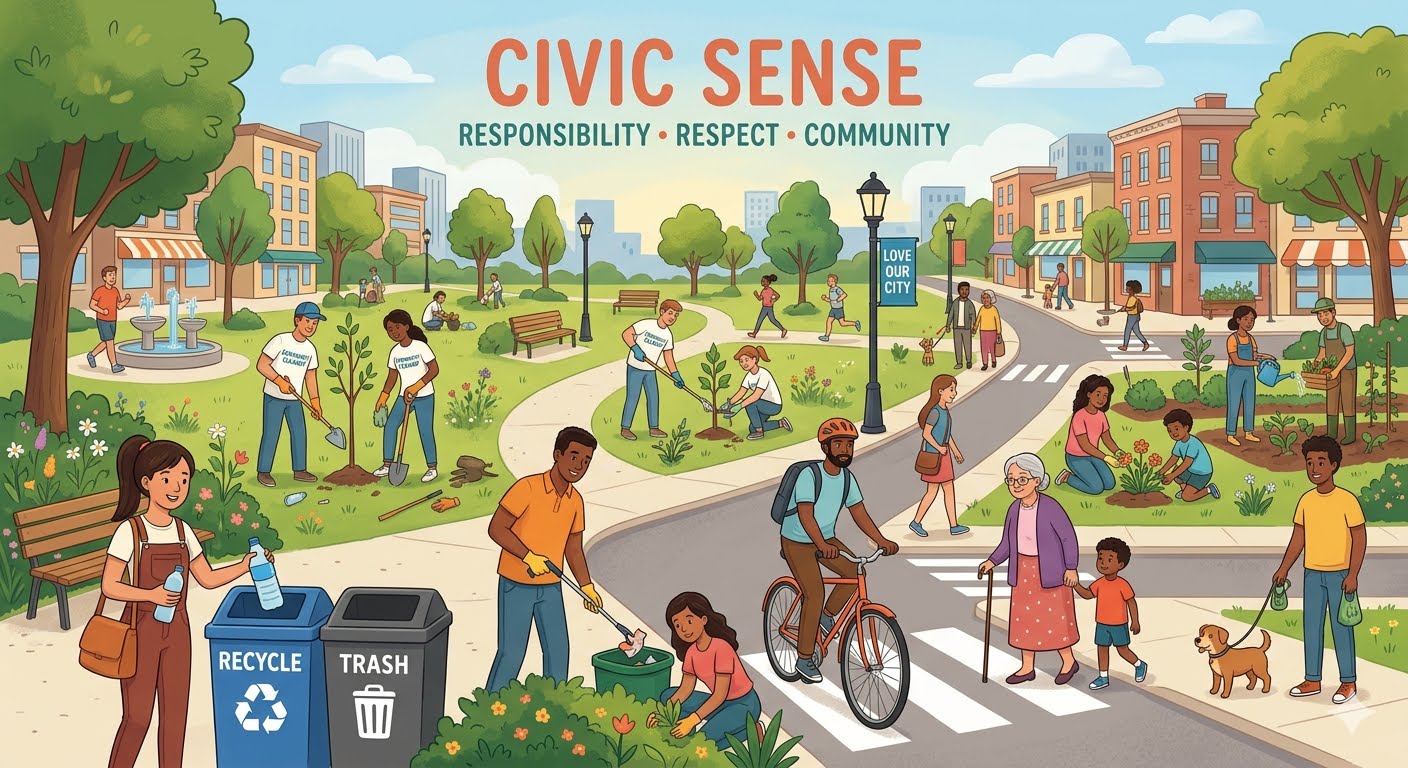
Civic sense, also referred to as public etiquette, is not merely about cleanliness or following rules, it refers to the social ethics, responsibilities, and conscious behaviour every individual must practice in public spaces to ensure a harmonious and well-functioning society. It is an internal moral compass that guides how we treat public property, follow laws, respect fellow citizens, and behave ethically beyond the boundaries of our homes. Civic sense encompasses the values, attitudes, and behaviours that define our relationship with the community and the environment. It is the unwritten social contract that binds us together, fostering a sense of responsibility and mutual respect. When practiced, it enhances public health, reduces pollution, and fosters collective responsibility.
In simple terms: Civic sense is ‘how you behave when no one is watching’. It’s not just about following rules; it’s about respecting the space we all share and realising that small actions make a big difference.
People often skip civic rules because of survival mode, weak rule enforcement, it provides immediate selfish benefits, and a lack of early teaching. Many view public spaces as “no man’s land”, caring only for their private property. They often do not follow civic sense due to a combination of learned habits, psychological burnout in crowded environments, and a general lack of strict consequences. Upbringing plays a major role, as many people are taught private cleanliness but are rarely socialised to respect public spaces.
The lack of civic responsibility stems from several distinct factors: When it comes to public property there is a widespread mentality that “it belongs to everyone, so it belongs to no one”. People protect their private homes but readily disregard public cleanliness or order. When civic rules are weakly enforced, people realise they can get away with breaking them. For many people breaking rules is often seen as being “smart” or saving time rather than being unethical. Some reasons for this behaviour is poor education, weak enforcement of rules, just a general mindset that public spaces are not our problem, no fear of wrongdoing and selfishness and peer pressure are also a reason for uncivilised behaviour.
Can Civic Sense be taught? Of course, yes. None of us is born with civic sense. Though we have the ability to speak, words and languages are taught to us by adults. Similarly, civic sense too has to be taught and inculcated. This requires empathy, personal responsibility, and stronger punishments. The household is the first classroom for civic values. Children who see their parents place waste in dustbins, turn the switch off when it is left on, lower their voices in public, and help strangers, naturally internalise these behaviours. Education plays a major role in developing civic sense. Schools and colleges are the first places where students learn social behaviour beyond family values. Early exposure helps students develop lifelong habits of responsible citizenship. Civic behaviour should be taught to a child, right from day one when he/she enters the school including preparatory school. In addition, recognition and reward for civic behaviour alongside academic achievement should also be emphasised for appointments in public and private sector. Civic sense is not someone else’s responsibility. It is yours, mine, and every Indian citizen’s, regardless of education, income, or status.
Are we ready to learn something from the Japanese who voluntarily cleaned a stadium after a World Cup 2026 football match, conveying a message of civic sense to the world?
(Ravi Singh Negi is an Advocate, Social Worker and Marriage/Academic Counsellor.)