Book Review
By Raman Kumar
In Ajay Jugraan’s wide-ranging collection, an Indian reader encounters not merely a sequence of poems but the record of a sensibility making a home in English through attention, memory, and unembarrassed feeling.
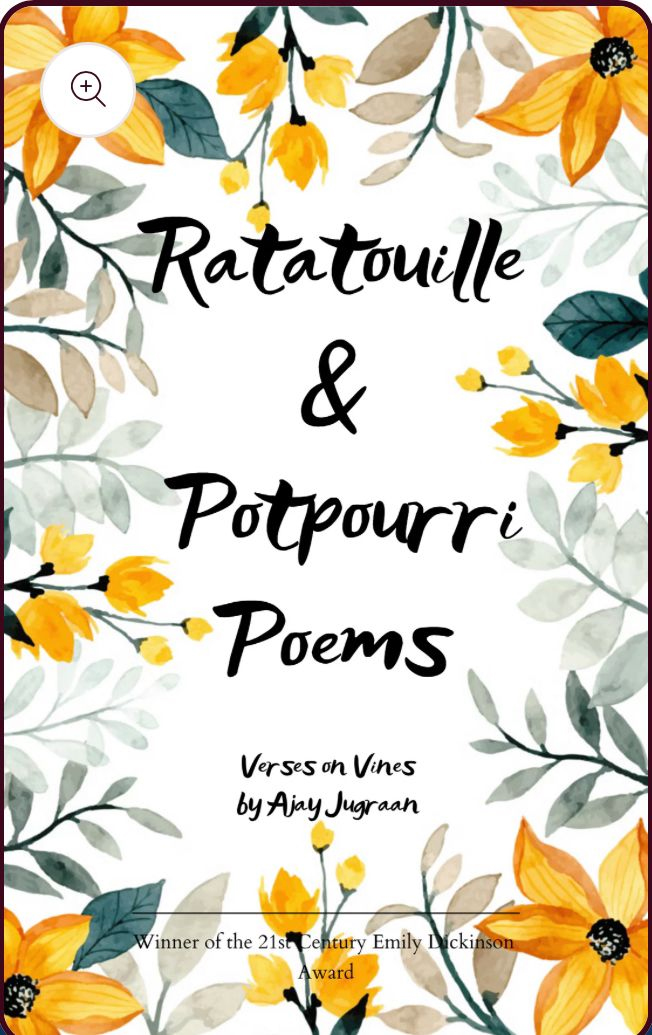
Ajay Jugraan’s Ratatouille & Potpourri Poems is, on the face of it, a book of variety. It gathers into one volume poems on hills and gardens, parents and lovers, war and ageing, weather and small domestic incidents. Yet what makes the collection memorable is not the range of its subjects alone. It is the quality of attention that runs through them: patient, intimate, and quietly grateful toward the visible world. This is a poetry that does not seek to astonish by difficulty. It seeks, instead, to remain close to experience.

That closeness matters, especially in the context from which such writing emerges. Jugraan’s poetry often feels shaped by a lived relationship to English rather than by institutional ease within it. The result is not ornamental literary display but something more affecting: a language inhabited through care. One senses throughout the book a writer using English not as an inherited cultural certainty but as a chosen medium of feeling, recollection, and moral witness. The poems derive much of their force from that self-fashioned intimacy. They are not anxious about pedigree. They are concerned with presence.
The collection’s title advertises miscellany, and the miscellany is real. But the best way to read this volume is not as a loose assortment. It is a record of what the poet has found worth preserving: a rainbow over the hills, the naming of flowers, the changing health of a parent, the ache of memory, the spectacle of violence elsewhere in the world, the comedy and pathos of small daily life. What unifies these pieces is a recurring ethical impulse: to notice carefully before one speaks.
This is especially clear in the nature poems, which are among the strongest in the collection. Jugraan’s landscapes are not decorative backdrops. They are inhabited presences. Hills, rivers, rain, trees, smoke, foxes, birds, blossoms: these recur not as stock pastoral furniture but as things genuinely encountered. There is often a local intimacy in the poems, a sense that the poet knows the terrain he is writing from. He is not trying to produce the sublime. He is trying to honour proximity.
At the same time, the natural world in this collection is never merely consoling. Forest fires enter the scene. Animals are shadowed by threat. Ecological damage unsettles visual delight. Again and again, Jugraan allows beauty and vulnerability to occupy the same frame. That doubleness gives the poems their emotional credibility. They are capable of wonder, but they are not innocent of danger.
The garden poems deserve particular notice. Here Jugraan’s delight in naming flowers becomes a mode of devotion. The botanical specificity of these poems is not fussy; it is affectionate. To list jasmine, gladioli, frangipani or bottle brush is not simply to catalogue but to cherish. The garden becomes, in these pieces, a form of emotional order: a space in which attention is both sensuous and steadying. The poems do not rush toward symbolism. They begin by looking.
“Jugraan writes as if attention were itself an act of care.”
The family poems are the emotional centre of the book. Jugraan writes movingly of parents, inheritance, frailty, and after-presence. What saves these poems from easy sentiment is their reliance on remembered particulars. Grief is carried not by grand declaration but by minor details: a routine, a familiar object, the trace of a gesture, the persistence of a voice in recollection. The poems know that mourning lives in such details long before it becomes philosophical. Their directness, in this sense, is not simplification. It is fidelity.
There is something especially recognisable in the emotional weather of these family poems: the mixture of tenderness, responsibility, memory, indebtedness, and lingering incompletion that marks so much of filial life. Jugraan does not flatten that emotional world. He allows it dignity. For that reason, these poems feel not merely personal but culturally resonant.
The love poems are more conversational and, at times, less formally secure, but they remain revealing. What they offer is not verbal brilliance so much as emotional recognisability. These are poems of return, hesitation, uncertainty, and old feeling not quite extinguished. They are strongest when they lean into speech and vulnerability rather than lyric polish.
The war poems widen the volume’s moral radius. Here Jugraan turns from the intimate to the public, but he does so without abandoning the same basic stance of witness. These poems are less subtle than some of the family lyrics, and occasionally they verge on statement. Yet their seriousness is undeniable. They arise from the refusal to let distant suffering remain abstract.
It is true that the collection is uneven. Some poems might profit from greater compression; there are lines that explain what the image has already disclosed. But I find myself less interested in that than in what it reveals about Jugraan’s larger poetic temperament. He is not a poet of concealment. He does not hide feeling behind cleverness. He would rather risk saying too much than retreat into literary guardedness.
And that, finally, is what gives Ratatouille & Potpourri Poems its distinct place. It is a book of self-fashioned lyric hospitality: open to weather, memory, grief, and affection; unafraid of tenderness; unashamed of wonder. Its poems do not merely describe a world. They make visible the effort of dwelling in it attentively, and of making a language one’s own through that dwelling.
(Raman Kumar is presently Director, Nature Science Initiative, Dehradun.)