By Arun Pratap Singh
Garhwal Post Bureau
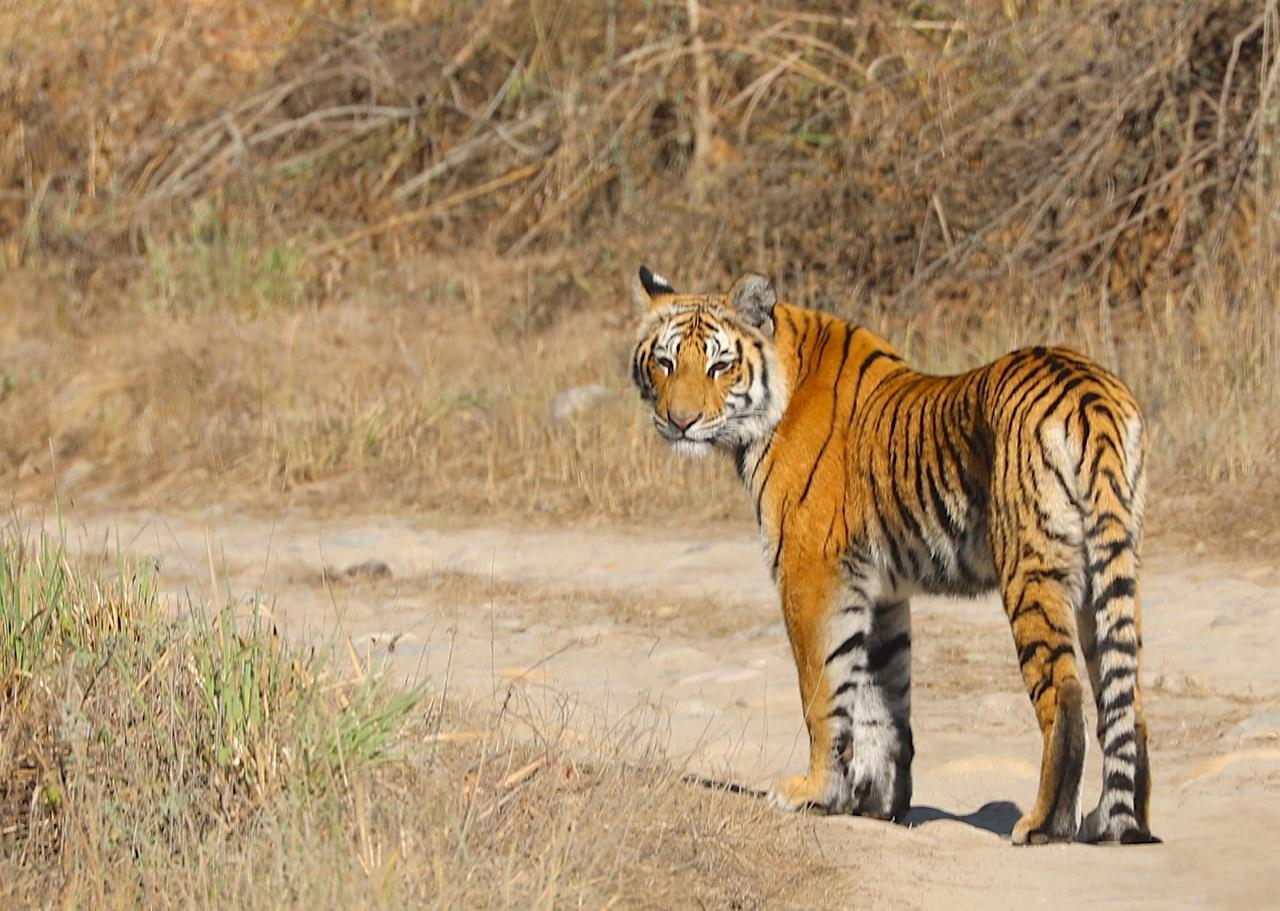
Dehradun, 3 Jul: The increasing movement of tigers and other wild animals out of the Rajaji Tiger Reserve and into neighbouring states of Himachal and UP has raised fresh questions over changing wildlife behaviour and habitat dynamics and ecological debate. However, the forest officials claim that the phenomenon reflects healthy ecological connectivity rather than a cause for concern. While the Uttarakhand Forest Department and Rajaji Tiger Reserve authorities have described the movement of big cats into Himachal Pradesh as a positive sign of continuous forest connectivity between the two states, the fact remains that tigers were virtually unheard of in the Paonta Sahib region until recently, making the latest sightings particularly significant and a topic of ecological debate. It may also be added here that this movement of tigers beyond the state forests comes at a time when the Uttarakhand Forest Department is preparing to relocate 5 more tigers from Corbett Tiger Reserve to Rajaji Tiger Reserve. Earlier, too, 5 tigers had been relocated to Rajaji from Corbett and the tiger spotted in Himachal recently is likely to be one of these.
It may be recalled that Garhwal Post had reported in a recent article that a tiger had been sighted in the Paonta Sahib area of Himachal Pradesh about 2 months ago. Speaking to Garhwal Post at the time, Rajaji Tiger Reserve Director Koko Rose had confirmed the development and attributed the increased movement of wildlife to the newly constructed elevated wildlife corridor at Mohand along the Delhi-Dehradun Expressway. He had observed that the corridor had considerably improved the safe passage of wild animals between different forest ranges by eliminating a major barrier and vehicular traffic that previously restricted their movement.
However, the latest developments have once again brought into focus the growing tendency of wildlife to move beyond the boundaries of the Rajaji Tiger Reserve. While the Uttarakhand Forest Department continues to invest substantial resources in strengthening conservation measures and increasing the population of tigers and other wildlife within the reserve, a number of animals are increasingly venturing beyond their traditional territories. More significantly, several of them are not returning to Rajaji after establishing themselves elsewhere, compelling forest officials to monitor their movements outside the reserve and even beyond the state’s borders.
Independent wildlife experts also claim that this tendency may be a reflection of the possibility that the ecology of the Rajaji Tiger Reserve may not be very healthy and that there could be dearth of prey in the reserve forcing the tigers to move out and not return. While the movement of wildlife from Rajaji Tiger Reserve into neighbouring states has emerged as a subject of increasing interest among wildlife experts and forest officials. While publicly the forest officers attribute the movement to the wildlife corridor and claim this to be a healthy sign, the fact remains that the department itself is confused and confounded by the development. This is indicated by the fact that recently a team of Rajaji Tiger Reserve officials and wildlife specialists travelled to Himachal Pradesh following reports of a tiger being sighted in the Paonta Sahib area. At first glance, the visit appeared to be part of a routine inter-state wildlife conservation exercise. However, the primary objective was to ascertain whether the tiger had originated from the Rajaji Tiger Reserve.
To verify this possibility, a team of experts from Rajaji Tiger Reserve visited Himachal Pradesh on 19 June and carried out a joint inspection with officials of the Himachal Pradesh Forest Department. Camera traps were installed at several strategic locations in an attempt to capture images of the tiger and establish its movement pattern. Despite extensive monitoring, the tiger has so far not been photographed by the camera traps, nor has there been any confirmed report of its return to Uttarakhand. One tiger that was spotted in Paonta Sahib in April or May was caught on camara by independent people.
However, this is not the first instance of a tiger from Rajaji Tiger Reserve venturing into another state. In 2023, a tiger was also reported to have reached Himachal Pradesh. Forest officials had monitored its movement on that occasion as well, but there was no confirmed record of the animal returning to Rajaji thereafter. The recurring pattern has prompted wildlife experts to believe that some tigers may be establishing permanent territories outside the reserve after dispersing from their original habitat.
Similar examples have been witnessed within Uttarakhand as well. A tiger that had earlier been relocated from the Corbett Tiger Reserve to Rajaji Tiger Reserve did not eventually establish a permanent territory within Rajaji. Instead, it settled in the Rishikesh area of the Dehradun Forest Division, indicating that large carnivores often choose habitats based on ecological suitability rather than administrative boundaries. There have been also reports that tigers have been spotted in the hills of Uttarakhand, something which was not happening in the past. Leopards are considered the kings of the hills.
However, significantly, the phenomenon of movement of wild animals out of Rajaji Tiger Reserve is not confined to tigers alone. Rajaji’s elephant herds have also repeatedly travelled into Himachal Pradesh and Uttar Pradesh over the years. Several herds have remained outside the reserve for prolonged periods, with some elephants not returning to their earlier habitats. While long-distance movement by elephants is considered natural, the tendency of some herds to establish themselves in new landscapes has become an important subject of study for wildlife scientists and may have something to do with the ecology of Rajaji Reserve.
Speaking to Garhwal Post, Rajaji Tiger Reserve Director Koko Rose said that several such cases have been recorded over the years in which wild animals moved beyond the reserve’s boundaries. He observed that long-distance dispersal is a natural behavioural trait, particularly among young male tigers that often travel hundreds of kilometres while searching for new territories. According to him, the movement of a tiger beyond Rajaji cannot, in itself, be regarded as an unusual occurrence.
Rose, however, also conceded that no single factor could be held solely responsible for the increasing movement of wildlife outside the reserve. He pointed out that several ecological and infrastructural changes could be influencing these dispersal patterns simultaneously. One of the most significant developments, he noted, has been the construction of wildlife corridors, underpasses and elevated structures as part of the Delhi-Dehradun Expressway project, particularly the elevated wildlife corridor at Mohand, which has substantially improved safe movement between forest ranges and reduced the barrier effect once created by the busy highway.
Rose also reiterated that attributing such movements to any single reason would be simplistic, as several ecological and environmental factors work simultaneously. Nevertheless, he maintained that the wildlife passages, underpasses and elevated wildlife corridor constructed along the Delhi-Dehradun Expressway have significantly improved landscape connectivity by removing one of the biggest barriers that previously restricted wildlife movement. Earlier, the national highway carrying heavy traffic often posed a serious threat to animals attempting to cross between forest divisions, resulting in accidents as well as habitat fragmentation. With the completion of the dedicated wildlife structures, tigers, elephants and several other species are now able to move more freely and safely between Uttarakhand, Himachal Pradesh and adjoining forest landscapes.
The western part of the Rajaji Tiger Reserve supports a substantial leopard population, leading to increased competition for territory and prey. Such ecological pressures may encourage some animals, particularly young dispersing male tigers, to explore less competitive landscapes offering better opportunities for establishing independent territories.
At the same time, Rajaji Tiger Reserve Veterinary Officer Dr Vivekanand Sati reminds that the selection of a new territory by any wild animal is a complex natural process based on careful assessment of habitat conditions. According to him, animals instinctively evaluate the availability of adequate forest cover, water sources and natural habitat before deciding to settle in a particular area. He said perennial water availability remains one of the most important factors influencing habitat selection. Equally significant is the level of human disturbance. Wild animals are more likely to establish themselves in landscapes where human interference is minimal and the risk of poaching or other illegal activities remains low. For predators such as tigers and leopards, the abundance of prey species including chital, sambar, wild boar and other ungulates is another determining factor. Areas supporting healthy prey populations naturally become more attractive for large carnivores.
In the case of elephants, food availability assumes even greater importance. Since elephants require enormous quantities of vegetation every day, they prefer habitats that provide abundant grasslands, shrubs, tree cover and reliable water sources throughout the year. These ecological requirements often influence the direction and extent of their seasonal and long-term movements.
Despite the scientific explanations offered by wildlife experts, several broader questions continue to remain unanswered. Why are increasing numbers of wild animals leaving the Rajaji Tiger Reserve? Are these movements merely part of their natural dispersal behaviour, or do they also reflect changing ecological conditions within the reserve? Are the forests of neighbouring Himachal Pradesh offering comparatively favourable habitats with better food resources, reduced competition or lower levels of human disturbance? Or has the improved connectivity created through wildlife corridors simply enabled animals to access landscapes that were earlier difficult to reach? So far these questions remain unanswered but would require a deep consideration and research.