Cong leader interacts with students at ‘Chhatron ki Goonj’
By Arun Pratap Singh
Garhwal Post Bureau
Dehradun, 17 Jul: Defying persistent rain and adverse weather conditions, a large number of students gathered at Bannu School Ground in the Race Course here this evening to participate in Congress leader and Leader of the Opposition Rahul Gandhi‘s ‘Chhatron Ki Goonj’ programme, where he interacted with students on issues relating to education, employment, competitive examinations and the challenges facing the country’s youth.
Beginning his address, Rahul Gandhi paid heartfelt tributes to senior Congress worker Amar Singh Mehta, who lost his life on Thursday while supervising preparations for the programme after an iron rod from a temporary structure collapsed at the venue. Gandhi described Mehta’s demise as a great loss to the Congress family and expressed his condolences to the bereaved family.
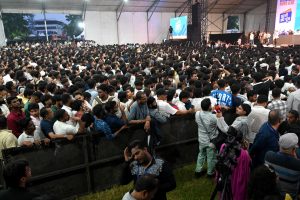
Thanking the students for turning up despite heavy rain, Gandhi said the enthusiasm shown by the youth of Uttarakhand reflected their determination and aspirations. He described the youth as the country’s greatest strength and said the purpose of the interaction was to listen to their concerns and discuss the issues affecting their future.
During his address, Gandhi said crores of young people across the country spend several years distancing themselves from their normal social life while preparing for competitive examinations and during this period, they spend around Rs 9 lakhs. He said students study for eight to ten hours every day and their entire families stand by them throughout this demanding journey.
He said many families even take loans to finance their children’s education and coaching, while numerous poor and middle-class families remain unable to provide higher education to all their children because of financial constraints.
Gandhi said the real challenge facing the country’s youth extended beyond academic preparation. According to him, young people today were confronted with two paths — one of hard work and the other of paper leaks. He alleged that those with money and corrupt intentions found opportunities through leaked examination papers, while honest students who relied solely on merit were left at a disadvantage. He claimed repeated paper leak incidents had played with the future of hardworking youth and said around 7.5 crore young people have been adversely affected. He added that 152 examination papers have been leaked during the past 10 years, affecting about 7.5 crore students. He also reminded that out of 9 crore aspirants only 6 lakh aspirants succeed which means that only 1 out of 150 aspirants succeeds.
He also claimed that incidents of paper leaks were on the rise but no one had been punished or sent behind bars. He further said that preparing for competitive examinations was not an individual struggle but one shared by the entire family. For middle-class families, he said, securing a government job remained one of the most important aspirations, and when recruitment examinations were cancelled or compromised because of paper leaks, the dreams of entire families were shattered. He added that paper leaks were an insult not only to students but also to their parents.
Gandhi also argued that employment opportunities outside the government sector remained limited. He claimed that the manufacturing sector had weakened considerably, corporate employment opportunities were inadequate and quality private-sector jobs were not easily available. As a result, he said, government employment had become the primary option for a large section of the country’s youth, making transparency and fairness in recruitment examinations even more crucial.
Gandhi claimed that there were five avenues of employment for the youth in India. One was the manufacturing sector, which he alleged had virtually closed. The second was the public sector, which, he claimed, had increasingly been privatised. The third avenue, he said, was now being affected by artificial intelligence. According to him, only two options are effectively left. One is to work extremely hard and compete for professional courses and government jobs, but even that path has been undermined by paper leaks. The other, he alleged, is corruption, whereby those with money can buy leaked question papers and secure success.
Making the programme interactive, Gandhi invited four students from the audience onto the stage and listened to their experiences and concerns regarding education, competitive examinations, recruitment processes and employment opportunities. He engaged with them at length and sought their views on the challenges faced by students and job aspirants. One of the participants, who introduced himself as a student, appeared to be in his mid-thirties and had come from Gaya in Bihar.
During the interaction, Gandhi invited students to share their experiences from the stage. One student said, “We worked extremely hard in 2020. After we came out of the examination hall, we learnt that the paper had been leaked. It completely shattered our morale.” Another student said she had appeared for the Patwari recruitment examination in 2025, but its question paper was also leaked, forcing candidates to take the examination again. A third student said years of hard work were put at stake because the government had failed to prevent paper leaks. He also expressed concern over the increasing number of private medical colleges, alleging that many deserving students were still unable to secure admission to government medical colleges despite their merit. Another student claimed that most medical colleges in Uttarakhand were privately run, while there were only six government medical colleges in the state. Gandhi listened to the students’ experiences and responded to their concerns during the interaction.
Educator Abhinay, popularly known among students as ‘Abhinay Maths Sir, also addressed the gathering and claimed that he has been consistently exposing the reality of paper leak cases. He warned that future generations would continue to suffer unless the menace is effectively tackled. Stressing the need for urgent corrective measures, he said governments would have to seriously address the issue and treat every report of a paper leak with the seriousness it deserved. He added that it is the responsibility of the government to rectify the system and ensure fair recruitment processes, observing that mere statements or political rhetoric would not solve the problem.
During the programme, a photograph of Riya Thapa, a Dehradun student who allegedly died by suicide following a paper leak controversy, was displayed on a large screen. Describing her death as deeply tragic, Rahul Gandhi invited her father, Rajesh Thapa, onto the stage to share his family’s ordeal. Recalling the events, Rajesh Thapa said his daughter had worked tirelessly to prepare for the examination and would often study until 3 am. He said she was devastated after learning that the examination paper had been leaked on the day of the test and broke down in tears. According to him, the alleged paper leak shattered her morale and left her deeply distressed. Gandhi listened to the family’s account and expressed sympathy over the tragedy while reiterating the need for transparency and fairness in recruitment examinations.
The programme generated considerable enthusiasm among Congress workers and students. According to the party, more than 2.5 lakh students had registered for the event. Congress leaders had made elaborate arrangements, with entry being regulated through prior registration, while help desks and QR code-based registration facilities were also provided at the venue to facilitate participants.
Rahul Gandhi‘s visit, his first to Dehradun in a long time, infused fresh enthusiasm among Congress workers, who described the turnout despite inclement weather as a reflection of the growing interest among students in issues concerning education, employment and recruitment examinations. The interaction concluded with Gandhi listening to students’ views and responding to their questions on matters affecting the country’s youth.