By KULBHUSHAN KAIN
“I was just three years old when Partition tore the subcontinent apart. I have no personal memories of those chaotic days, but the stories my parents passed down are etched forever in my mind. Our family belonged to Sialkot, but we happened to be visiting relatives in Sindh when the frenzy began. Boarding a train home, news broke mid-journey that riots had erupted, so my father broke our journey at Lyallpur, where my mother’s family lived. He wanted to assess the situation as it unfolded. We boarded a tonga towards her ancestral home, but found that the house was locked, and deserted. Her family had already fled.
As we stood stranded, a Muslim neighbour hurried towards us, ‘You must leave immediately,’ he urged. ‘It is no longer safe for a Hindu family here.’
My father asked, ‘But how do we leave safely now?’
He looked my father in the eye, raised his rifle, and replied, ‘I will protect you for as far as my gun can shoot. Beyond that, you are in God’s hands.’
By some stroke of divine luck, we made it back to the station, boarded a train to Sialkot, and crossed over to safety in Jalandhar.”
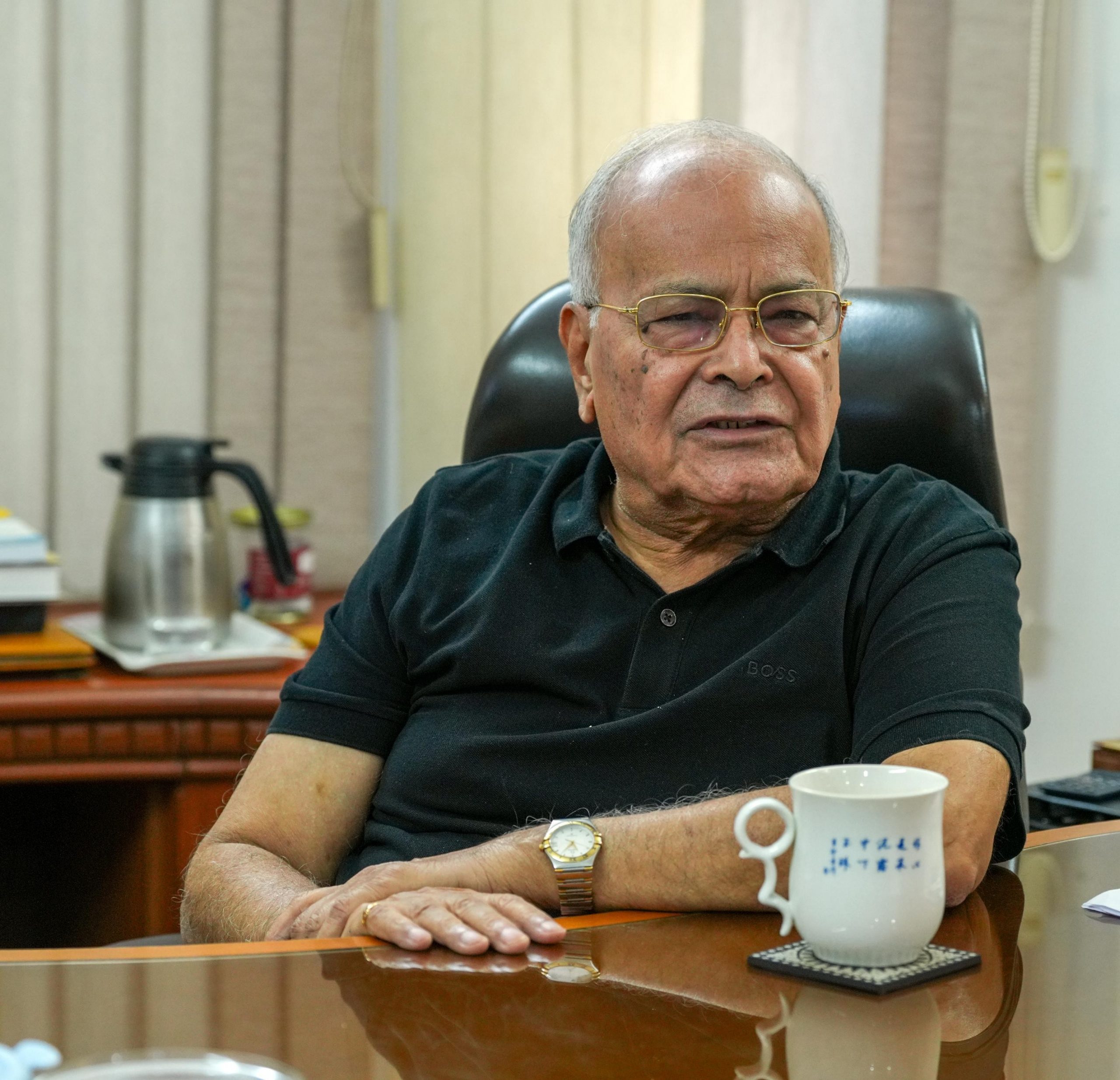
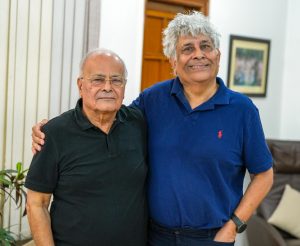
Thus began the odyssey of Vijay Kumar Dhawan. A man who survived the razor’s edge of 1947 to reach the pinnacle of Indian industry: founding Chairman of the Confederation of Indian Industry (CII) in Uttarakhand, creator of successful companies, and a member of the Board of Governors of IIT Roorkee.
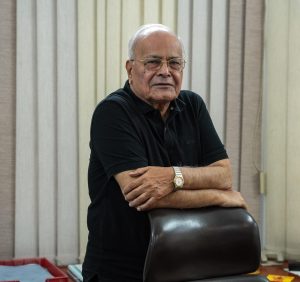
I did not walk into our interview to rehash resume highlights. I wanted to meet the real Vijay Dhawan — and at 82, he is astonishingly alert, his memory retaining dates and milestones with an effortless precision that leaves you in awe. He sits comfortably across the table – neat, alert and dapper.
The Mentors Who Forged a Leader
Long before he became an industrial giant, his character was forged in a classroom, shaped by two mentors: Yash Johri and CK Dixit.
Johri taught him mathematics in school, but his influence went beyond equations. In an era when penmanship was a mark of distinction, the young Vijay struggled with terrible handwriting, while Johri possessed an exquisite script and impeccable sartorial grace. Fascinated, Vijay copied his master’s strokes until he made the style his own — even today, Dhawan’s handwriting remains elegant, a tribute to the teacher he so revered.
Dixit, who taught physics, was warm and approachable, making complex science feel like an invitation rather than a chore showing Vijay that true authority comes with warmth, not intimidation.
Falling in Love with Dehradun & Taking the Leap
That grounding stayed with him through a career that began far from entrepreneurship: six years with ONGC in Assam, followed by six years at Larsen & Toubro (L&T), which posted him to Dehradun as a resident engineer in 1973 — a pivotal turn of fate.
Earning a modest Rs 1,100 a month, he fell in love with the valley. “It was a system,” he recalls of those corporate years, “a graph.” But the spirit of independence burned too brightly within him, and one fine day he walked away from the security of a paycheck to build an empire of his own.
Success was no effortless curve. In those early hiccups, he found guidance in a legendary Italian engineer, Dante Siracuza, revered across the oil and gas sector as the ‘Father of Fishing Tool Technology.’ Dante offered unwavering support, with two non-negotiable rules:
“You will never let down a customer. And you must do your business with absolute earnestness and unshakeable commitment.”
That encounter became the bedrock of Dhawan’s business philosophy, transforming his enterprise from a fledgling venture into a runaway success story.
Lessons from the World Stage
Building a global business brought a life of extraordinary travel — over a hundred countries across Europe, the Americas, Africa, and Asia. I asked him which two cities in the world he considers the finest.
He smiled. “It comes with a rider. A city isn’t just about pretty scenery or good food — it’s about its soul, its culture, its geography, its people. Each exists in its own unique realm. And when you visit a city too often, it loses its novelty – human nature pulls us toward the unfamiliar.”
Yet his personal favorites brought a nostalgic sparkle to his eyes — the Middle East, whose heritage and culinary traditions had captured his heart.
“Lebanon was truly breathtaking, and Beirut in those days was absolute magic,” he recalled, remembering drives through Jordan, the charm of Turkey, and the beauty of ancient Tehran. “I feel I’ve had the very best of both worlds.”
Vending Machines and Changing Perceptions
I asked how Indians were perceived abroad in the 1960s, ‘70s and ‘80s. Dhawan chuckled, recalling his first trip to Los Angeles. Craving coffee after an endless flight, he found no café — only a vending machine, and no coins to work it. A stranger handed him some, but he had never used such a machine. “I watched an American lady operate one, studied her movements, then replicated her exact key presses — and out came a steaming cup of coffee!”
The stranger asked where he was from. “India,” he replied.
“How on earth did you get here?”
“By airplane,” he answered innocently.
The man’s eyes widened. “I thought India was just a land of elephants and snake charmers!”
“That was how the West saw us back then,” Dhawan smiled. “See how dramatically the world — and India’s place in it — has transformed since.”
A Moment of Unforgettable National Pride
Asked to recall a moment of profound pride at being an Indian, his eyes lit up instantly. He remembered visiting the Indian Embassy in Tehran, where a massive black-and white photograph stopped him in his tracks — Prime Minister Indira Gandhi landing at the airport, greeted by Saddam Hussein himself.
“The composition was unforgettable,” he remembered. “A gust of wind had whipped the hem of Gandhi’s saree into a dramatic arc around her feet. Saddam Hussein — tall, imposing — was bent forward, deferentially speaking to her. She was not tall, but standing regal while this formidable leader bowed to address her. She looked nothing less than a visiting queen. That photograph stayed with me forever — it made me immensely proud.”
Words of Wisdom for the Next Generation
We had been talking for nearly three hours, monsoon rain beating down outside. I asked my final question: what advice would he give the young generation today?
“First, work first. Today the jargon is ‘be a job creator, not a job seeker.’ But how can you create a job if you haven’t worked one yourself? Learn the ropes as an employee, then take the leap.
“Second, true leadership requires knowing your people personally — even today, I know the names of my office assistants and peons.
“Lastly, cultivate the capacity to take risks. I walked away from a secure job with very little money in my pocket. If you possess leadership, honesty, and ambition, calculated risks will almost always pay off.”
A World Shrinking to a Family
Earlier, Dhawan had mentioned a stint in Bhubaneswar before founding his company, a detail that simmered quietly in my mind. As we prepared to part, a realisation clicked into place.
I asked, him whether he was related to Santosh Dhawan and her family from Odisha? She is my wife’s maternal aunt who often reminisces about the Dhawans of Odisha.
Astonishment washed over his face, followed by a warm, radiant smile.
“Of course! We are cousins!”
How strange and magnificent life is. The vast, monumental world had suddenly shrunk into a single room and into a family.
We said our goodbyes. Dhawan walked me down from his office himself. Watching him descend the stairs with effortless grace, I knew his journey is far from over.
Outside, the rain had not relented, it was coming down now in torrents, drumming on the pavement, blurring the poles of the street lights. Someone stepped forward with an umbrella and held it over me as I made my way to the car, but I barely felt the weather. I kept thinking that, if the monsoon could pour like this, unceasing, year after year, and still Dehradun’s hills stood exactly where they had always stood, then some things, too, are simply built to outlast the rain.
मिट्टी में जो जड़ें गहरी हों, वो आँधी से नहीं डरतीं,
बरसातें आती–जाती हैं, पहाड़ अपनी जगह खड़े रहते हैं।
Vijay Kumar Dhawan’s story, I suspect, is one such root.
Pics. Bhumesh Bharti
(Kulbhushan Kain is an award winning educationist with more than 4 decades of working in schools in India and abroad. He is a prolific writer who loves cricket, travelling and cooking. He can be reached at kulbhushan.kain@gmail.com)