 By Manoj Pande
Temples and ashrams are here, as in all holy towns, but it is the rivers that are the main draw in Amarkantak, a pilgrimage town in Madhya Pradesh bordering Chhattisgarh. Situated on a plateau about 1,048 m (3,438 ft) on the Maikal Hills which link the Vindhya and Satpura mountain ranges, it is the origin of not one, not two but three rivers, not counting the many seasonal streams that flow from its vast forests.
This is where the river Narmada begins its 1300 km long journey westwards to meet the Arabian Sea near Bharuch. It is one of the two major rivers that flow westwards, the other being Tapti. The river Sone that flows in the opposite direction (eastwards) also originates here, meeting the Ganga at Maner near Patna after a 784 km long journey. And about 10 km away, yet another river, Johilla, begins its short journey of about 170 km to meet Sone at Manpur near Umaria. And therein lies a tale, more about which later.
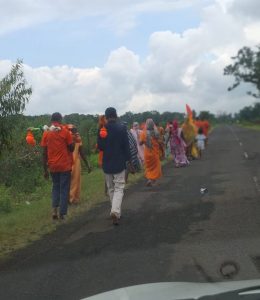
Its distance from major towns has kept the place relatively pristine, mainly visited by village folk and those from nearby districts, the numbers swelling during festive occasions. It was the last Monday of Shravan month when I planned to visit, but was advised against it as the place was teeming with pilgrims, and the inevitable traffic snarls. So, I went the next day when calm had been restored, though some groups of pilgrims could still be seen walking back down the road.
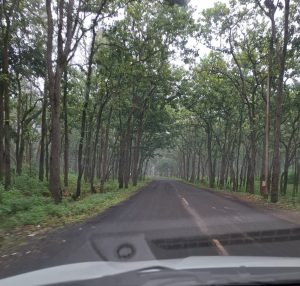
Amarkantak lies in the Anuppur District of Madhya Pradesh. Nearest railhead is Pendra Road, 40 km away in Chhattisgarh on the Katni-Bilaspur line of the South East Central Railway. The road journey from Pendra Road to Amarkantak is quite picturesque. The climb begins within a few kilometres of leaving the station premises and soon enough we are in Madhya Pradesh. The road, barring a few patches, is reasonably good and the views as we pass through the rich forests, especially in monsoons are picture perfect.
‘Narmade har’ was Puran Banjara’s first WhatsApp message to me. He was to be my local driver. While travelling to new places, the man at the wheel is usually the source of much local information. Puran fit the bill perfectly, telling me about the villages we passed and mango trees that grow wild here. Eucalyptus trees also occupy a large area though attempts are being made to replace them. He also pointed out some tracts of land, where medicinal plants are being grown. Otherwise, the forests here are a mix of many kinds of deciduous trees.
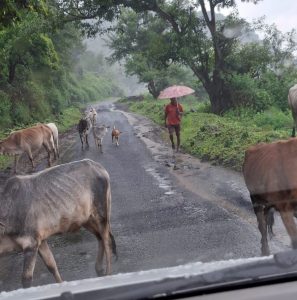
Puran informed me that most of the village inhabitants are from the Baiga tribe, though there are Gond villages too. Rice planting was going on, and in some places the plants had come up to half a feet height. Enroute, one spotted many cattle, but not really robust.
Entering the town, one passes many small shops, ashrams, temples and one Gurudwara too. Compared to 2004, when I had last come here, concrete structures have multiplied manifold which includes hotels, schools, shops and restaurants. Some Ashrams, like the Kalyan Ashram have an imposing entrance. At a distance one can see a huge Jain temple under construction.
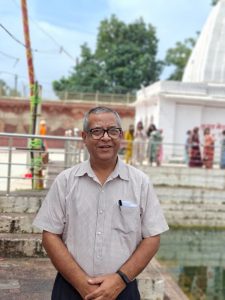
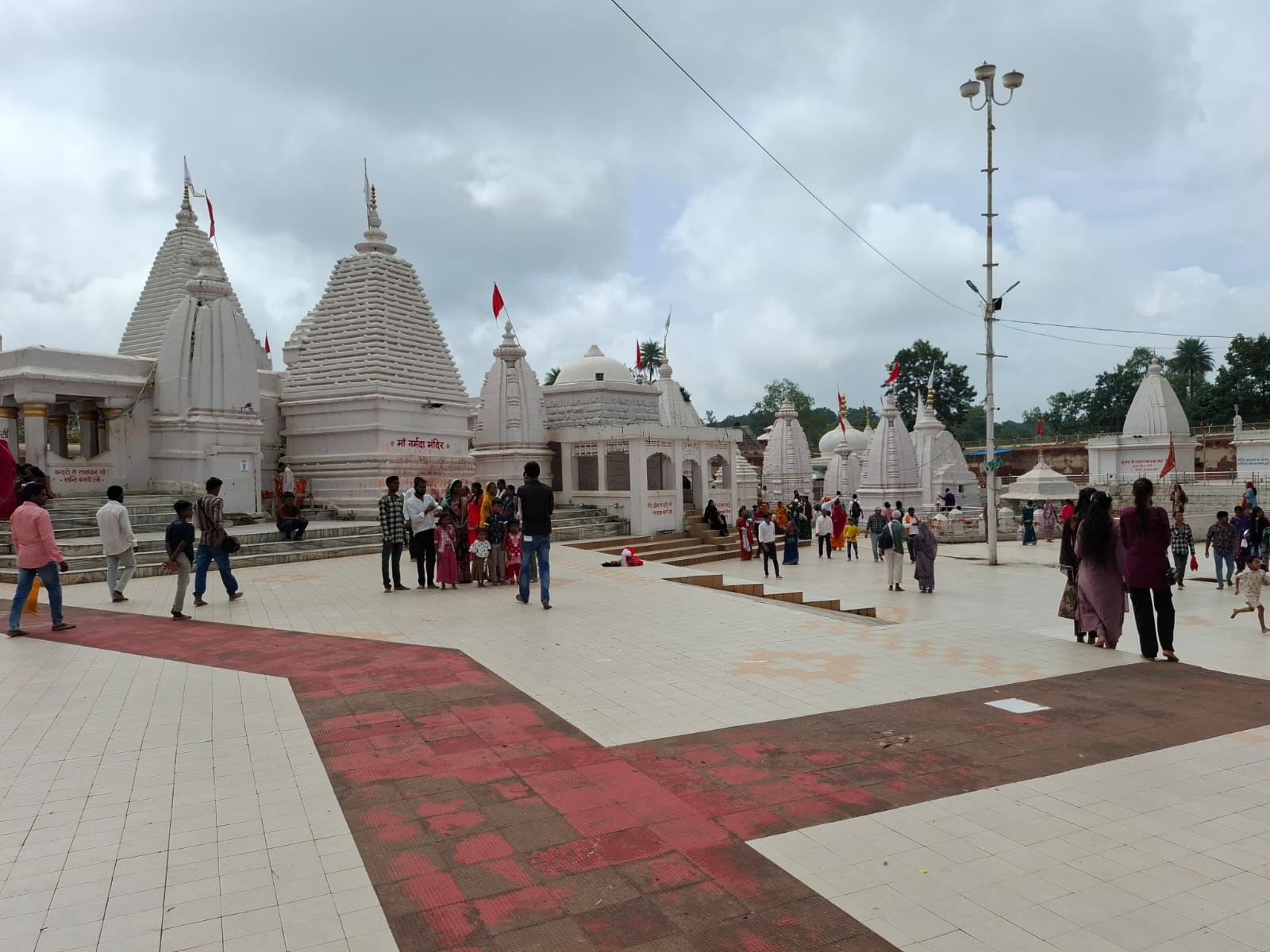
Narmada Kund is supposed to be the place (Udgam Sthal) from where it begins its journey, only to disappear and then emerge as a fast flowing river some kilometres ahead. There is a small temple at that exact place, surrounded by a water tank. There are many other temples of different Deities around the walled and gated complex. All temples have a white exterior. A ‘pujari’ sits in front of most of them waiting for the next faithful to give offerings and be anointed with a tika on the forehead. Nobody is in a rush, nobody pesters you, it is all very nice, unlike the horrible experience most of us have in the pilgrim towns of UP and the north. This, to me is the distinguishing feature of small towns of Madhya Pradesh.
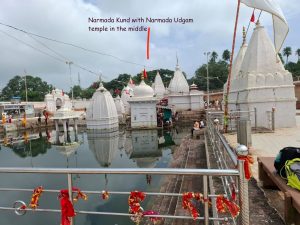
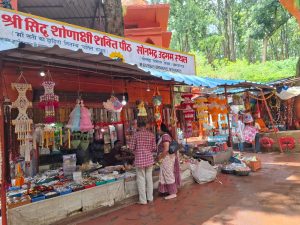
I was particularly touched by the honesty and simplicity of the person at the counter selling the ‘prasad’. I wanted to carry a small bottle of Narmada Jal, which, as per the board outside, was among the items on sale. The gentleman expressed his inability, stating that due to the monsoons and the rush of pilgrims a day back, the water in the Kund is dirty and will be sold only after the tanks are cleaned. Imagine that happening in Haridwar!
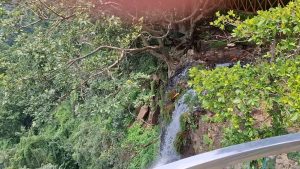
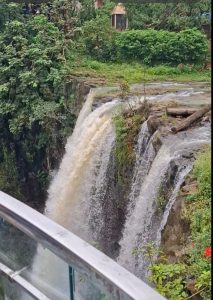
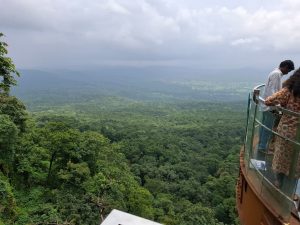
Kapildhara: A drive through thick forests takes one to Kapildhara – a waterfall, where the river plunges almost 100 feet down at great speed. The sage Kapil Muni is said to have meditated here. Unending green forests are a soothing sight, especially during the monsoon. Depending on time and interest, one can go down the hill or visit some of the small temples here.
And like the rest of the place, be watchful of the monkeys.
Sonmuda: The Sone River begins its journey here emerging from a small kund and then falling over 200 feet. The views are wonderful, and one needs to walk down couple of steps to the viewing point. If interested one can also watch the sunrise from here. And both these places have a small glass platform for better view of the waterfall. The charges are minimal and when I visited, apart from the usual photographer, there was a person offering drone view photography for Rs 400. Here, too, there are temples including the Sone udgam temple.
Amarkantak has been mentioned in the scriptures and visited by holy men since ancient times. Adi Shankaracharya was here, as was Kabir. Kalidasa is said to have mentioned it in his works. Temples built by the Kalchuri rulers are now ASI protected monuments. Rani Ahilyabai Holkar also did renovation works in the Narmada Kund complex. Since I last visited over 20 years ago, there are now more roads and ghats for the pilgrims. For those spending more than a day here, visit to other places in the vicinity is an option. Otherwise, just walk through the forest.
Narmada and Sone: Most of our rivers are feminine (nadi) but Sone is masculine (nad) – a rarity. And there lies the folklore with a common thread but slight variants. It is said that the beautiful Princess Narmada was the daughter of King Maikal of Amarkantak soon to be married to Prince Sonbhadra. She sent her companion Johilla to have a glimpse of the prince. Sonbhadra mistook Johilla to be Narmada and started living with her. On coming to know of this betrayal, the furious Narmada vowed to remain unmarried (kanya) for eternity and went off in a huff in the other direction to the west. Left to himself, the dejected Sonbhadra continued his journey to the east.
It is a geological fact that Narmada has never changed its course as it runs in a rift valley between the Vindhya and the Satpura Ranges. And while Narmada runs its full course to the sea, neither Johilla nor Sone complete their journeys – Johilla merging with Sone after flowing for 170 kms and Sone with the Ganga after 700 kms.
And as I rounded off my trip, I stopped to pick up a bottle of water. Its name? Amarkantak! Absolutely brilliant branding. Finding another one called Kapildhara, I picked that one too. Thus, apart from memories and photos, these now empty bottles that I brought back shall remain a unique souvenir of my visit to Amarkantak. ‘Narmade har’!
(Manoj Pande is a former Member of the Railway Board, who now resides in Dehradun.)