 By Dr Sanjeev Chopra
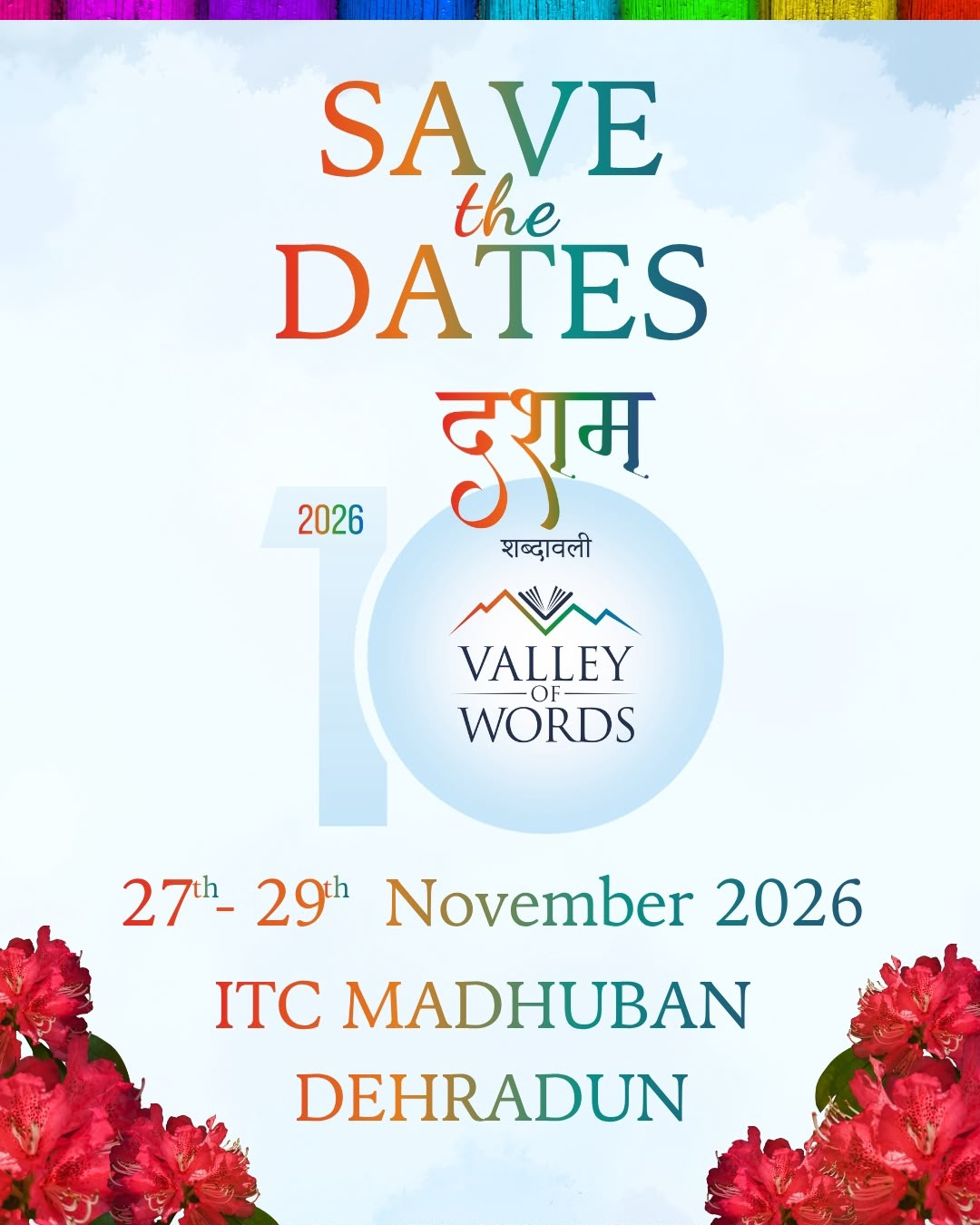
Individuals have a lifespan of a few decades, but when they can come together to ideate and create institutions with purposes larger than each of their own selves, they create a VoW moment — for themselves, and for the larger ecosystem around them. Thus it was ten summers ago, when some of us met in the lawns of Madhuban on the 12th day of March in 2017, to plan the first-ever literature and arts festival of Dehradun. Spring was in the air. We all felt that given the surfeit of established authors from the valley in all genres and all languages — Hindi and English, Urdu, Punjabi, Garhwali, Kumaoni and Jaunsari — why not invite them to these lawns and curate sessions around their works?
However, after the first round of chai and coffee, we veered to the view that we were not looking at a one-off event, but instead a platform in the present continuous. And a year-on-year offering cannot be from the same set of people. This was to be a festival for writers and their readers, critics, reviewers, and for interested onlookers! Should newer voices from across the country (and beyond to wherever our funds could permit) not be invited to our picturesque Valley? And should not the word encompass all forms of creative expressions from music to sculpture, dance and visual arts? There were many names, formats, suggestions, and thoughts before we settled on the “Valley of Words”— a wonderful name, and a unique acronym: VoW. Now we say VoW whenever there is something to feel excited about, when we are drawn to something… and this is what we have been trying from the first year of the Festival.
Let me also mention another fact about institutions. While they must retain their core, they cannot afford to be too rigid: or they fossilize. At the same time, if they meander well beyond their course, they lose track. So they must evolve by strengthening what has been done well even as they adapt their themes to feedback.
Therefore, let me first talk about our vision – non-adversarial conversations on the best of contemporary writings, inter-generational dialogues, volunteer-driven and a not-for-profit orientation. We aim to seek and support excellence in others, and to bring people back to books, stories and discourses on life itself.
With all this in mind, we sought ideas and opinions on whom to invite. We received a number of suggestions, including the fact that ours should not end up being just another elite English literature festival. Thus, from the first year itself, equal emphasis on sessions and Book Awards in Hindi Sahitya along with translations from Bhashas of Bharat into Hindi have been built into our curation. We also decided that we need to have dedicated sessions on ecology and environment: these we named after RS Tolia — a mentor to a generation of administrators, foresters, and researchers. Likewise, to honour and acknowledge the tradition of valour of Uttarakhand, we decided to have a dedicated vertical on Military History and Strategy.
As that was our first year, we sent out all the invites without knowing how many would accept. In fact, when the first invites were sent out, our website was still under construction – but the response was phenomenal. We realized that authors and artists were as excited as us to come to our Valley. We had over one hundred authors and discussants with eighty sessions over three days and four sessions running in parallel! The exhibition and cultural programmes too were a runaway success, but we were entirely exhausted and had also realized that we needed to structure the programme flow better in order to facilitate smoother conversations.
While there was a consensus that the first VoW Book Awards were conferred upon those who deserved them, the issues of a transparent nomination process and a more inclusive reach were raised. From the second year onwards, we started writing to publishers to nominate books published in the last calendar year, and set up a jury comprising scholars from the Valley to look at nominated books in the different categories. For the next two years, we tried to invite as many shortlisted authors as we could: this gave better structure to our sessions, and authors from different genres also got the opportunity to share their thoughts with one another outside of the session schedule, for discussions in the lawns and exhibition spaces are the real charm of a festival.
However, during the Covid year when physical jury meetings became difficult, it was decided that while the Secretariat could do the longlisting, the 10 selected books could be sent to the winners of the last year’s awards for careful reading to prepare the shortlist of 5 books per category. VBA-winning authors became the jurors for the next cycle of the VoW Book Award. Each longlisted book was thoroughly read and reviewed by the members of the Governing board as well, and finally based on the Jury’s recommendations, the announcement of the winner was made.
From 2020, we approached TBR to carry out a special edition of book reviews of our short-listed authors, and for the next four years this was brought out as a Collector’s item. From 2024, we have started bringing out our own publication named VoWels – which now carries interviews with the short-listed authors, reviews of our award-winning books and statements from our Board members.
My colleagues on the Board have discussed in these pages how we leveraged various challenges to our advantage: Covid pushed us to forge new partnerships which have helped us expand our demographics and geography, even as this has made our signature event more focused and engaged. I will not cover those aspects, except to say that without the ever-enthusiastic support from the Board, the confidence of the sponsors and the ebullience of our volunteers, we would not have achieved the milestones that we have in the last decade.
Each year, we get many suggestions, and this year one of the finest is the idea of a VoW Book Exchange. Through the column of VoWels, we encourage our readers to bring in their books – preferably with a note on what the book is about – and exchange with another book by another reader. Let knowledge grow from more to more, and thus be human life enriched — for this after all is the foundational idea behind the institution of the Valley of Words as enshrined by all the individuals who have contributed along the way.
Dr. Sanjeev Chopra is the curator of the Valley of Words : a pan India Literature and Arts festival based out of Dehradun. He is currently a Senior Fellow of Contemporary History at the Prime Ministers Memorial and Library and a Trustee of the Lal Bahadur Shastri Memorial . He is also on the Academic Council of the National Centre for Good Governance and the National Institute of Disaster Management . His recent books include The Great Conciliator: Lal Bahadur Shastri and the Transformation of India, and We the People of the States of Bharat : the making and remaking of India’s internal boundaries.