Around the World with the Most Travelled Indian
 By Nitin Gairola
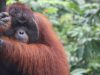
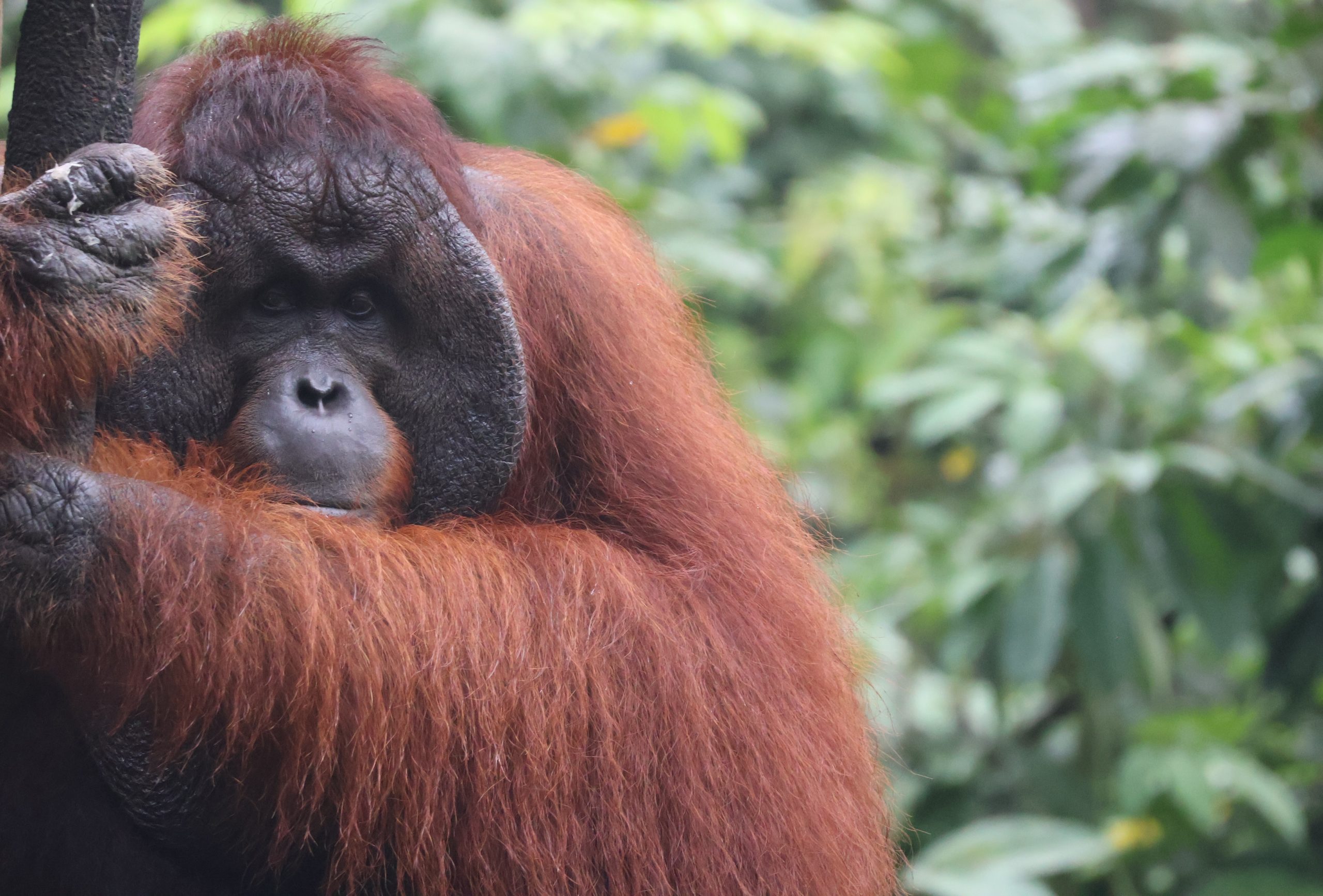
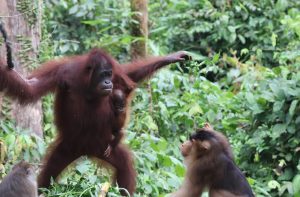
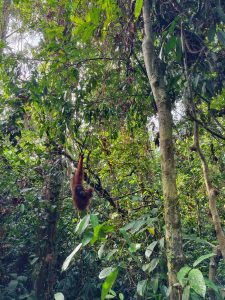
Before I draw the curtain on the Borneo series, I thought I should reflect on the incredible wildlife we witnessed on this equatorial island between the Asian landmass and the scattered big & small islands of Indonesia, one of which is Borneo itself. In fact, Borneo is shared unequally between 3 nations – Indonesia, Malaysia and Brunei and the first animal that comes to my mind when I think of either Borneo or Sumatra, is the mighty hairy great ape – the Orangutan. We saw the orangutans in the contained Sepilok Sanctuary and not in the pure wild of Sakau, but fortunately we were compensated when the only adult male in Sepilok paid us a visit that very evening when we had decided to go. We were told that witnessing this dominant male was a rare sight.
While Sepilok is actually a wild area, but as tourists we were only allowed to go to an open air – no barriers viewing platform which had the full wide view of the jungle ahead. But I must call out that the conservation staff there does lure the great apes and other primates with food, so that visitors get a guaranteed view of these incredible cousins of ours. In my case, while I knew we were to see a lot of female and adolescent orangutans in Sepilok, but I never imagined that I would see a large mature male, flanges and all. If you are into being awed by mega fauna (fancy word for large animals), then the male orangutan is something to behold, just as is the case with the huge silverback gorilla and the male lion with its mane. This gender rule doesn’t apply to all animals but it definitely does to orangutans, gorillas, lions, Siberian & Bengal tigers and Polar & Brown bears. The sheer size of these beasts is a sight to behold and a memory to keep.
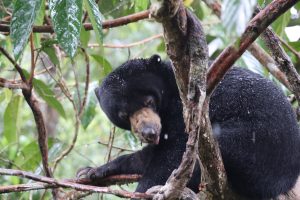
Another animal that you can only see from a viewing platform in Sepilok is the Sun Bear, the smallest of the 8 species of bears that include the Polar, the Brown Bear (Grizzly for Americans), the American Black Bear, the Spectacled Bear of Peru, the Giant Panda of China, the Asian Black Bear founds mostly in the Himalayas and the Sloth Bear that roams the tropical jungles of India. The Koala of Australia is naturally not a bear, rather a marsupial, even though it is funnily referred to as the ‘Koala Bear’. Strangely some people actually think it’s a type of bear but Australians have to accept that their continent doesn’t have one, and nor does Africa (too hot) or Antarctica (not too cold but pity it’s a bit too far for the Polar Bear to reach all the way from the north).
The Bornean Sun Bear is actually a tree climber, given its small size and since that we were high up on the metal canopy, we had an eye level view of the bear. But unlike the experience of watching orangutans in the dense jungle setting that is the backdrop in Sepilok, watching Sun Bears had a feel closer to that of a zoo than the wild and I would call the experience very underwhelming and disappointing. They had a reasonably large area to roam and to climb trees, but we humans had the vantage points connected by a metal walkway and it just didn’t feel right. As I said, prepare to be underwhelmed since finding sun bears in the true wild is nearly impossible, so this is your only choice if you want to see one. In a way, it is similar to viewing ‘wild’ Pandas in China who are also lured by food in what is the semi-wild. That’s the state of affairs today for certain charismatic species, so you can just imagine what’s happening to the lesser ones.
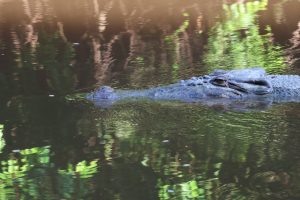
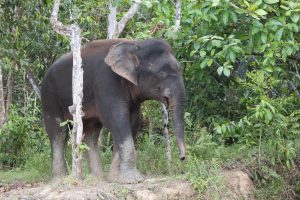
The 3rd big animal of Borneo is the pigmy elephant and along with the saltwater crocodile, sun bears and orangutans these 4 are the true mega fauna in this island. We saw quite a few pigmy elephants and saltwater crocodiles in the wild in Sakau, in their natural habitat and without any ‘viewing points’.
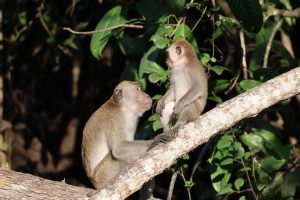
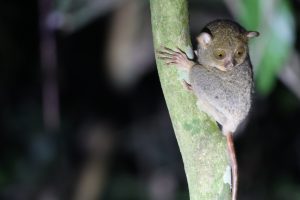
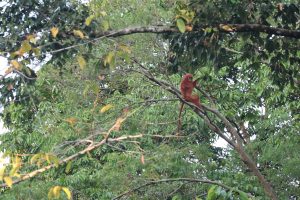
Besides this, Borneo has so many primates, monkeys in particular, and most of these are what are called ‘old world monkeys’. The prominent ones were the long-nosed Proboscis monkeys, the exotic looking Red-Leaf monkeys (maroon langurs) and the long-tailed and southern pig-tailed macaques. Never got to see the Bornean White Bearded Gibbons, but those are quite rare. Besides monkeys, we came face to face with the world’s second smallest primate – The Western Tarsier.
And then came the birds – and such colourful ones at that, as you would expect in an equatorial rainforest. Sakau has 8 species of hornbills itself – The Rhinoceros Hornbill, Oriental-Pied, White-Crowned, Helmeted, Bushy Crested, Asian Black, Wrinkled and the Wreathed Hornbill. These are naturally not their scientific names since otherwise it would be very difficult for amateurs like me to remember them. But we did have some experts on one of our boat rides, such as Doctor Prabha (who I had made a mention of earlier too). I would have loved to learn more about the birds of Borneo from her, as her knowledge was deep and her perspective wide. That’s a rare combination and it was a pleasure to cross paths with her.
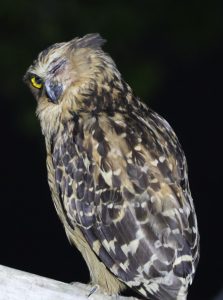
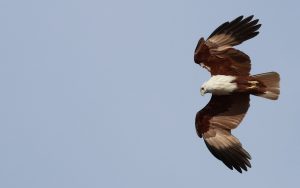
And the birds didn’t end with the hornbills, of which we saw 4 species. There were also birds of prey such as species of eagles, hawks, kites and owls and then there were the little ones like the kingfishers, the not-so-little storks and everything in between. Now I understand why ‘birding’ is a ‘thing’ and why Hollywood even made a movie on it – watch ‘The Big Year’.
The icing on the cake (if you will) were the creepy crawlies from the rainforest night walk and they just added another dimension to the visit although I must say that herpetofauna (reptiles & amphibians) are not on the top of my wildlife wish-list especially after whatever it was that bit me. But it was not as much a case of the Bornean bug getting me, but me getting the Bornean bug. I texted my friend and world traveller, Bernie, that this place is only second to Africa. He had visited Borneo a decade prior and replied ‘that’s saying a lot’. But he could relate to what I was trying to say. Borneo is special and I hope there is a second time. Until we meet again…
Nitin Gairola is an extreme world traveller who has been to every major desert & forest ecoregion on Earth and to around 150 countries & autonomous territories. He is unofficially known as the ‘most travelled Indian’ and this multi-decade exploration program to witness the entire world is named ‘Borderless Planet’. Nitin is a published travel writer & poet too. Join him @ www.instagram.com/MostTravelledIndian/