Nearly three centuries ago, a woman’s determination to protect trees inspired an extraordinary act of collective resistance. The Khejarli Movement remains a powerful reminder of the relationship between people, nature and communication.
By Yash, Prerna, Shivansh and Shibaan
under the guidance of Course Advisor, Science Communication, Dr Rashi Mishra
Long before environmental conservation became a global concern and social media turned ecological campaigns into public movements, a small village in Rajasthan witnessed an extraordinary act of courage. In September 1730, at Khejarli village, Amrita Devi Bishnoi stood against the felling of trees, setting in motion one of India’s most remarkable stories of community-led environmental protection. The incident was not merely a protest against the destruction of trees; it was an expression of a way of life in which protecting nature was inseparable from faith, culture and everyday existence.
The Bishnoi community, founded by Guru Jambheshwar (Guru Jambhoji) in 1485, follows 29 principles that emphasise compassion towards all living beings and the protection of nature. Two important teachings are Jeev Daya Palani (be compassionate towards all living beings) and Runkh Lilo Nahi Ghavo (do not cut green trees). For the Bishnois, trees and animals are not simply natural resources; they are integral to their beliefs and identity. This deep-rooted relationship with nature explains why the community responded strongly when royal officials arrived in Khejarli to obtain Khejri wood for construction work under Maharaja Abhai Singh of Marwar.
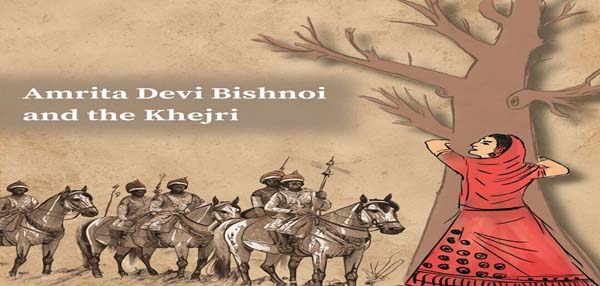
Refusing to let the trees be cut, Amrita Devi embraced a Khejri tree and sacrificed her life in its defence. Her three daughters stood beside her, and soon other members of the community joined the resistance. Historical accounts record that 363 Bishnois sacrificed their lives while protecting the trees. Amrita Devi’s sacrifice is remembered through the celebrated saying, “Sar santey rookh rahe, to bhi sasto jaan,” conveying that sacrificing one’s head to save a tree is a worthwhile bargain. Following the tragedy, Maharaja Abhai Singh is reported to have ordered an end to the felling of trees and the killing of wildlife in Bishnoi villages.
The Khejarli Movement also offers an interesting perspective from Media and Communication Studies. In 1730, without newspapers, television, radio or digital platforms, news of the resistance travelled from one village to another through oral communication and word of mouth. Community members became carriers of information, sharing what was happening and encouraging others to participate. In this sense, the community itself functioned as a communication network. People were not merely receivers of information; they were also its messengers and amplifiers. The movement demonstrates how shared beliefs, interpersonal communication and collective identity can transform a local incident into a wider community response.
The story travelled across generations through oral histories, folk narratives and spiritual teachings before reaching wider audiences through books, films and documentaries. Today, platforms such as Instagram and YouTube offer new ways of communicating its environmental message. Documentaries such as Saako 363 and Nature’s Martyrs: The Bishnois of Rajasthan also provide visual narratives of this remarkable legacy.
More than two centuries after Khejarli, the Chipko Movement emerged in the Himalayan region during the 1970s, when villagers, particularly women, embraced trees to resist commercial deforestation. The Khejarli sacrifice is widely remembered as a historical precursor and inspiration for Chipko. Both movements reflect a remarkable continuity in India’s environmental consciousness and demonstrate how women’s leadership and collective resistance can protect nature. The Government of India also instituted the Amrita Devi Bishnoi Wildlife Protection Award to recognise contributions to wildlife conservation.
Nearly 300 years later, Khejarli’s message remains unmistakable: when people unite to protect nature, one courageous voice can become the voice of an entire community and inspire generations to come. Historical accounts often draw a connection between the Khejarli sacrifice and the Chipko Movement of the 1970s, suggesting that Amrita Devi Bishnoi’s legacy inspired later environmental resistance in Uttarakhand.