 By Ganesh Saili
Our two cemeteries – the dominions of silence – one on Camel’s Back Road and the other above the Upper Mall, are still in pretty good shape, considering they have witnessed two hundred monsoons. This is where I met Ranjeet, the chowkidar, whose Rastafarian dreadlocks would spook any intruder. Many years ago, he, too crossed the Golden Bridge. But by then, he seemed to have taken the road less travelled by. On these bumpy, unpaved roads, converse denied with the departed, he had, over the years, perfected the art of talking back to his transistorised radio.
It went something like this: ‘This is All India Radio. The news, read by Devki Nandan Pandey!’
‘Yes! Yes! Tell me more!’ he said, gruffly. His Franciscan dialogues with the ether continued to the end of his days. He was the only one who could talk to the snow on his second-hand black and white television screen.
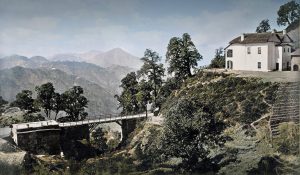
Looking back, I wish I could get some of the warmth of my father’s hand holding mine down the road that began from the now over-crowded Char Dukan, went past Childer’s Lodge; and on beyond the Cemetery before depositing us at the Language School.
This tradition of boarding houses dates to the 1900s when three bungalows were given licenses to operate as guesthouses. You had Rokeby, a three-minute short walk from Char Dukan; Fairview, six minutes, and sprawling Wolfsburn, barely four–minutes away.
These outings on the Upper Mall, or Western Circular Road, were very special to me. Years later, one walk stands out in the diminishing corridors of memory – Father and I would arrive at the five-acre spread of Wolfsburn, with its Doric pillared veranda wrapped around it, under the shade of a thatched roof and a large horse chestnut tree. This was home to Mrs. Edith Walsh, the last survivor of an Anglo-Indian family that had been in India for two hundred years or more. Quietly, without fuss, as was her wont, she would slip a stick of barley sugar into my hand.
God bless her soul! It left me with a permanent sweet tooth.
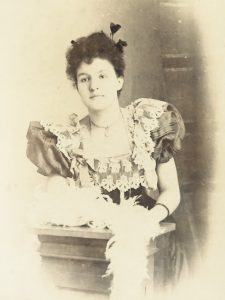
Luckily, while the going was good, she learnt the ropes of running a guesthouse from her husband. Their only child, Peter, left the station searching for greener pastures; he settled in New Zealand and never returned. Bravely, she learnt to fend for herself, even after a stroke left her like a crumpled bird to be carried around in a sedan chair by household help. Outside the store, under the chestnut tree, to this day, I can still hear her rattling off the list of provisions for the day: ‘Ek chattank dhania! Thora sa haldi! Thora namak! Adha seer chawal!’
In winter, she moved into a rented house in Dehradun’s Chukhuwala. Houses like Wolfsburn were left to the ministrations of Kalyan Singh, her faithful chowkidar. Regular as the seasons, this arrangement lasted until, on a cold winter’s night, aged ninety, without fuss, she left for the Land of Eternal Rainbows.
Or so we believed, until one night, the chowkidar, crumpled, dishevelled, pale as a sheet, almost knocked down our door.
“Saili Saab! Saili Saab!” the words tumbled out of his mouth, sloshing and bumping into one another in a haste to get spoken. Breathlessly, he stammered: “She’s back! It’s March and Walsh Memsaab has returned. She kept me awake all night, rattling the chain on the outhouse, screaming: ‘Kalyan Singh darwaja kholo! Kalyan Singh darwaja kholo!”
Poor man! We never saw him again. Kalyan Singh left the next morning for the safety of his mountain home, breathing fear instead of air, and vanished into the hills.
Wolfsburn was ripped apart. Out came the doors and windows, pried loose. The ruins were palmed off to an unsuspecting Professor Uniyal, who had retired from a teaching assignment in Ethiopia, who restored whatever little he could before they acquired it. You can still see the ruins telling a sorry saga of neglect. The more things change, the more they remain the same.
What lasts? Only the warmth of my father’s sandpapery hand holding mine as we walked down that road of memory.
Ganesh Saili, born and home-grown in the hills, belongs to those select few whose words are illustrated by their pictures. Author of two dozen books; some translated into twenty languages, his work has found recognition worldwide.