All Around the World with the Most Travelled Indian
 By Nitin Gairola
All through my growing years, ‘Afghanistan’ was always something to be feared and somehow this country was always in the news for all the wrong reasons. Why did this happen? Well it did because I am from the 80s and unfortunately it was only till 1978 that Afghanistan was a peaceful nation, most of the time under the rule of King Zahir Shah (from 1933-1973). In fact Afghanistan was so peaceful that it was part of the so-called ‘hippy trail’ for backpackers. Lonely Planet founders, Tony & Maureen Wheeler themselves passed through Afghanistan in 1972 during their epic expedition from England to Australia (from which came the first Lonely Planet guidebook a year later).

The Soviet-Afghan war broke out in 1978 (as kids our only understanding of it was via Rambo III) and it went on until 1989, a few years before Soviet U.S.S.R. itself broke up. It’s for no small reason that Afghanistan is called the ‘graveyard of empires’ as almost all those who tried to conquer this land ended up losing more than just Afghanistan. They lost their own empires – think Alexander the Great, the weakened British Empire and the recent exit of USA (which however is doing just fine right now). Just that USA had to exit a bit weaker too and without coming close to meeting their initial objectives.

We also know that at the turn of this century, the 9/11 disaster happened in NYC and again Afghanistan was back in the TV news. This was followed by the actual US ground invasion a month later in October 2001. So all in all there has been a lot of Afghan coverage over the last four decades and as we know, telly news is always about dramatic national level events from around the world. In fact just now the TV is telecasting disturbing scenes from the Pakistan – Afghanistan skirmishes, so this country does conjure visions of conflict.

Well during our visit to this part of the world just over a month back, we saw northern Afghanistan, an area called the Wakhan Corridor. It is a thin strip of historic land connecting Afghanistan with western China. The north of the corridor is the Gorno-Badakhshan autonomous region and the south is the Badakhshan province of Afghanistan and also the Khyber Pakhtunkhwa region of Pakistan. It is here in the Badakhshan region that we saw and met very kind everyday people living everyday stories and lives. And believe it or not, they understand Hindi a bit too. This is in part because of the strong links between Dari (prominent language in Afghanistan) and Urdu & Hindi and also in large part because of Bollywood movies and songs. So much so that I had a proper two-way conversation with few Afghan youths back in Dushanbe. One of them, Abid, spoke of the challenges of living in Kabul now and the fact that it was nearly impossible for him and his friends to get a work visa of a developed country. Naturally he spoke of Shah Rukh Khan, Salman Khan, Akshay Kumar and Bollywood in general and had seen SRK’s ‘Dunki’ too (and lived it as well, if you get my drift)

But why did I go to this place? For starters, when you are driven to see the entire natural world (i.e. every desert, every forest, every grassland, every tundra region) and also to see the entire political world (of every country on Earth), then you can’t cherry pick your destinations. Some are really safe and some not so much. Our recent trip to the Pamirs would not rank very high on the safety index as per me but it wasn’t as dangerous as it sounds either. While Gorno-Badakhshan is coloured a deep red in all government travel advisory maps (US, UK, Canada & Australian government sites seem to press the panic button very easily), our actual experience on the ground was quite all right. That being said we did have to go through a lot of security and permit check points, we were asked for bribes, we did drive in pitch dark on non-existent mountain roads and we had the unnerving sight of seeing soldiers with guns every 20 odd kilometers on the very long Tajikistan-Afghanistan border (almost 1,400 kilometers long). So I am not too sure if I should recommend this place or not since it was stunningly beautiful but had its own unique challenges and it may not find favour with some travellers.

The other reason for my fascination with Tajikistan and Afghanistan is that in 2013 I saw a Hollywood movie called ‘The Secret Life of Walter Mitty’ and it was very relatable for me at that time. In this funny yet inspiring movie, the protagonist (i.e. Walter) is a normal man in a normal corporate job but like many he used to day dream of grand adventures into the unknown. However Walter always had rude wakes up calls in his office cubicle or ‘corridor’ but then one day he just decides to take the plunge and leaves on an adventure to Greenland and Iceland. I went to these exact 2 places in 2017 but Afghanistan was missing since that was Walter’s 3rd big adventure – that too in its high mountains.

So you can imagine the excitement when Richa and I saw the Afghanistan sign board on the road. Right across the Panj River (extension of the Amu Darya) was Afghanistan and here we were jumping in front of a name feared by most, even in the extreme travel community. We could see a rusty red bridge that would take us across the border but it was not the one to take (closed due to security reasons). So Anzur, our ace driver for the Pamirs tour, then took us further on down the long road into the Corridor. After our full day ride from Dushanbe to Khorog and post spending a day in the town, we were on our way to Ishkashim (or Eshkashem).
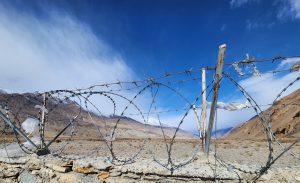
All through these two long drives, we had Afghanistan on our right side, like literally a stone’s throw away. There were no fences in between – just the river, and even that was dried up in some parts making it all the more concerning. Because of this we saw lots of soldiers with guns, patrolling the area and this was a bit unnerving at first. In any case we really enjoyed the ride and the stunning autumn beauty as we waved at Afghans right across the road. We saw so many people living in small communities overlooking the Amu Darya and it was pure elation to connect this way with the people of a nation that is considered very dangerous. I firmly believe that most people around the world are kind and don’t mean any harm but the country they live in force some to make hasty judgments and form perceptions. Abid, the Afghan youth I met, put it really simply. He said ‘it feels so good when I speak with people from India or Pakistan since all look and think just like me’.

So it was late in the night when we all reached Ishkashim. There we met Faromuz and we stayed at his place for the night (Anzur had all the contacts of this town). Next morning we were up early and had a nice morning walk and a stimulating conversation with Faromuz, who is a very learned man. Later that morning we officially entered Afghanistan via the land border. While we felt we had seen Afghanistan for 2 full days during our journey on the Wakhan Corridor, this time we were well and truly on their soil. We went to a border market and met with a lot of traders who were selling everything from kitchen wares to clothes, perfumes, vegetables and what not. I couldn’t resist being sold their recognizable rolled-up cap called Pakol, which is a symbol of identify for the Afghans. I also had some succulent kebabs and their black tea and managed some brief conversations with the people at the market. While few may have spoken nicely with us to sell their wares, we felt some genuine warmth in the people too. I gathered they hadn’t seen an Indian in some time.

One thing we couldn’t do was get our photographs taken with the guards since that was a big no-no in these parts. We had a funny incident when I went to a guard asking for a photograph and he thought I was asking for a cigarette (it was a cold morning in November after all). He looked a bit bemused when he offered a cigarette which I refused saying that I don’t smoke. Richa even wanted a photograph with the ‘Welcome to Afghanistan’ board which was promptly refused by the security. He had a slightly shocked expression on his face but it was followed by a smile (‘shock & smile’ is better than ‘shock & awe’, if you know what I mean). And with that we were ready for our next destination in the Wakhan.
So this was supposed to be a place in turmoil post the exit of US troops in 2021 but we did manage to see a more peaceful side of the country, albeit in the far northern corner of it (so it may not be representative of the state of the nation). But it is experiences and interactions such as those in Ishkashim which is the reason why we travel. Somehow travel just reaffirms the faith in humanity and the goodness of people no matter how they are portrayed or spoken of. If there is one good thing that comes out of travel, it is that it shatters your preconceived notions and reduces your general cynicism and negativity about the world. I couldn’t think of a better way to start 2025 than with this message. A wise man (not sure who) once said that ‘in the initial days of travel we seek the unique & different but later start to notice the similarities’. I tend to agree with this.
Nitin Gairola is from Dehradun and has travelled the natural world more than almost any Indian ever. He has set world travel records certified by India Book of Records, has written for Lonely Planet, and holds National Geographic conservation certifications. He is also a senior corporate executive in an MNC and in his early days, used to be a published poet as well. More than anything else, he loves his Himalayan home. Reach him at: www.facebook.com/MostTravelledIndian/ ; www.instagram.com/MostTravelled_Indian/; nitin.gairola@gmail.com