All Around the World with the Most Travelled Indian
 By NITIN GAIROLA
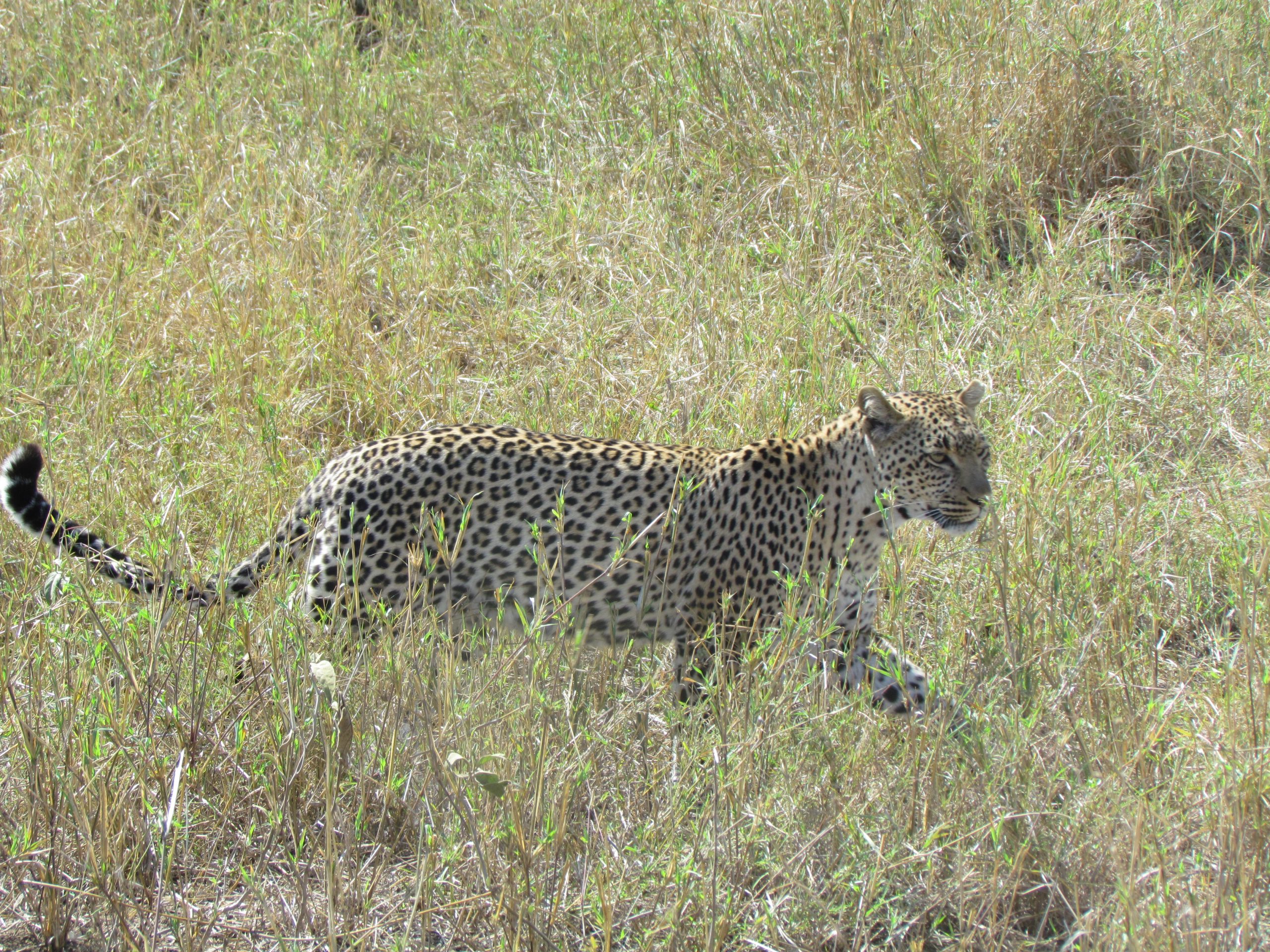
The Lion, as iconic as it is, is not the only big cat of Africa, as this land also has the stealthy Leopard, the superfast Cheetah and the medium sized Caracal, Serval and even the rare African Golden Cat. I have had the good fortune to see and photograph all these beautiful beasts in the wild (baring the Golden Cat that lives in western & central Africa) and I have been particularly lucky with lions and leopards of East & South Africa, not so much with the other four. My major cat regret so far is not to see a cheetah in full speed chasing its prey, since I have only seen them feed on one thus far.
I have also viewed both lions and leopards stalk, hunt, eat, socialise and sleep from very close quarters – sometimes too close. This feature is about my close-up views of the leopard, which is one of the ‘Big 5’ of Africa, i.e., one of the 5 African animals that were considered the hardest to hunt in those (thankfully) bygone hunting days. Today, it’s just a difficult animal to ‘shoot’ and ‘capture’ on camera. Like millions, I also like the idea of Safari Tourist’s Big 5 rather than the Safari Hunter’s Big 5 and these Big 5 of Africa are – The Elephant, Lion, Leopard, Rhinoceros and Cafe Buffalo.
So, after writing about Elephants and Lions previously, this feature is all about Leopards. I had this one leopard incident in 2016 in Uganda’s Queen Elizabeth National Park that got us scared out of our wits. We had made an impulsive decision to head to this park on our independent long tour of Central Africa (not very wise) and upon reaching there, we were told that all the camps had been booked already, as we had arrived in the peak season (not like our tiger safari peak season since we didn’t encounter that many tourists). So, the jeep driver found us a rundown dormitory just outside the park limits and the place was absolutely empty and unoccupied (not surprisingly considering its condition). We thought at least we would get some sleep here and would wake up fresh for our morning game drives in the park.
So, the night fell and we slept, quite tired from our journey the previous day. But then around 2 in the morning, I heard a low growl coming from right outside our bedroom window. While I was excited, I soon realised that one of the three tall vertical windows had its glass pane missing and the same window didn’t have 2 out of its 3 vertical iron bars either. The other two windows were intact, at least that’s what I could recollect. I wasn’t sure if there was enough space for a leopard to get in from the broken window, but I didn’t dare go near it to find out. To make matters worse, I couldn’t recall if the main door to the hallway (within which all the dormitory rooms were) had a latch or not. This meant that we couldn’t even go out of our bedroom and into the hall and so were royally trapped. I however did think of running to the common bathroom, again outside our room, as the last resort. But the risk in that would be getting caught by the feline in the same hallway that led to the bathroom.
This surely was the scariest night of my life and I didn’t get much sleep after 2 a.m. and, later, Richa had also woken up. And when I told her about the situation we were in, she couldn’t sleep either. We stationed ourselves near the door of the bedroom, so that if the cat found its way from the window, we would rush to the bathroom across the hall, and if it came from the hallway itself, we would keep ourselves locked in the bedroom.
It was only by around 5 in the morning that the dawn was breaking, the growling had died down and we were breathing again (yes, it was much more than just breathing a sigh of relief). After 3 long hours, I knew we were safe then and I can’t tell you how happy we felt when we heard the sound of the jeep rolling in. Once outside, I did examine the window and saw the missing pane & bars and felt that a medium sized leopard may have squeezed in, since it’s a cat after all. We considered this a narrow escape and we got ‘leopard lucky’, but not in the way we would have wanted. Ironically in that morning game drive, we saw a huge pride of lionesses not too far away, but not a single leopard. This was one leopard ‘sighting’ for our ears and fears only.
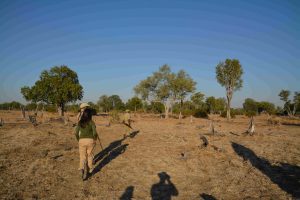
grasslands is not for the faint of heart
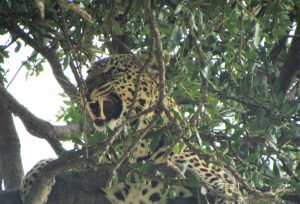
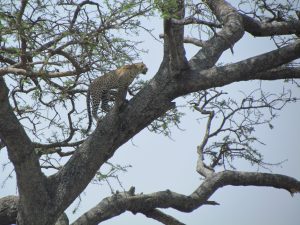
The leopard holds a special place in our hearts since during our first ever African safari in 2012, on the very first evening in the Masai Mara in Kenya, we somehow got a sign that we were going to be ‘leopard lucky’ in this life. Within an hour into that evening safari, we saw this feline atop a tree, growling and glaring down on our jeep and displaying all its imposing canines. I got some amazing photographs which I felt captured the intensity of this beast, and then saw the cat come down the tree in less than a second before it got camouflaged in the Savannah. It made me realise the speed and stealth of these predators and how they were designed for primarily just one thing – which is to hunt. I am glad I wasn’t on foot.
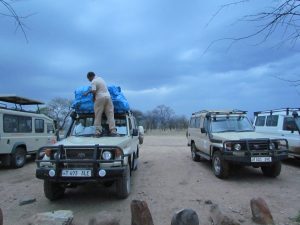
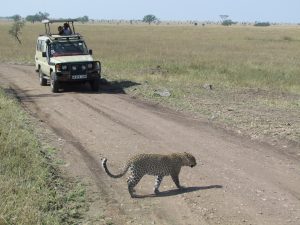
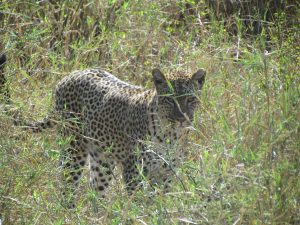
Later, the endless plains of the Serengeti in Tanzania turned out to be a leopard paradise for us too. We got so many sightings that even our guide was a bit taken aback. We saw a leopard dragging its kill onto a tree, another gracefully coming down a branch and one that passed us right in front of our jeep (and our eyes) in broad daylight. All this was captured by my camera, of course.
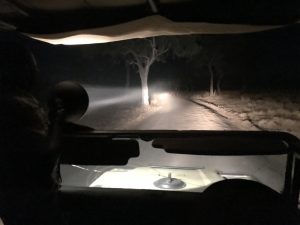
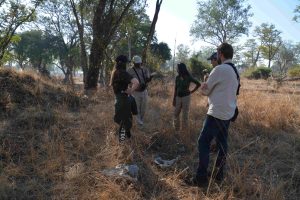
Years later we had gone to South Luangwa National Park in Zambia, which is famous for its leopard sightings. There, we did night safari drives and walking tours as well, with Zambia being one of the few countries that allow such amazing alternate safaris. The park lived up to its reputation and we had no less than 4 leopard encounters during our 5 days and nights in South Luangwa. Having said that, we somehow felt that the leopard sightings in East Africa took the cake due to the unobstructed grassland views there. As amazing as they are, forest & woodland trees do come in the way of wildlife viewing, and I suppose that is the advantage of the endless grasslands of Kenya or Tanzania, the top wildlife destinations for those doing their ‘one big safari’. But yes, I have to give it to Zimbabwe, Zambia and in particular South Luangwa for their walking safari, where we walked into the wild with a guide and a guard with a gun, in our search for wildlife. We didn’t see a leopard during that particular walk, but saw its fresh kill (the guide identified it as a very recent leopard kill since the prey was perched atop a tree and the same tree had claw marks). I sure am glad we didn’t meet that leopard when we were on foot.
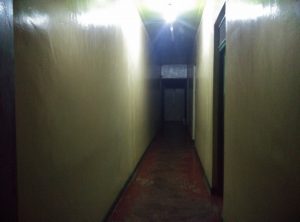
we were alone and heard the leopard
So, as you can see, I am totally in awe of this magnificent and mysterious feline and also happy that our own national parks in India are the homes of many such leopards as well, including the iconic and elusive ‘black panthers’ in Nagarhole National Park, which are actually not a different species but simply the outcome of a skin pigmentation disorder. It is quite similar to the case of the ‘white tigers’, which are also not a species in itself, contrary to what some think.
Speaking of species, the leopard has truly only 1 species around the world (Panthera Pardus) but taxidermists and naturalists do like to classify them into 9 sub-species based on where they are found. These are the African Leopard, Indian Leopard, Sri Lankan Leopard, Arabian Leopard, Persian Leopard, Javan Leopard, Indochinese Leopard, North Chinese Leopard and finally the Amur Leopard of Eastern Siberia. The most populous of these sub-species is the African Leopard followed by the Indian (over 100,000 and 14,000 individuals respectively), and this also reflects the work done in these parts of the world to promote wildlife tourism and to thus indirectly protect these cats and all other fauna and flora.
The rarest of rare leopard is the Amur Leopard with just 100 individuals, followed by the Arabian Leopard at 200 and the Javan at 600. Even the Sri Lankan and Persian ones are at less than 1,000 individuals but better to have this cat considered as rare, rather than not there. It is a joy to view it in the wild as it is to view any animal in its natural habitat. Just know that, unlike the lion, the leopard is a solitary cat that hides if it can. The deep jungles give it a lot of room to hide but the open savannah grasslands don’t. That’s why the East and Southern African belt is the true land of the leopards.
(Nitin Gairola, often considered the most travelled Indian, is a ‘Natural World’ traveller from Dehradun. Inspired by Sir David Attenborough, he is near his quest to become the first person to travel to the entire natural world of every major desert, forest, grassland, tundra & ice ecosystem or biome on Earth, besides every major country. This multi-year project is called ‘Borderless Biomes’ and Nitin has also set world travel records certified by India Book of Records, has written for Lonely Planet, holds National Geographic conservation certifications, studies biogeography and is a senior corporate executive in an MNC. In his early days, he used to be a published poet as well. Join him @ www.instagram.com/ MostTravelledIndian/)