Book Review
 By Yasmin Rahul Bakshi
———–
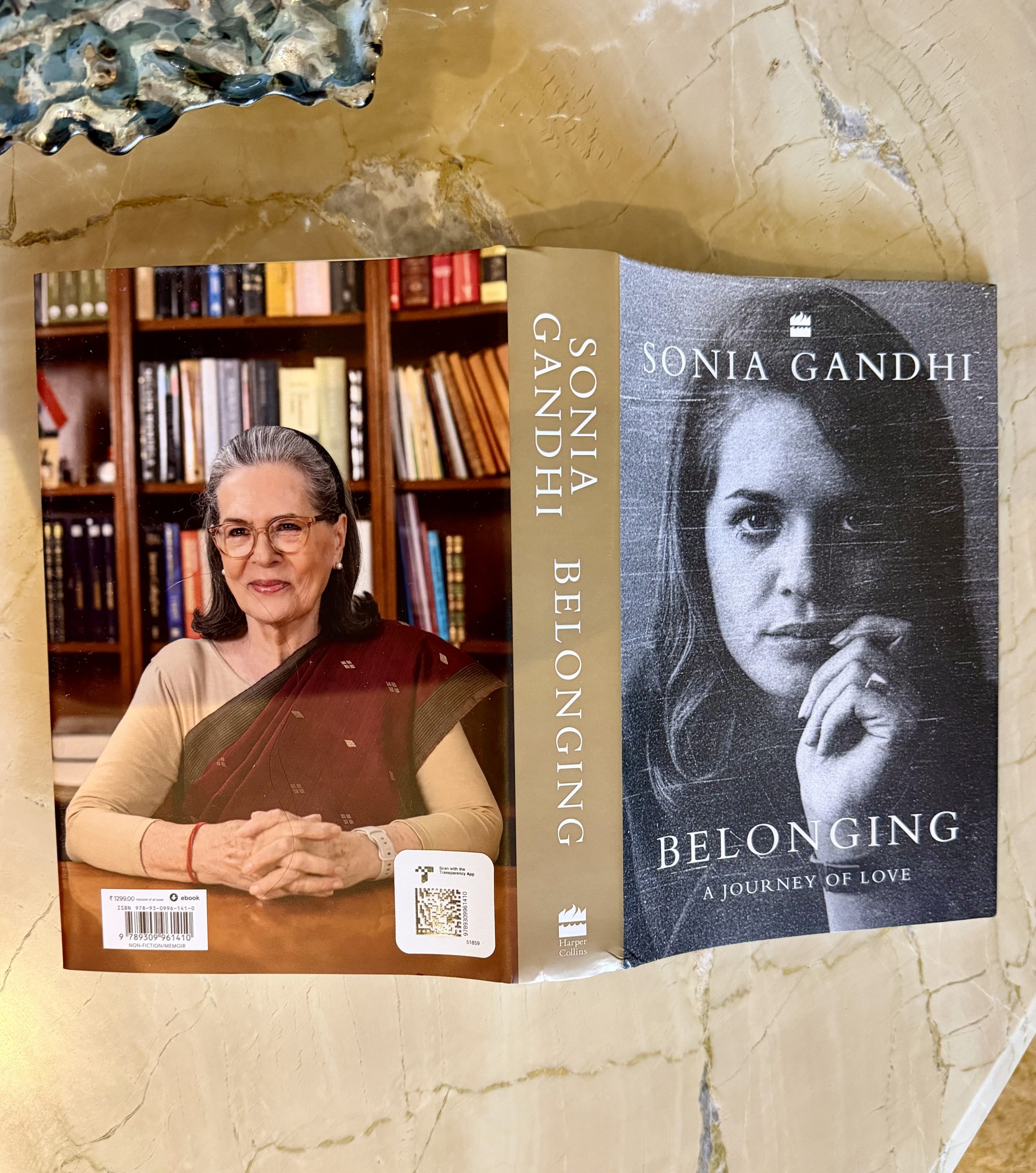
‘Belonging: A Journey of Love’ by Sonia Gandhi
————–
Some lives begin like a fairy tale, with little indication of what lies ahead. Sonia Gandhi’s is one of them. A young Italian woman meets an Indian student in Cambridge, falls in love and marries into a family whose name is already woven into the history of a nation. What follows is a life she could scarcely have imagined, marked by extraordinary circumstances, heartbreaking losses and the constant presence of politics.
What I found particularly endearing was how ordinary those early years seemed. Her childhood in Italy was far removed from the world of privilege and power she would eventually enter. There was a strict father, a mother who held the family together and the familiar routines of a modest household. Then came Cambridge and Rajiv, a young man who would become a commercial pilot and had little inclination towards politics.
There is something lovely about those recollections. Two young people falling in love, making plans for their future and knowing nothing of what fate had in store for them.
Then came India, and with it an entirely different world.
Adjusting to a new country is never quite as simple as falling in love with someone who belongs to it. There were unfamiliar customs, food habits, family expectations and a household where politics was never very far from the dining table. Sonia makes no secret of the difficulties she experienced in those early years. She was homesick at times, uncertain of herself and conscious of how much she had to learn.
I rather enjoyed these passages. There is an appealing honesty in her description of those adjustments, including the little domestic irritations that are so much a part of settling into another family. For all the grandeur associated with the Gandhi household, some of its everyday moments were surprisingly familiar.
Her relationship with Indira Gandhi is another interesting aspect of the memoir. We have read so much about Indira the Prime Minister that it is refreshing to encounter her as a mother-in-law. Sonia remembers a woman who could be affectionate, demanding, impatient and vulnerable. Their relationship developed over time, as relationships within families generally do.
I found myself drawn to this more personal portrait. It is easier to understand historical figures when we are occasionally allowed to see them away from the podium, with their ordinary habits and imperfections intact.
The memoir takes a painful turn when Sonia writes about losing her first child, a baby boy born prematurely who survived only a few hours. It was a sorrow she had kept largely away from public knowledge for decades. There is nothing theatrical about the way she recalls it, which makes the account all the more affecting.
Then came the assassinations of Indira Gandhi and, seven years later, Rajiv Gandhi.
The country remembers these events as moments of enormous political consequence. Sonia remembers them as the loss of two people around whom much of her life revolved.
Indira was the woman with whom she had shared a home for years. Rajiv was the young man she had fallen in love with, married and expected to grow old beside. Their deaths changed the course of Indian politics, but for Sonia they also brought an abrupt end to the family life she had known.
It is difficult to read these chapters without thinking about the peculiar cruelty of having to endure personal grief in public. There was little opportunity to withdraw from the world when the world was watching every expression, every movement and every decision.
The political chapters are interesting for a different reason. Here, Sonia revisits events that continue to trouble India’s collective memory, including the Emergency, Operation Blue Star and the anti-Sikh violence of 1984.
I found myself questioning her account at several points.
She acknowledges that the Emergency was a mistake and recalls differences within the family over its imposition. Yet I would have liked her to go further. The suspension of democratic freedoms and the excesses committed during that period deserve more than an explanation of the circumstances in which decisions were taken. I wanted a clearer examination of responsibility.
The discussion of 1984 left me with similar feelings. Sonia writes about the brutality of the violence, the suffering of Sikh families and the long struggle for justice. She also recalls the fear and uncertainty within her own household following Indira Gandhi’s assassination.
Her memories are valuable, particularly because she was so close to those at the centre of events. But proximity also has its limitations. Affection and loyalty inevitably influence how we remember people we love. While reading these passages, I kept wishing she would move a little further away from the family’s perspective and examine the political failures more searchingly.
There is no denying the terrible circumstances in which she found herself, but the suffering beyond the Gandhi household was immense. The families who lost loved ones in the violence deserve an equally uncompromising place in any account of those days.
And yet, some of the most affecting political passages are those in which she recalls meeting ordinary people who had suffered during communal violence. The injured, the bereaved and those searching desperately for missing family members appear far removed from the language of political debate. Such encounters seem to have left a lasting impression on her.
I appreciated these moments because they reminded me that the consequences of political decisions are rarely confined to those who make them.
The memoir also revisits other difficult chapters in India’s political history, touching upon questions of secularism, communal harmony and the changing political climate. Sonia’s views are naturally shaped by her own convictions and her long association with the Congress. Readers will not necessarily agree with her conclusions, but they do offer an insight into how she understands the events she witnessed.
Her decision not to become Prime Minister in 2004 is another significant part of the book.
I remember the uncertainty surrounding that moment, when the Congress-led alliance had won the election and Sonia was widely expected to assume office. She recalls the fears expressed by Rahul and Priyanka, who had already lost their grandmother and father to political violence and were understandably anxious about their mother’s safety.
Reading her account brings a personal dimension to a decision that has been analysed politically for years. She eventually supported Manmohan Singh for the position.
There will always be differing opinions about that decision and the political arrangement that followed. Nevertheless, understanding the anxieties within her family helps explain why the choice was far from straightforward.
For me, however, the most compelling part of Belonging lies in its title.
Sonia Gandhi has spent much of her public life facing questions about her Italian origins. Her identity, her loyalties and her place in Indian politics have all been subjects of debate. Yet belonging is a far more complicated matter than birthplace alone.
She came to India as a young bride, leaving behind the familiarity of her childhood. She learnt to live within a different culture, raised her children here and gradually built a life that was entirely her own.
After Rajiv’s assassination, she could have returned to Italy. Indeed, her family had reasons to worry about her safety. Returning to the country of her birth might have offered some distance from the grief and political pressures that surrounded her.
But by then, what exactly would returning home have meant?
India was where she had married, become a mother and spent the greater part of her adult life. It was also where she had experienced her deepest sorrows. Her memories, relationships and responsibilities were rooted here.
I think this is where the memoir makes its strongest impression. A country becomes home gradually, sometimes without our even noticing. Through ordinary routines, familiar faces, family celebrations and shared experiences, it becomes part of who we are. And when sorrow enters that life, the attachment can become even more difficult to explain.
That does not mean the book is without shortcomings.
There were occasions when I wished Sonia had been less guarded, particularly when discussing political controversies and decisions involving people close to her. The personal chapters are often remarkably candid, while the political ones sometimes seem more carefully measured. Having chosen to tell her story, she might have allowed herself greater freedom to confront uncomfortable questions.
Perhaps that reserve is simply part of her nature. She has never been someone who readily shares her private thoughts, and even in a memoir, there are boundaries she appears reluctant to cross.
Still, I finished the book with a greater understanding of the woman behind the public image. Not because I agreed with every political interpretation, but because the personal story is far more complicated and moving than the familiar headlines suggest.
There is much to admire in the resilience with which she has faced extraordinary circumstances. There is also something deeply human about her attempts to protect her family, preserve her privacy and find her place in a country that has both embraced and questioned her.
Belonging is an engaging memoir, especially when Sonia allows her personal memories to speak without the weight of political explanation. It is not a definitive account of the events that shaped modern India, nor does it answer every difficult question about the Nehru-Gandhi family’s political legacy. But it offers a perspective that few others could provide.
What began as a young woman’s love story became a life of responsibilities she had never anticipated and losses no one should have to endure.
She came to India for love. She stayed even after that love had cost her so much.
Somewhere along the way, a foreign land became home.