Pleasant Recollection of the Past
 By Arun Kumar Singhal
Since the formation of the new state of Uttarakhand in 2000, Dehradun, situated in the hill region of northern India, has had the honour of serving as the state capital. Despite the inevitable developments, one significant advantage for Doonites is the close proximity to state governance.
What prompted me to write this piece is the rediscovery of an old incident, brought to light by documents I recently uncovered. As pleasant memories resurfaced, I felt compelled to share them with all humility.
Since its inception, Uttarakhand has been led by several eminent personalities as Governors. While each has made significant contributions to the state, one stands out for his unique qualities. I am referring to the late Dr Aziz Qureshi, who served as the Governor of Uttarakhand from 2012 to 2015 and also held the governorships of Uttar Pradesh and Mizoram at different times.
Dr Qureshi was not only a respected politician, social worker, lawyer, and educationist but also a true gentleman. His academic credentials were exceptional. While his list of political and social achievements is extensive, what truly set him apart was his humanitarian and people-centric approach.
This piece, however, focuses on Dr Qureshi’s intellectual side. His passion for literature, intellectual pursuits, and social service, combined with his habit of avid reading and his keen interest in scanning the contents of major national, regional, and local newspapers, reflected his commitment to staying informed and engaged on all fronts.
Dr Qureshi’s profound knowledge and love for Sanskrit led him to take the oath of office as Governor in Sanskrit—a rare and unique practice at the time, followed by very few, if any.
It was Sanskrit that connected me to him, and I have something interesting to share, taking you back ten years.
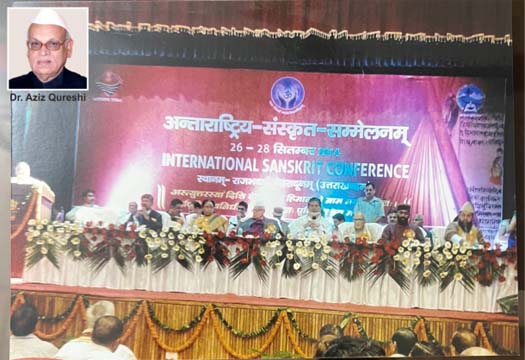
As someone who enjoys engaging in social and intellectual pursuits during my spare time, away from my regular work routine, I had the opportunity to attend the International Sanskrit Conference held from September 26–28, 2014, at the Raj Bhavan in Dehradun, supported by the Uttarakhand Government. Although I had always been intimidated by Sanskrit during my school days, the fact that the subject no longer had any bearing on my report card gave me the courage to confront it now. I decided to attend the gathering of Sanskrit scholars, eager to revisit the point where my understanding of the language had left off since my school days.
Listening to the scholars at the conference, I realised the subject wasn’t as intimidating as I had thought during my school years. If only I had understood it then, it would have spared me the regular red marks on my report card. That’s a light-hearted reflection, but a true one. I kept jotting down points from the conclave that intrigued me, intending to weave them into a write-up, unaware of its pleasant outcome. The piece was published in the Garhwal Post in October 2014.
On the day of publication, I was at home when, around 9 p.m., I received a call on my landline from the Governor’s office. The voice on the other end asked for me and informed me that Governor Qureshi wished to speak with me. For a moment, I was confused, wondering what the speaker meant. I asked for the reason for the call, as I had heard Governor Qureshi was a no-nonsense man. The response was simply, “Please speak.” Hesitantly, I said, “Hello?”
The crisp voice on the other end responded, “I am Qureshi, and I am reading the coverage of the International Sanskrit Conference that you wrote, which appeared in today’s newspaper.”
“Sir, is anything quoted incorrectly?” I asked. He went on to say, “I’m pleased with how well you captured the objectives. Thank you!”
Breathing a sigh of relief, I thanked him and explained that, although my knowledge of the language was limited, the speakers at the conclave had made the subject understandable. He laughed and complimented me, saying, “Good work. I’ll send you an appreciation for your writing,” he added and then hung up.
I was floored. Receiving such praise from the first citizen of the State, and that too through a personal call despite him not knowing me before, was truly humbling.
A few days later, to my surprise, I received a DO letter from the Governor. The letter read:
“I am really grateful for your article published in today’s newspaper and I have no words to convey my feelings of thanks for the way you have appreciated my humble efforts for the propagation and progress of the great Indian language ‘Sanskrit’ for which I have been trying since long. I need strong and full support from friends like you who can take the trouble of writing such beautiful articles. Once more my sincere thanks to you. With all my good wishes, Yours sincerely.”
This was Dr Qureshi: a people-friendly Governor who knew how to acknowledge and encourage intellectual work.
The point I wish to emphasise is not the recognition I received from the first citizen of Uttarakhand—though I feel humbled by it and by the other two acknowledgments across different Governor regimes. What truly matters is the personal touch of a leader and, undeniably, the power of the pen.
Though Dr Aziz Qureshi is no longer with us, his intellectual legacy and gentlemanliness continue to resonate. His numerous deeds, as we saw, read, and heard about them, reflect a persona marked by rare qualities—qualities that are swiftly fading in today’s world.
(Arun Kumar Singhal is a resident of the Doon. He has been a social worker, an author, and a writer specialising in energy and environmental issues for over three decades)