The Five Lamps of Consciousness
 By Rajat Aikant Sharma
Before Ayodhya shimmered with lamps, before Lakshmi rose from the sea, there was another kind of light — the one that appeared when existence first learned to heal itself.
That was the first Diwali.
It had no name. Only a feeling — the moment the cosmos discovered rhythm.
Today we call it Deepavali, but it isn’t one festival.
It’s five different dawns of consciousness, spread across Yugas and dimensions, braided together into one magnificent continuum.
Each day comes from a different plane of reality — yet somehow, they align each year on the same moonless night.
Let us walk through them — one lamp at a time, one frequency at a time.
The First Lamp — Dhanteras: When the Ocean Remembered Health
Satya Yuga — The Primordial Age
The Devas and Asuras churned the Kshira Sagara, the Ocean of Milk, using Mount Mandara and the serpent, Vasuki.
From the waves arose Dhanvantari — Vishnu as the divine physician — holding the Amrit and the knowledge of Ayurveda.
That moment when the universe first learned to heal is Dhanteras.
Modern physics might call it biological coherence — chaos remembering how to heal.
The “Ocean of Milk” reads as primordial plasma; Dhanvantari is that quantum intelligence separating poison from nectar.
We buy metals on Dhanteras because metals are conductors — silver for lunar frequencies, copper for terrestrial fire, gold for solar coherence.
Even if we now buy phones instead of kalashas, the principle remains: prosperity begins with cleansing, with making space for energy to flow.
Dhanteras tells us healing is wealth.
The Second Lamp — Naraka Chaturdashi: When Darkness Was Understood
Dvapara Yuga — Krishna’s Frequency
Krishna and Satyabhama stormed Narakasura’s fortress and freed 16,000 imprisoned beings at dawn.
This is Chhoti Diwali — the turning point before illumination.
Narakasura isn’t just a demon; he’s every shadow-frequency we refuse to integrate.
Krishna and Satyabhama are awareness and courage — the dual-processing needed for inner alchemy.
That’s why we bathe before sunrise with sesame oil — it’s not ritual, it’s neurochemistry.
Abhyanga Snan stimulates lymph flow and resets circadian rhythm.
The small diyas at thresholds are psychological anchors — light placed exactly where the subconscious hides its fears.
Chhoti Diwali teaches that illumination is not the absence of darkness, but its understanding.
The Third Lamp — Diwali: When Two Universes Converged
Treta Yuga + Satya Yuga — The Fusion
Here, two cosmic events overlap on the same Amavasya.
In the Treta Yuga, Rama returned to Ayodhya after fourteen years.
Citizens lit lamps so the victorious king would see no darkness.
In the Satya Yuga, Lakshmi emerged from the churning ocean — cosmic grace descending.
Around the 4th–10th century CE, during the Gupta and Bhakti movements, these two moments fused.
Because Lakshmi is Sita.
Wherever Vishnu walks as Rama, she walks as abundance.
The fire of dharma and the fragrance of grace became one celebration.
Even astrophysics acknowledges this design.
The new moon is Earth’s most electromagnetically still moment.
Lighting oil lamps creates ionisation — subtle changes that stabilise neural coherence.
The ancients called it Lakshmi Aagman; quantum field theory might call it entropy reversed.
On Diwali night, you’re not performing tradition — you’re recreating the moment light and order entered existence together.
The Fourth Lamp — Govardhan Puja: When Earth Was Worshipped
Dvapara Yuga — Ecological Theology
The morning after fireworks, silence returns.
That morning belongs to Govardhan, the hill Krishna lifted.
When villagers worshipped Indra for rain, young Krishna questioned:
“Why praise clouds and not the mountain that catches their water?”
He taught them to honor Govardhan — the living body of nature.
Indra unleashed storms.
Krishna lifted the mountain, proving divinity doesn’t reside above the sky — it rests in Earth’s humility.
Every Govardhan Puja reenacts this truth.
We build mounds of clay, decorate them with flowers, prepare Annakoot — a mountain of food symbolising abundance and gratitude.
Scientifically, this day marks perfect agricultural timing: monsoons end, soils breathe, winter crops begin.
Cow dung enriches soil, communal feasts redistribute nutrition, fasting balances metabolism.
Krishna’s message isn’t myth — it’s ecological philosophy: “Don’t worship the storm. Worship the mountain that endures it.”
After illumination comes integration.
The lamp that burned in the sky must now rest on the ground.
The Fifth Lamp — Bhai Dooj: When Love Outwitted Death
Pre-Vedic Dawn — Before the Ages
The last lamp is also the first.
It belongs to the Rigveda’s oldest hymn: Yama and Yami, twin children of the Sun.
Yama becomes the first mortal, bringing death into order.
Yami becomes the river — life’s flow.
When Yama departs to his dark realm, Yami’s grief becomes the first emotion to confront mortality.
That paradox — affection refusing to die — is Bhai Dooj, celebrated two days after Diwali.
Yama visits Yami (now Yamuna).
She marks his forehead with remembrance.
He grants that all brothers blessed by sisters will live long, protected from death itself.
The new moon of Diwali marks the void; Bhai Dooj marks the first crescent returning.
After dopamine of divine ecstasy comes oxytocin of human warmth.
Yama and Yami symbolise law and love, permanence and flow — holding hands across the oldest gulf: death itself.
Before the gods churned oceans, a sister lit a lamp for her brother, and even Death forgot his duty.
The Festival That Is Remembering Itself
These five lamps aren’t just Earth-stories.
They’re dimensional markers — coordinates in consciousness.
Dhanteras: When matter learned self-repair.
Chhoti Diwali: When awareness faced its shadow.
Diwali: When moral order synchronised with cosmic grace.
Govardhan: When heaven remembered it needs ground.
Bhai Dooj: When love transcended entropy.
The ancient seers never saw the Devas and Asuras as gods and demons, but as polarities — positive and negative charge, matter and antimatter, consciousness and chaos, churning toward balance.
What if the churning of the ocean wasn’t myth, but racial memory of humanity’s first contact with higher intelligence?
What if Dhanvantari’s emergence was a metaphor for the moment knowledge itself descended — the seeding of healing wisdom into early life?
The Vedas speak of Vimanas — celestial vehicles.
The Mahabharata describes weapons that echo nuclear fission.
Perhaps mythology is compressed data from pre-human intelligences — Diwali as an ancient download protocol, five sequential upgrades to consciousness, repeated every year so we never forget.
Diwali 2125: The Festival Goes Interplanetary
In a hundred years, when humanity has settlements on Mars and Europa, what will Diwali look like?
Dhanteras will be celebrated in orbital biodomes, where settlers 3D-print tools from asteroid metals, honoring the moment closed-loop ecosystems achieved sovereignty.
Chhoti Diwali will happen in VR temples, where AI-guided meditations help colonists process the psychological shadow of leaving Earth — the oldest human grief, now integrated through neural lace.
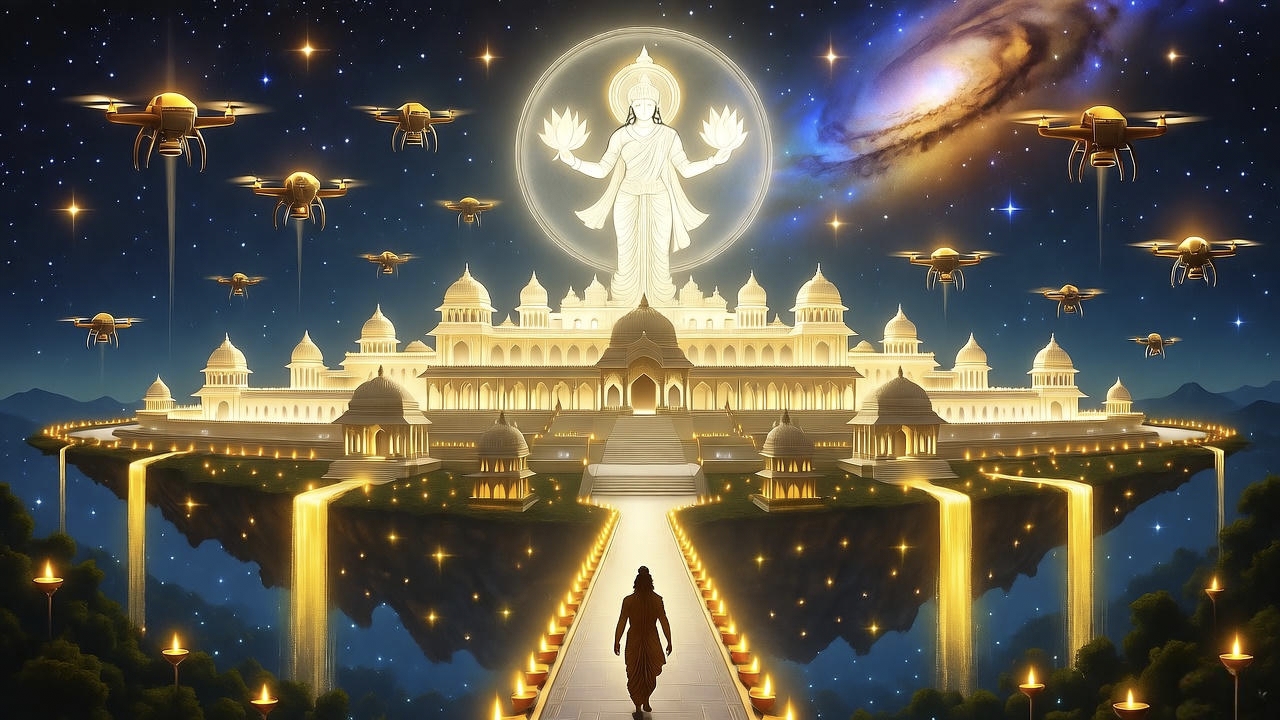
Diwali will light up simultaneously across three worlds — Earth, Mars, and Luna — with quantum-entangled diyas flickering in perfect synchrony across millions of kilometers, proving that light transcends distance when consciousness aligns.
Govardhan Puja will honor the first Martian mountain used to shield a colony from solar storms — humanity finally understanding that every planet is Govardhan, every act of shelter is Krishna’s lifted hand.
Bhai Dooj will be celebrated between siblings separated by light-years, their holographic tikkas applied across the void — love proving again that it outruns death, and now even spacetime.
The Lamp That Never Goes Out
Perhaps we’ve been celebrating Diwali backwards.
We think we light lamps to remember the past.
But what if we’re lighting them to signal the future?
What if every Diwali is a beacon transmitted not just across time, but across dimensions — a coherence pattern that advanced civilisations recognise as humanity remembering it is conscious?
The ocean still churns.
The mountain still waits.
And somewhere, Yami still lights her lamp — not because death can be defeated, but because love is the only force in the universe that refuses to forget.
When the last human lights the last lamp on the last Diwali — in whatever form consciousness takes by then — they will understand what the first physician, the first warrior, the first king, the first ecologist, and the first sister always knew:
Light doesn’t defeat darkness.
Light is what darkness becomes when it remembers itself.
That is Diwali.
That has always been Diwali.
That will always be Diwali.
Happy Deepavali.
(Rajat Aikant Sharma is a writer, columnist, and photojournalist whose work spans culture, history, philosophy, and human narratives across the world.)