 By Anil K Raturi
Over the last few weeks, the world has been in the grip of soccer fever.
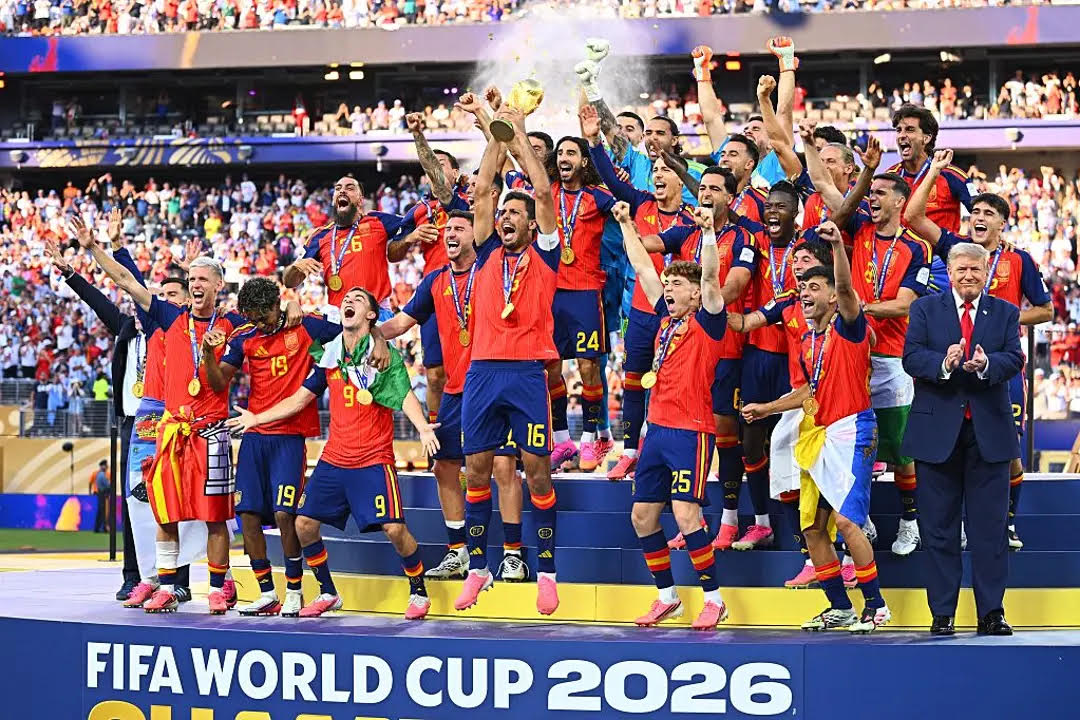
The 23rd FIFA World Cup competition is finally over with Spain becoming World Champions!
They edged out the defending champions Argentina, 1-0, in the finals.
There is something magical about soccer, which compels human hearts to love it the most amongst all sports.
The Spain-Argentina final match of 2026 became one of the most watched single event in human history!
Soccer is a game that transcends mankind’s differences of language, ethnicity, culture and geography.
Playing or watching this game seems to substantiate some inscrutable aspects of human nature, such as passion, the ensuing conflict and the need for belonging to a community.
The duel for the ball played through the modern rules of the game seems to vicariously satisfy some of our primordial urges of tribalism!
Man’s innate need for identity and belonging, compels him to cultivate a community spirit.
This manifests through the plethora of fans and their loyalty to the various clubs and national soccer teams. The requirement for playing a game of soccer is minimal. Just a ball and a field is needed, so it naturally has a democratising effect because all and sundry can resort to its pleasure.
The rules are also very simple.
All one needs to do is to somehow put the ball into the opponent’s goal using any part of one’s body, except the arms and hands!
The nature of the game is such that high scoring results are a rarity. This natural limitation, while watching a match, creates tension amongst the fans, which gets released when the team that they support scores. Following which, a rich flow of natural dopamine is unleashed within their systems, making the game addictive! The ninety minute game of soccer played on a field of about 100×50 yards is intensely physical. At the international stage, the game demands from its players immense reserves of stamina and strength. Additionally, apart from footballing skills, it also requires them to have an ability for bursting into sudden sprints.
However, the final match played between Spain and Argentina, despite being keenly fought, did not rise up to the spectacular heights, which one associates with such events.
Spain’s mastery over keeping possession through its “tiki taka” style of short skilful passes, stifled Messi and Argentina’s flair for attacking. Spain preferred possession to control the pace of the game. It was happy to secure a lead of one goal, which it defended efficiently by combining as a well-knit team.
Lack of possession upset the rhythm of the Argentinians. Messi’s team, reduced to ten men, disappointed fans by resorting to defensive play. I have watched all the final soccer matches on TV since the 1978 World Cup at Buenos Aires.
I have seen the magical football of Maradona of 1986, the subtlety of Zidane’s foot of 1998, and I have watched Pele’s poetry in motion, in the tournaments of 1958, 1962 and 1970!
For decades, I have witnessed the spectacular Latin American finesse and artistic style, (“Joga Bonito” fluid attacking, creative and “Ginga”-rhythmic movement) primarily manifested by Brazil, contested by the North European power and tactical oriented organised method of the game, called “Total Football” (best represented by the Dutch team of 1974)!
In the backdrop of such spectacular soccer, the final match of 2026 was the most lacklustre.
Both teams focused more on defence than attacking. It reminded one of the “Catenaccio” -ultra defensive – European style, developed in 20th century Italy.
A theory about the human brain propounds that the left side of our brain deals with logic while the right is preoccupied with emotions. Logic is mathematical and tactical. Emotion is romantic!
To realise his or her true destiny, a human being needs to find the unique creative self.
Creativity requires both logic and emotion, tactics and romance.
Spectacular football can only come when it has wholesome creativity, which requires a marriage of mathematics with art!
Perhaps, unlike the past final matches of the FIFA World Cup soccer, where spectacular creativity reigned, in the 2026 final match between Spain and Argentina, the discerning fan was disappointed to see that mathematics seemed to trump art!
Nonetheless, the game of soccer still holds its magical power to continue to thrill us!
(The author is a retired IPS officer and former DGP, Uttarakhand.)