Garhwal Post Bureau
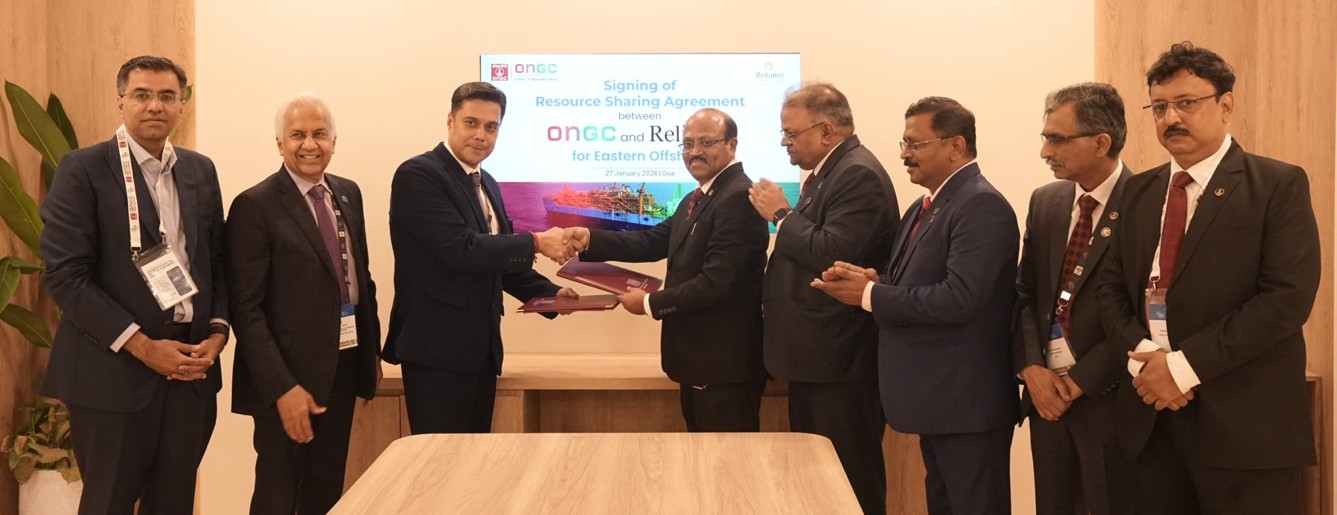
Goa, 28 Jan: Oil and Natural Gas Corporation Limited (ONGC) and Reliance Industries Limited (Reliance) signed a path-breaking agreement on 27 January to enable resource sharing for deepwater offshore E&P operations on India’s East Coast, particularly across the Krishna Godavari (KG) basin and Andaman offshore, marking a major step towards cost optimisation, faster execution, and improved asset utilisation in complex deepwater projects.
This agreement is aligned with a forward-looking initiative facilitated by the Oilfields (Regulation and Development) Amendment Act, 2025 (ORDA Act 2025), introduced by the Ministry of Petroleum and Natural Gas (MoPNG), which creates a clear enabling framework for E&P operators to share infrastructure and facilities, both onland and offshore, for more efficient development of oilfields and production of hydrocarbons.
Under MoPNG’s enabling initiative, ONGC and Reliance will pursue sharing of key resources required for offshore operations, which may include (but is not limited to): onshore and offshore processing; facilities, drilling rigs, marine vessels (MSV, Tugs, PSV), Power, Pipelines, logging and well services, etc.
The agreement is expected to deliver measurable benefits through a structured framework for pooling critical assets and capabilities, including:
- Cost optimisation through shared use of high-value rigs, vessels, logistics and specialised subsea equipment.
- Improved resource utilisation by reducing duplication and idle capacity across operators.
- Faster mobilisation and execution by improving access to the limited deepwater services available.
- Stronger operational resilience and safety readiness through shared emergency response and training capabilities.
The agreement reflects the Government of India’s emphasis on energy security through scaled domestic exploration and production, enabled by progressive regulation, streamlined infrastructure utilisation, and industry collaboration.