By SATISH SHARMA
I landed in Tokyo on 1st October 2026. This was my first visit to Japan. I was invited there to attend the closing ceremony of the 20th Asian Games held at Aichi Nagoya.
At the Nagoya Airport the members of the reception committee were very friendly and cordial. They verified my credentials and were happy to note that their country would be covered by international media. I was handed over a coupon of 10,000 Yen for travel expenses being part of the media team from world over. Later, the coupon was topped up by 20,000 Yen. Cars and taxis are expensive in Japan so we were advised to travel by trains and bus.

The next day I boarded a train after a 20 minute walk from my hotel to watch the women’s hockey finals between India and China at Gifu Prefectural Green Stadium, Kakamigahara. I changed another train and reached my destination in another district roughly around 40 kms from my hotel at Nagoya. I left my second train and volunteers guided me to the shuttle bus service parking which was a ten minute walk from the station. During this walk I noticed the houses, fields, and crossed houses with green hedges. I was so thrilled to notice green hedges after so long. Once my hometown, Dehradun, was famous for its grey hair and green hedges. Unfortunately, the green hedges and canals have vanished now.
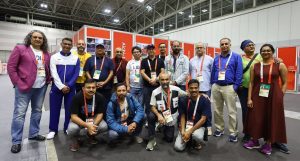
I watched the match between China and India live and we all saw how our tigresses played and won the match. Our girls played to perfection. Their stamina level was amazing and the technique too. They were no less in comparison to the Chinese team.
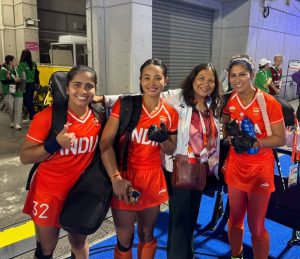
It was great meeting many people in the stadium, including Tapan Das, Deputy Chief of Mission Alaknanda Ashok, her retired IPS husband Ashok Kumar, and son Shashwat Garg. I got a lift in Alaknanda’s official car back to my hotel at night.
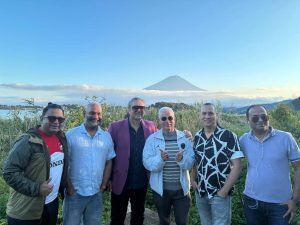
On 3rd October, I watched the India-Pakistan cricket finals. India won the match gloriously. And I was thrilled to see our medal tally increasing. It was a proud moment for all of us.
After the match, I was joined by my old friend, Pradeep Ranjan, who took me for dinner to Nagoya. Pradeep spent his childhood in Rishikesh and later studied in Roorkee. He is an AI expert and heads an automobile company’s vertical in Japan as Global Head, Centre of Expertise, ‘Enterprise Applications’. I had the best Sushi of my life. At the restaurant, there were some young Japanese boys who were very keen to meet me. Ranjan who speaks Japanese, introduced me to these young boys. The boys were thrilled to meet me after knowing my profile. They clicked pictures with me and we connected on Instagram instantly.
People in Japan are keen to meet and chat with new persons of whatever origin.
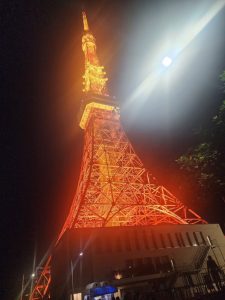
On the last day at Nagoya, i.e., 4th October 2026, I was joined by Lucky Khan from Kani (35 kms from Nagoya). Before going there, he lived in Dehradun for many years. He was associated with movie making in Dehradun. But now for the past four years he is in Japan. Lucky Khan, too, is very hardworking and has adopted all the good habits of the Japanese. He is married to a Japanese lady and has a daughter. He said, ‘I’m here to make my parents proud and will not indulge in any wrong activity.”
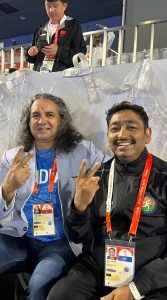
I was overwhelmed with the way he brought breakfast, fruits, etc., for me, all packed from home. He drove me to Nagoya Castle in his cute car and spent almost half a day with me.
Later, I was invited by Digvijay Singh Deo for a group photo with the Indian media delegation at the Press Centre. The press centre was huge and International media in large number were busy filing their stories. Here, I met the National Correspondent of Garhwal Post, Ratnajyoti Dutta.
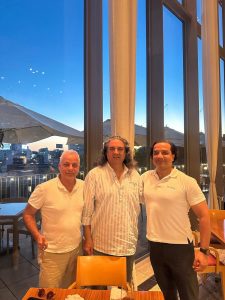
The media delegation from India was super happy with the arrangements made by the Olympic Council of Asia and Indian Olympic Association. The Chairperson, PT Usha, and Capt Ajay Narang, were seen personally monitoring the media.
The closing ceremony was watched by the entire world through the live telecast and it was a proud moment to watch the Indian contingent led by Neeru Dhanda with the tricolour fluttering high.
On the 4th itself, I boarded the Shinkensen (Bullet Train) from Nagoya to Tokyo. And in 1 hour 30 minutes I was in Tokyo. It was a fun ride.

I was in Tokyo for a holiday after a long time, though I checked the final pages of Garhwal Post every day and slept at around 3 a.m. (Japan time).
In Tokyo, I was hosted by Pradeep Ranjan, his colleagues and friends. He has a 3 BHK house at Nishikasai.
During my 8 days stay at Tokyo, I visited Skytree, Asakusa (1968 movie Aankhe, starring Dharmendra and Mala Sinha was shot here); Chiba, Roppongi, Shibuya, Oena, Renkoji Temple, Meiji Jingu shrine at Harajuku, Atom Tokyo discotheque, Vine Social restaurant at Nishikasai, and many other places including the Zoo, Tokyo National Museum, etc., the Kawaguchiko Lake near Mount Fuji via two hours road journey.
It was a proud moment for me when I visited Renkoji Temple to pay my tributes to Netaji Subhas Chandra Bose.
The people of Japan are patriotic, honest, disciplined, hard working, and courteous. Due to this they have made Japan so modern and beautiful. The country that faced the 2nd World War disaster is one of the most liked countries in the world by the tourists today. Japan is almost crime free and monitored by cameras all over.
Interestingly, people here use mobile, AI, and other technologies in the interest of self-growth. Not like many of us who just comment on social media and do not work at all.
We, all Indians, must take a pledge to be more patriotic and honest. I’m sure one day we will become a super power.
People in Japan eat healthy, walk too much, sleep early, get up early.
People don’t talk loudly here. There is no noise pollution in entire Japan. Here no loudspeakers are allowed for prayers.
During my stay at Tokyo, I met some wonderful people including Sandeep Sharma (Sandy); Anurag Mahant; Rohan Saluja; Srini; Abhinav Ranjan; and Abhinav Thapliyal. They all were celebrating Navratras with great fervour.
I also met many people from Uttarakhand, Nepal, and other places. They all are hardworking people too and supporting their families in their native lands.
Abhinav Thapliyal is a native of Dehradun. He did his schooling from the prestigious Marshall School. Later, he went to Tokyo for higher studies. He learnt the Japanese language and is doing great. He is a successful entrepreneur. Abhinav is married to a Japanese girl and they both were blessed with a baby 2 months ago. They got married two years ago in Dehradun at Hyatt Regency.
I went for a long walk at the end of my Japan journey along The Arakawa River, Tokyo making lifelong memories!
I’m certainly going to change my food habits after this wonderful visit!
Cleanliness in Japan: A Culture of Collective Responsibility
Cleanliness in Japan is more than a matter of hygiene; it is deeply embedded in the country’s culture, everyday habits, and sense of collective responsibility. Influenced by Shinto concepts of purification, Buddhist traditions, and longstanding social customs, respect for cleanliness is cultivated from an early age. Japanese schoolchildren routinely participate in cleaning their classrooms and shared facilities, reinforcing the importance of personal accountability and respect for communal spaces.
These values extend into daily life through practices such as removing shoes before entering homes, carefully separating household waste, and taking personal rubbish home when public bins are unavailable. What makes Japan particularly remarkable is not simply the cleanliness of its streets, trains, and public spaces, but the widespread understanding that maintaining them is a shared responsibility.
Ultimately, Japan demonstrates how cleanliness can become a natural part of everyday behavior rather than something maintained solely through regulations or enforcement. Japan’s example offers a valuable lesson to the world: lasting cleanliness begins not with government initiatives alone, but with individual discipline, education, and respect for others.