 By UPENDRA ARORA
It’s in the air. There is something almost magical about this valley of ours — green and serene, with a delicate web of little rivulets (now almost disappeared) and dry riverbeds strewn like necklaces across its terrain.
Tucked warmly between the great mountain ranges on one side and India’s sacred river on the other, Dehradun, or the Doon Valley, has always been a source of enchantment for the traveller, many of whom succumbed to its charm and made the valley their home. The Doon Valley was written about centuries ago, when it was a thick orchard of litchi and mango trees traversed by people heading further up to the mountains; later, when wars were fought here, and later still, when Guru Ram Rai first set foot in it.
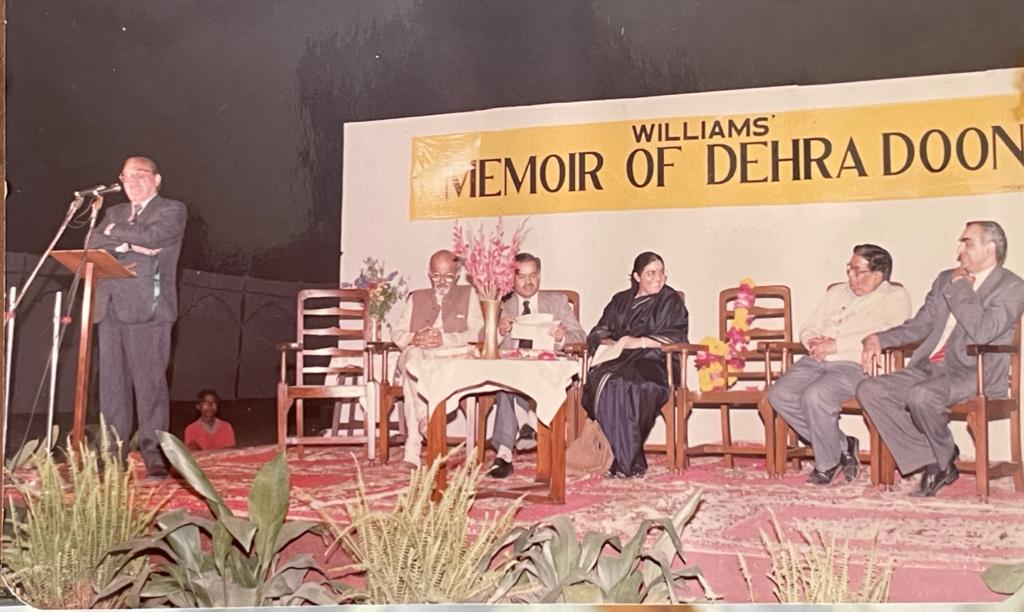
The valley’s history, sociology, geography and anthropology were extensively documented in the nineteenth century by acclaimed British authors, for by then the British had made it their summer home on the way to a cooler Mussoorie. The books written by Williams and Walton are considered classics today, remaining comprehensive and authentic texts of reference. GRC Williams was the first Superintendent of Dehradun, and his immensely readable Memoir of Dehra Doon (1872) was perhaps written before the fountain pen even existed. HG Walton recorded his own innings in the valley in the Gazetteer of Dehra Dun (1911).
Mussoorie and Dehra Dun have always shared a cosy co -habitation — books about the Doon Valley carry exhaustive information about the “Queen of the Hills,” and likewise, books about Mussoorie tell of the Doon that was. The Story of Mussoorie (1910) by F Bodycott offers an interesting account of the valley as the British perceived it: they would reach it by road and train, then hire porters to carry them and their belongings on foot up the hills to Mussoorie.
Picturesque landscapes naturally lend themselves to intellectual creativity, and the Doon Valley has long been a place of retreat for writers who like to surround themselves with the echoes of their own literary imagination. Among the contemporary authors who have left an indelible mark on English writing in India, Dehra Dun boasts a proud list, and rightfully so. Ruskin Bond, India’s most loved author, made Mussoorie his home, while acclaimed travel writer Stephen Alter is a longtime resident of the same hill station. Pandit Nehru’s niece, Nayantara Sahgal, is an old resident of Dehradun; her novels Plans for Departure and Rich Like Us, among others, received international critical acclaim and still enjoy a wide readership, with her body of work studied by literature students across Uttarakhand and beyond. Nehru himself wrote a great deal while imprisoned here during the freedom struggle.
Allan Sealy also calls the valley home. He began by writing on travel before his novels Trotter-Nama and Asoca found international publication. The leading contemporary poet Arvind Krishna Mehrotra shares a close association with Dehradun, spending time here at his mother’s house. Another writer belonging to the valley, well known for her work and recently reprinted, is Nergis Dalal, whose daughter Roshan Dalal is a noted children’s historian, with several bestselling books to her credit. Vandana Shiva, a world renowned environmental leader and thinker and author of many books, including Earth Democracy, Biopiracy and Slow Living, belongs to Dehra and lives here.
The valley has stolen hearts from across the seas too, drawing people who chose to make it their home and went on to write about their experiences. Two names come instantly to mind: Lewis King and David Keeling. Lewis led an extraordinary life, having travelled the world the hard way before settling here to build a home and a family of the friends he made; his controversial book, The Twentieth Century.
Heretic, questions a range of existing notions of time, space and existence. David Keeling, a former member of the British Foreign Service, retired to an English-style cottage in Dehradun and wrote a weekly column in The Asian Age full of joyously amusing anecdotes about the valley and its residents, laced with typically witty British humour. These columns were later published as a collection titled Doon on a Sunday.
The valley has always been a seat of learning, home to some of the finest institutions in the country. The Indian Military Academy trains young cadets; the Forest Research Institute leads research into ecological issues nationwide; the Wildlife Institute of India is internationally acclaimed for its work protecting the subcontinent’s flora and fauna; and the Trigonometrical Survey of India, one of the oldest institutions in the country, has its headquarters here. The well-known and highly respected travel writer Peter Hopkirk came looking for information at the Survey while researching his book Quest for Kim, and with a little help he was able to tour the museum and pay tribute to India’s great cartographers and surveyors — an experience he later praised warmly in his writing. Heinrich Harrer, too, in Seven Years in Tibet, wrote of his understanding of life in the valley, where he was interned during the Second World War.
Ruskin Bond, a true well-wisher of the valley, first lived in Dehradun before Mussoorie, and his books capture the verdant valley and the hill station as they once were. He has the rare gift of weaving stories that appeal to every age, from seven to seventy, immortalising both the valley and Mussoorie in the imagination of readers everywhere. His readership spans not just Dehradun and its visitors but the entire country and beyond, and the valley now shares a deep and lasting association with him.
Popular author and journalist, Khushwant Singh, in his famous column, once wrote most judiciously that the bookshops of a town are the barometer by which we can justly measure a city’s intellectual strength.
After launching his book nature watch, at our bookstore, he mentioned it warmly in his popular column the following week, praising our collection as better stocked than that of most other cities he had visited — a fine reflection, we like to think, of the valley’s citizens.
The valley is equally famous for its schools. Institutions like The Doon School and Welham’s rank among the country’s best and are steeped in history, their alumni going on to distinguish themselves across many walks of life. Indira Gandhi used to visit Dehradun with her father as a child, and her love of books brought her regularly to our bookstore. Later, after enrolling her sons at The Doon School, she would visit us whenever she came to see them, and continued ordering her books from our store lo ng after becoming Prime Minister. One of the defining threads of our relationship with her was her love for the environment; since we publish and stock books on ecological issues, she was always keen to encourage our contribution to the larger cause of conservation. She passed this enthusiasm for reading and environmental protection down to her son Rajiv, who continued to patronise the bookstore for years after.
The valley has always enjoyed an intellectual air. Schools use literature as a foundation for study, encouraging children to read widely and develop a lasting habit of learning. And because the valley is home to so many educational institutions, it is naturally also home to educationists driven by their own quest for knowledge — readers of literature, politics, art, defence and military affairs, ecology and environment, anthropology and history alike.
Dehradun has always been home to citizens who see the world through the pages of the books they read. It is a place many dream of retiring to, spending their later years by a cosy fire in winter, curled up with a book in a rocking chair. This is one reason the city has flourished: retired educationists, environmentalists, government employees and army officers choose Dehradun over other cities to settle down in, bringing with them the knowledge and wisdom that experience unfolds, and helping make the city a thinking one — conscientious, mindful, and aware of its rich natural, architectural and intellectual heritage, which its citizens work continually to preserve. Such social awareness is not possible without a genuine understanding of changing times, and this is exactly what books and literature provide. We can proudly say that even in this supersonic age of cyber -rule, our quaint valley of grey hair and green hedges holds firmly onto that spirit.
This is one of the many reasons tourists keep flocking to the valley. Many travelogues carry a rich account of the city. A good bookstore reflects the character of a city, much as Cambridge and Oxford, both centres of learning, can boast of their own — Heffers for Cambridge, Blackwell’s for Oxford — and we take quiet pride in how our citizens feel about ours.
Dehradun has always been a sophisticated town of thinkers and thinking, one that continues to cherish its reputation for education and learning. It remains a shiningly optimistic sign for future generations, even on the otherwise rather bumpy road that lies ahead in this fast-changing world of information.
(Upendra Arora, Manages Natraj Bookshop, on Rajpur Road).