 By Ganesh Saili
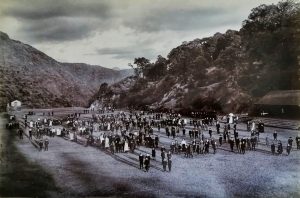
Halfway on the old Mussoorie-Rajpur bridle path is Jharipani, where the East India Railway founded a school for the children of their employees. The Oak Grove School is situated at an elevation of 5,300 feet, spanning a 259-acre estate with water supplied from the tranquil waters of Mossey Falls.
The Chapmans joined the school on 19th May 1888, he as the first Headmaster, she as the first Headmistress. Luckily for amateur historians like me, his diaries survive, with entries starting June 1st 1888, when twenty-eight boys arrived under the charge of Mr Clarke. Ten days later, two of the boys ran away, and by the 14th, they were found with their relatives in distant Kanpur! How on earth did they scamper downhill to Rajpur, walk to Haridwar and reach Kanpur? They were railway children, and probably knew the train staff!
An entry from August that year: ‘I had to stop giving boys supper to reduce expenses.’
Another entry, this time from February 1889: ‘Mr Frank Cooper joined the staff from Calcutta Boys’ School. Salary Rs 80 per month plus food, quarters, light and fuel.’
Apart from the cold weather, children sick, fever and colds, there were cheap thrills aplenty; there was a Sergeant, who allowed the Matron into his rooms for ‘smoking’. Grimly, the Principal notes, ‘I had to speak to him about this.’ On March 15, 1889 both of them got their marching orders after forfeiting a month’s pay. ‘I have notified the commanding officer of his Regiment to stop his pay.’
Next summer, on May 24 1889, Henry Thomas fell from an off-limits area near the boys’ lavatory, fracturing his arm. Although he received immediate attention from the school doctor, his condition deteriorated, and he passed away on the morning of the 27th. Henry Thomas has the dubious distinction of being the first Oak Grove School student to die.
Pic courtesy: The Internet
Who can write a story on Oak Grove without mentioning Stephen Fennimore, a teacher, and his wife, Millicent? She had got herself embroiled in a petty defamation suit, which her husband found more and more distasteful as the case dragged on. The awful business drove him to a terrible solution. On the night of November 24, 1917, his wife was sound asleep. He armed himself with a revolver, moved to her bedside, and shot her through the back of her head. Inexplicably, for who could have possibly mistaken her death for suicide, he slipped the weapon under her pillow, and then calmly walked to the lavatory three rooms beyond his bedroom, leaned over his loaded rifle, and shot himself.
Nearby, Fairlawn Palace’s Madalsa House is home to the shaven-head Tibetan nuns of the Mindrolling Monastery. This was once home to another of our Mussoorie authors, Pema Chodron. She is from the Kagya & Shambhala lineage, writing books like When things Fall Apart: Heart Advice for Difficult Times and The Places That Scare You. They have been listed as bestsellers in the New Yorker.
To this day, at the bottom of the Jharipani incline, above the hustle and bustle of traffic, those who believe in such things can hear echoes of ‘koi-hai?’ or ‘is anybody around’, an expression used by the White Sahibs when calling for the help to take orders for drinks at places like Mrs Granges’ Hostelry. The place had character and individuality that were a class all of its own: her table silver, her coffee, white bread, imported cheeses, salads, white loaf sugar, and the various confections were unique. Weeks after a special event, you could have heard her guests discussing the evenness of the frosting, the symmetry of the chocolate wedges, or the pineapple chunks in her pastries. Before concluding this somewhat disjointed collection of vignettes related to Oak Grove School, how can I forget James Hackney, an ex-Woodstock alumnus who, in the early 1970s, shocked everybody by jumping off the sun-kissed cliffs of Jharipani in a hang glider to land safely down below in Purkul Village. He had successfully flown the hill station’s first hang glider.
Of course, the school authorities were not amused and banned any future attempts at gliding on the breeze.
(Ganesh Saili, born and home-grown in the hills, belongs to those select few whose words are illustrated by their pictures. Author of two dozen books, some translated into twenty languages, his work has found renown worldwide.)