By ARUN PRATAP SINGH
Garhwal Post Bureau
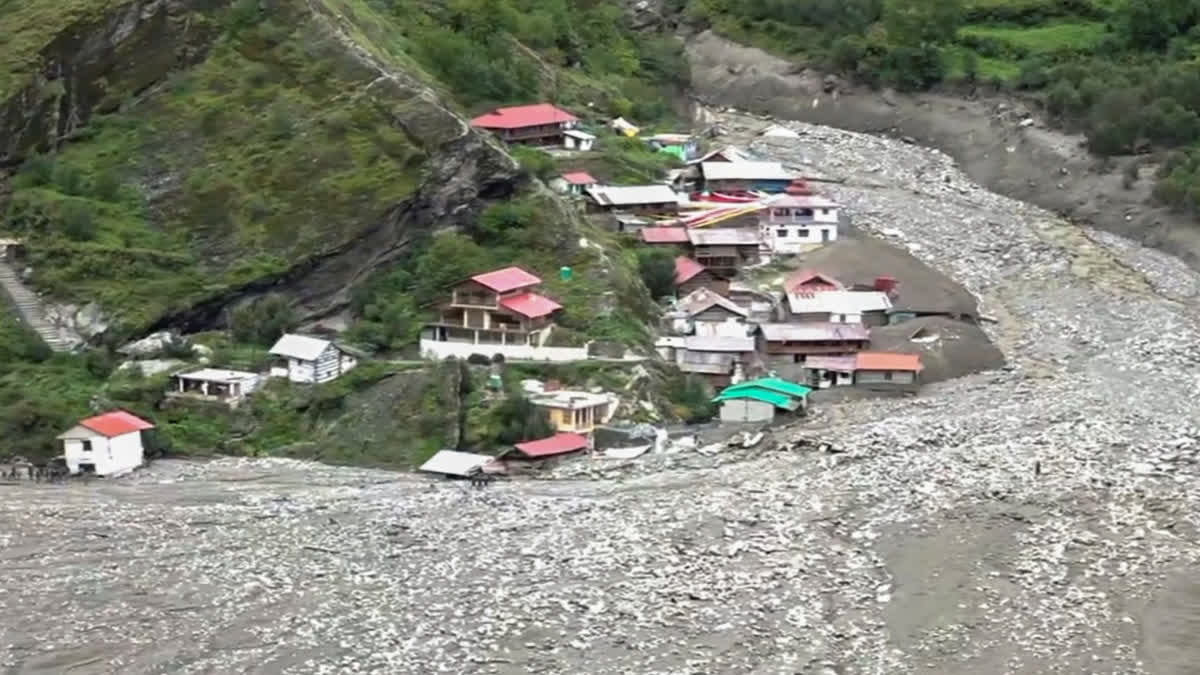
Dehradun, 6 Aug: Nearly forty-seven years after it last followed its original course, the Kheer Ganga, a tributary of the Bhagirathi, has returned to its ancient course and has brought with it a trail of devastation and destruction. The raging waters, laden with massive boulders and debris, swept away the newly established settlement of Dharali that lay in its path.
Last evening, while speaking to media persons, the Meteorological Department of Uttarakhand refuted initial reports that the disaster was triggered by a cloudburst. Rohit Thapliyal, a scientist at the Meteorological Centre in Dehradun, claimed that no data indicating any cloudburst event has been recorded in Uttarkashi. Therefore, the incident cannot be officially classified as such.
Meanwhile, fresh images from the disaster-hit area have emerged, shedding light on the probable cause. These photographs show a massive glacier deposit slide nearly 7 km upstream of Dharali, at an altitude of about 6,700 metres above sea level. Satellite imagery estimates the thickness of the glacial debris at 300 metres, covering approximately 1.12 square kilometres. The dislodgement of this debris is believed to have triggered the destructive deluge downstream.
The geologists remind that Kheer Ganga converges with the Bhagirathi River near Dharali and has for years been creating new floodplains in the region. In due course of time, these floodplains began to be used for agriculture. Over time, encroachments crept in, and construction activities multiplied across the flood-prone areas. Numerous hotels, markets, and houses were built, despite the area’s vulnerability.
Owing to such encroachments, Kheer Ganga was forced to abandon its natural course and began flowing from an unnatural direction, even reversing its flow northward at certain stretches. But rivers, particularly in inclement weather, have a tendency to reclaim their original course, often with devastating consequences. Many independent environmentalists as well as geologists claim that this is what happened yesterday afternoon. The river, cascading down steep gradients with boulders and debris in tow, resumed its ancient path and obliterated the recently settled colony before joining the Bhagirathi.
The satellite images, point to the source glacier of the Kheer Ganga and indicate the presence of hundreds of small glacial lakes at high elevation. Due to the steep slope, the accumulated water overflowed these natural basins. It is possible that these lakes might have been breached, and it then created a domino effect, with successive lakes bursting and unleashing a torrent that carried boulders and debris all the way down to Dharali.
Interestingly, the older, original settlement of Dharali remains unscathed. Situated east of the Bhagirathi atop a small hill, it lies safely outside the flood zone. The Bhagirathi once curved southward from the hill’s base, and it was along this very flood zone that the new Dharali was ill-advisedly established. It appears that the foresight of the earlier generations in choosing a safer site has once again been vindicated.
Historical records confirm that Kheer Ganga followed the same path in 1978. It has simply returned to its natural route, sweeping aside all man-made alterations along the way.
It may be reminded here that Uttarkashi, a region known for its scenic beauty and spiritual importance, has long been vulnerable to natural disasters. Situated near the origin points of both the Ganga and Yamuna rivers, it has faced repeated shocks from earthquakes and floods. Tributaries of the Ganga such as Asi Ganga, Rano Gadh, Ganganani, and Kheer Ganga have all contributed to this vulnerability.
Unfortunately, despite being a high-risk seismic and flood-prone zone, unregulated construction has gone unchecked in Uttarkashi district. Following the 1991 Uttarkashi earthquake, there was considerable discourse on adhering to a master plan and building earthquake resistant structures, but little was implemented on the ground. Even after the cloudburst events of 2013 and 2023, encroachments have continued unchecked.