By Sunil Sonker
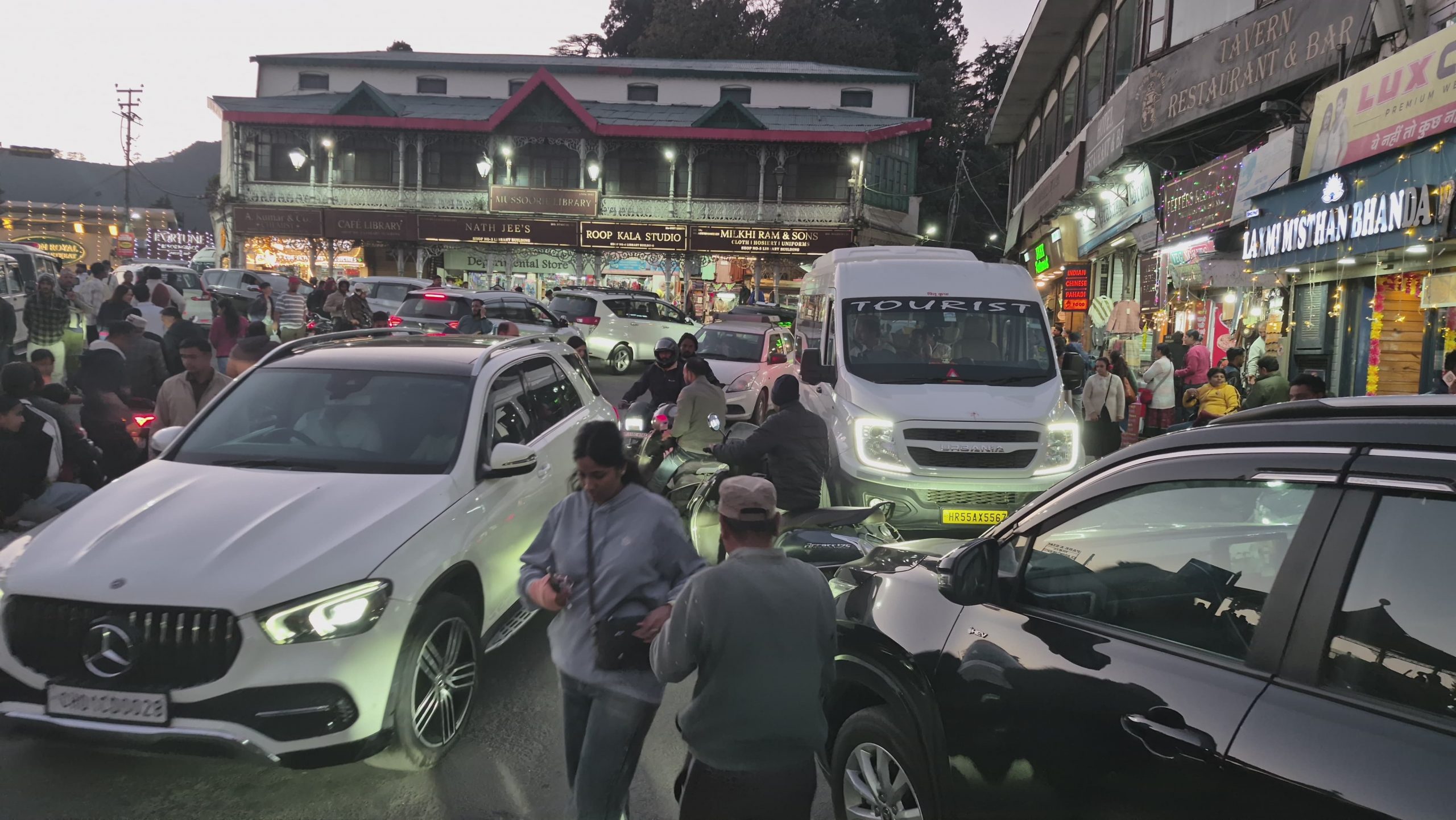
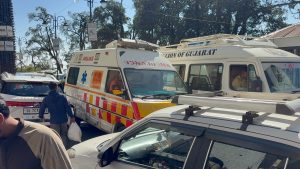
Mussoorie, 11 Nov: The problem of traffic congestion is becoming increasingly critical due to the rising influx of tourists in Mussoorie. Even after the long holidays and the weekend, the city’s traffic system has failed to return to normalcy. On Wednesday, long queues of vehicles were observed on major routes in Mussoorie from the early morning hours. The situation became so dire that a ‘108’ emergency ambulance, on its way to collect a patient, became stuck in the gridlock. This has once again raised serious questions regarding the state of Mussoorie’s traffic management and the accessibility of emergency services.
Around 11 a.m. on Wednesday, an increase in traffic volume at Picture Palace Chowk led to a major jam, with a long line of vehicles quickly forming all the way to the Bata Company outlet. Both tourists and local residents faced immense difficulty. Most concerning was the moment a ‘108’ ambulance—heading from the Mussoorie Girls’ area toward Picture Palace to pick up a patient—became trapped in the traffic. The fact that an emergency vehicle could get stuck in such a manner highlights the critical state of the city’s traffic infrastructure.
The congestion was not limited to the Picture Palace area; the Mussoorie-Dehradun road also experienced heavy traffic pressure, with long lines of vehicles stretching from Kitabghar to the Gas Godown. Meanwhile, motorists on the Mussoorie-Dhanaulti road also faced significant challenges due to the traffic jams. Traffic disruptions across various parts of the city have compounded difficulties for both tourists and local residents.
Rajkishore, a tourist from Delhi visiting Mussoorie, shared that he remained trapped in traffic for several hours on Tuesday and faced the same issue again on Wednesday morning. He remarked that there appears to be an inadequate police presence to manage traffic at a major tourist destination like Mussoorie—a situation that negatively impacts both visitors and the local population. He noted that while tourists come to Mussoorie seeking a peaceful holiday, they end up spending hours stuck in traffic.
The traffic problem in Mussoorie is no longer limited to mere inconvenience for tourists and locals. When a ‘108’ ambulance—en route to pick up a patient—gets caught in a traffic jam, it becomes a serious issue concerning healthcare services and public safety. In this hill town, limited road infrastructure, a growing number of vehicles, and a lack of parking spaces already pose significant challenges to traffic management. Under these circumstances, ensuring dedicated routes for emergency vehicles and deploying sufficient police personnel at key intersections has become essential.
Locals point out that traffic congestion in Mussoorie occurs every weekend and during long holidays, yet no concrete steps have been taken toward a permanent solution. If effective traffic management, adequate parking, and specific provisions for emergency vehicles are not implemented in a timely manner, it could become difficult to transport critically ill patients to the hospital on time in the future.
Jagjit Kukreja, General Secretary of the Mussoorie Traders’ Association, stated that there is a severe shortage of police personnel in Mussoorie, which makes it extremely difficult for the police to handle the increased traffic pressure during weekends and long holidays. He stated that, for such special occasions, the administration should plan ahead and deploy an adequate police force along with capable officers; however, such arrangements were not evident this time. Consequently, both local residents and tourists are bearing the brunt of this situation. He noted that tourists visit Mussoorie for a pleasant experience, but if they end up stuck in traffic jams for hours, they return home with memories of congestion rather than fond recollections of the town. This negatively impacts the image of tourism in Mussoorie.
Mussoorie Station House Officer (SHO) Narendra Singh Gahlawat mentioned that Mussoorie is witnessing an unexpectedly large influx of tourists. Despite this, the entire police force is working to keep traffic flowing smoothly. He explained that whenever a traffic jam occurs, it takes approximately 15 to 20 minutes to clear the congestion and restore order. However, Mussoorie’s unique geographical terrain, limited road network, and a lack of sufficient parking are the primary factors contributing to traffic disruptions. He added that because the available parking capacity does not match the number of vehicles, the pressure on the roads often intensifies. The SHO stated that the government, district administration, and police are making joint efforts to resolve the traffic congestion in Mussoorie. Recently, the district administration identified 41 locations in Mussoorie for the development of parking facilities. The municipal council is also working on a plan to develop smaller, localized parking areas within neighbourhoods. Furthermore, efforts are underway at the government level to construct large-scale parking facilities. He added that discussions are ongoing with senior officials regarding the shortage of police personnel in Mussoorie, and efforts are being made to ensure an adequate police presence soon.