
 By Rajat Aikant Sharma
The silent disappearance of stars, wonder, and cosmic thinking in modern India
There was a time when nights were not empty.
Before television glow escaped from every window, before phone towers blinked across ridges, before LED lights flooded even the smallest hill towns, darkness itself had a presence. Real darkness — the kind in which the Himalayas disappeared into silhouettes and the sky slowly revealed its hidden architecture.
A child once grew up looking upward.
Today, most children grow up looking down — at screens.
Even in places like Mussoorie and Dehradun, where the stars once arrived like ancient guests every evening, the night sky has begun fading into a pale grey ceiling. The hills that once carried silence now carry neon signs, hotel lights, headlights, glass buildings, dust, smoke, and the constant hum of electricity.
And perhaps without realising it, we have lost something much bigger than stars.
We have lost perspective.
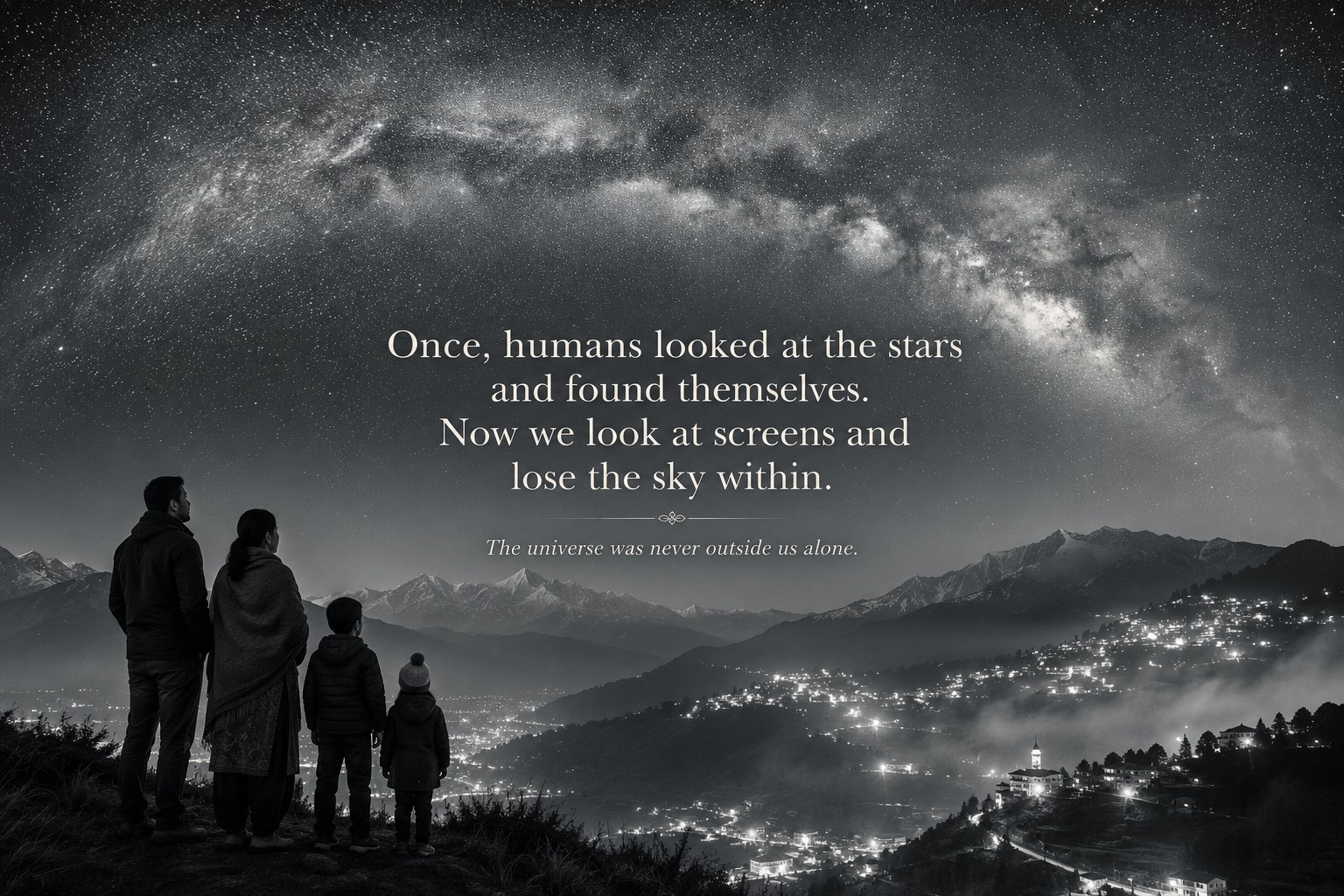
I often think about this during my yearly treks with family and children into remote Himalayan regions where electricity still disappears after sunset and phone signals surrender to the mountains. Initially the children become restless. They search for networks. They complain about dead batteries. Silence unsettles them.
Then the sky appears.
Not the weak urban sky we now call “night,” but a living cosmos. A river of stars. The Milky Way stretching like spilled silver across infinity. Constellations emerging one by one until the darkness itself begins to feel illuminated.
And suddenly the children stop speaking.
For many of them, it is the first time they truly see the universe.
You can almost watch the human mind recalibrating itself. The ego becomes quieter. The body feels smaller. Questions emerge naturally.
“How far does this go?”
“Are there people somewhere out there looking at us?”
“How tiny must Earth look from another galaxy?”
In those moments, the mountains become classrooms far greater than any school. Because beneath a true night sky, every human being realises the same thing: we are unimaginably small — and yet mysteriously alive.
Perhaps older civilisations understood this better than we do.
India once lived by the stars. Not metaphorically — literally.
Farmers watched the sky before sowing crops. Pilgrims travelled through mountain routes using constellations. Temples aligned themselves with solar cycles and celestial geometry. Villagers in Himalayan regions could identify stars with astonishing ease. Grandparents narrated stories of Saptarishi, Dhruva, Rohini, Mrigashira, and the movement of seasons through nakshatras.
The sky was not decoration.
It was memory. Calendar. Philosophy. Direction. Mythology.
Even spirituality emerged from this cosmic intimacy. Ancient Indian thought never saw the universe as separate from human consciousness. The same akasha that existed outside also existed within. The cosmos was mirrored internally. The observer was never separate from the cosmos; he was part of its rhythm. Perhaps that is why so many sages meditated under open skies rather than enclosed rooms — not as a preference for weather, but as a philosophical necessity.
Today we have more information than ever before, yet far less wonder.
Children can identify hundreds of app logos but cannot recognise Orion’s Belt. Many have never seen the Milky Way even once in their lives. Entire generations now grow up under polluted skies where only a handful of stars survive above urban haze. What they have never seen, they cannot consciously miss — and yet something within them knows it is absent.
The tragedy is not merely environmental.
It is psychological.
Modern life constantly magnifies the self. Social media creates an endless performance of identity. Cities surround humans with mirrors of their own importance. Every screen quietly whispers the same message: You are the centre.
But the night sky once reminded humanity of the opposite.
You are not the centre.
You are part of something vast beyond comprehension.
And strangely, that realisation did not create despair. It created humility. Calmness. Balance. A sense of proportion that no therapy session or productivity system has ever quite replicated.
The sky slowly vanishes not through one catastrophe, but through thousands of small illuminations.
Even the mountain air itself no longer remains fully transparent. Dust from construction, changing weather patterns, smoke, and suspended pollution now soften the sharpness of the heavens.
A single bulb may seem harmless.
A million bulbs erase the galaxy.
Astronomers warn that humanity is rapidly losing visibility of the night sky. In many cities around the world, children can no longer see more than a few dozen stars with the naked eye. In a few generations, the Milky Way itself may become something people only know from photographs. But the deeper loss cannot be measured scientifically.
What happens to a civilisation that no longer looks upward?
What happens when nights lose mystery?
Earlier generations experienced power cuts as inconvenience, yet hidden within those outages was an accidental gift. Families climbed terraces. Conversations slowed. Summer skies opened themselves. Children counted stars until sleep arrived naturally.
Today electricity never sleeps.
Neither do we.
Even our nights now resemble extended daytime. The human nervous system rarely experiences true stillness. Notifications continue past midnight. Artificial brightness follows us into bedrooms. Sleep itself has become shallower, more anxious, less restorative. The cosmos outside the window becomes irrelevant compared to the screen inside the palm.
And yet somewhere deep within us remains an ancient hunger for the sky.
You notice it whenever people travel to remote mountains and suddenly begin photographing sunsets, stars, clouds, and silence as though rediscovering something forgotten. You notice it in villages where elders still instinctively look upward before discussing weather. You notice it when a child witnessing the Milky Way for the first time falls completely silent.
Wonder still survives.
It is merely hidden beneath modern noise. We have not lost the capacity for awe — we have simply stopped giving it the conditions it requires.
Perhaps that is why these yearly journeys into remote Himalayan darkness feel increasingly necessary to me. Not as tourism, but as remembrance. A reminder to children that beyond cities, beyond identities, beyond politics and algorithms, there still exists an infinite universe quietly surrounding us. A universe in which our arguments, ambitions, and anxieties become astonishingly small.
And maybe that smallness is not humiliating.
Maybe it is liberating.
Because when we finally understand how tiny we are within the cosmic ocean, we also understand something equally beautiful: every human life becomes miraculous. A breathing species standing on a floating planet, circling an ordinary star, inside one galaxy among billions — still capable of love, thought, poetry, grief, imagination, and wonder. How extraordinary that is.
Perhaps the sky never truly abandoned us. Perhaps we simply flooded it with so much light that we could no longer see what had always been there.
And maybe the real question modern India must ask is not technological or environmental, but spiritual:
In illuminating every corner of our world, did we accidentally darken something within ourselves?
Tonight, perhaps before sleep, step outside for a few moments. Look upward. Even through the haze, a few stars still remain — patient, ancient, indifferent to our forgetting. Waiting for humanity to remember them again.
(Rajat Aikant Sharma is a writer and photojournalist exploring culture, history, and human stories. Beyond print, he creates digital content, posters, and social campaigns that extend his editorial voice into the world of influencer engagement and brand storytelling.)


