
 By Savitri Narayanan
The lunch bell chimed and instantly the students remembered how hungry they were! For the dozen or so children from Kishanpur village, reaching in time for the morning assembly meant getting up really early, completing the morning routine, getting into the uniform, grabbing the schoolbag and rushing to school! Maaji would be thoughtfully waiting at the door with the lunch bag knowing that, in case Raju forgot to take it, he would go hungry till back home in the evening, because the Rampur High School was about three kilometres away.
“Have your breakfast, Raju betey, you’ve a long walk,” she would remind. As he rushed out, Raju would grab the breakfast of leftover rotis with pickle which could be eaten on the way.
Rampur High School, located near Haridwar, was managed by a trust consisting of well-placed, kindhearted, mostly retired individuals keen to help out the community. The students were keen learners, had hopes and dreams to be successful and make their mark in the world. Most of them came from middle-class or lower middle class families of the nearby villages. The teachers, too, except for a few, belonged to the nearby villages. They were qualified and capable, could easily seek better-paid jobs in nearby English medium schools but didn’t.
Following the lunch bell, the students spilt out into the front ground and headed for their regular spots where they exchanged news and often shared food as they ate.
Raju’s lunch-mates, as usual, assembled under the mango tree in the upper-ground. Yatish and Sooraj were from a nearby village so walked to school together too. Vedansh joined them near the temple. Subhash came from Kishanpur, his father owned the grocery shop and also a scooter. Either his father or uncle dropped and picked up Subhash.
“You stay behind the Rajaram Market, right?” one day Sooraj asked Subhash over lunch, “You can easily walk down, why the scooter?”
“That’s right”, Kunal supported, “Why trouble your elders?”
“Some of our classmates walk down from that area, you could join them!
“Walking is good exercise! The school makes us walk about six kilometres daily!”
Subhash got offended, “None of you own a scooter or a car, so you’re jealous!”
True, their parents owned only bicycles but where was the question of jealousy?
Subhash belonged to Kailashnagar, near Mussoorie, where their family had lived for generations. They owned land and also had a grocery store which was doing very well. It was a year ago that Subhash’s father put his younger brother in charge of that shop and moved to Kishenpur to open a new shop. He bought a shop and a nearby bungalow. Subhash’s chachaji and dadiji also moved with them.
Subhash was in Class IV when he joined the school unlike his classmates who were there right from Class I. He was still getting used to the village’s ways of living.
Subhash continued, “You don’t even have cooking gas at home, you drink dirty water….”
“What do you mean by dirty water?” Raju couldn’t take it anymore. “We drink clean water!”
“Yes, of course,” Chetan supported, “We drink clean water, boiled water.”
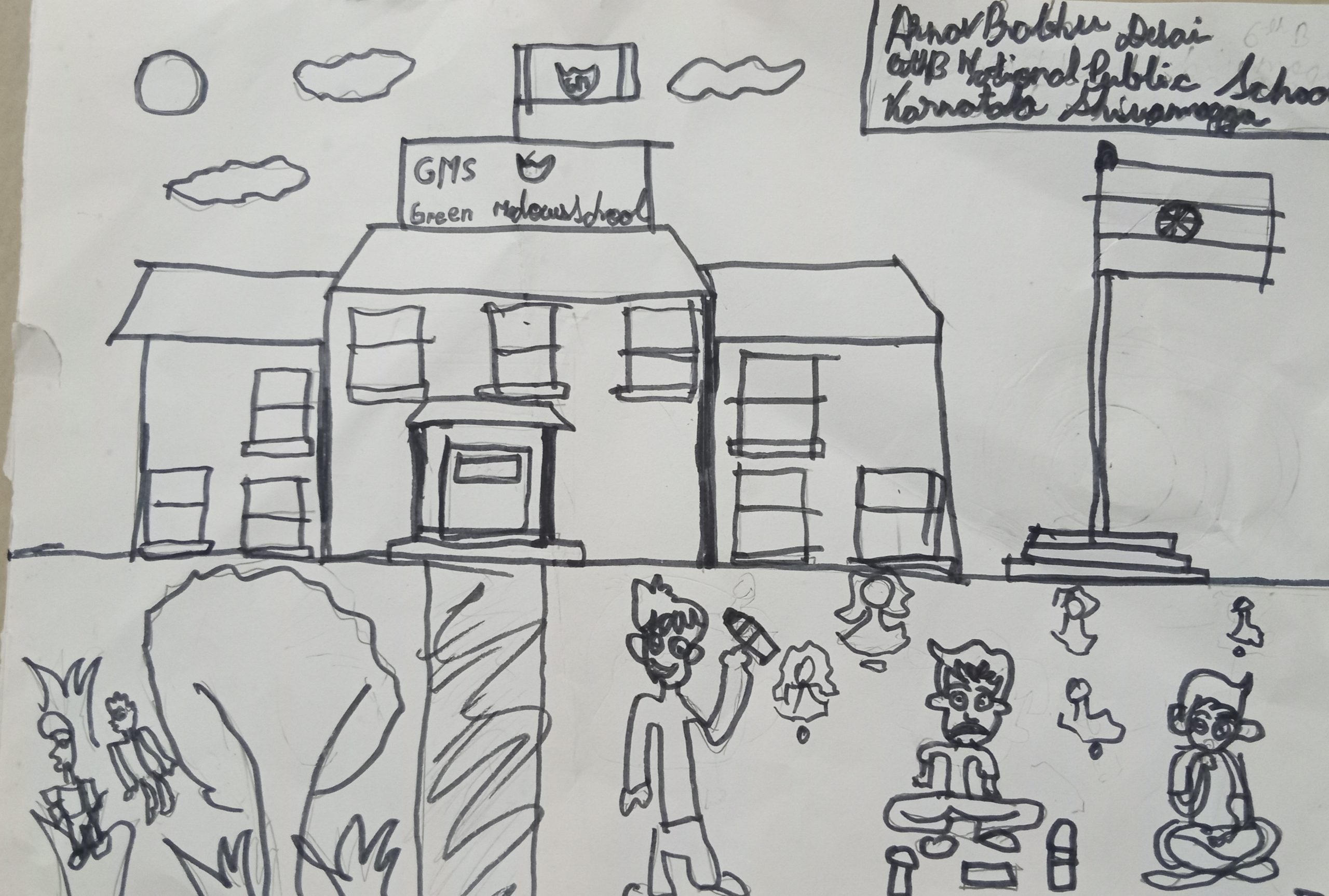
“See what I drink, this is CLEAN water,” said Subhash holding up his sealed bottle of mineral water, “It’s water purified in factories, it costs money!”
Sujata ma’am who was on lunch duty stopped by, “One should be happy while eating,” she said. “What’s this argument about?”
Everyone started speaking at the same time, pointing at Subhash and his mineral water bottle.
“You’ve got a point there,” she said, “Today is Wednesday, 7th period is our Science period, isn’t it? Let’s have an open discussion regarding this! Now that you’ve finished eating, go and play!”
***
The bell chimed marking the 7th period, the time that the class was eagerly waiting for! Sujata madam walked in and promptly came to the point.
“Today was my lunch duty, as I walked around, happened to hear a few of you having an argument,” she said. “Doesn’t matter who said what but the topic is important! Water is a precious resource to be preserved for the future, let’s have an open discussion. Welcome to raise your hand and share your thoughts. Of course there’ll be different viewpoints but remember to listen attentively, with an open mind.”
Soon the class got into a lively discussion.
“Is the water in the river and streams dirty?”
“The water from our well comes up muddy sometimes, what to do?”
“When our well’s water turns muddy, maaji fills the pots in the evening, by morning the mud settles down at the bottom and the water becomes clean…”
“It happens in my home too, maaji then gently transfers the clean water to other pots and throws away the sticky mud!”
“We have a large pot to boil water which is then kept aside for drinking.”
True, the water for washing, cleaning or cooking is not boiled but the drinking water is always boiled.”
“Madam, Subhash drinks water bought from the shop.”
“He says that water is cleaned by machines in big factories…..”
“He says we drink dirty water.”
“I’m pleased about this discussion!” smiled Sujata madam, “You see how over the years your families have learnt to live with nature, including purifying the muddy water!”
“Having lived in a city, Subhash has seen other ways of life which you haven’t,” she continued. “Like the mineral water sold in bottles. It’s not only Subhash but thousands of people who drink bottled water.”
“But why, madam? So many plastic bottles, like our Science lesson says, don’t they pollute the environment?”
Sujata madam looked around the class, the same question reflected in many eyes. She took a deep breath and said, “You must’ve heard your parents and grandparents lament about the way the world is changing. At present the focus seems to be on making money, any way! The ethics and values seem to have taken a backseat! You know how the water cycle works. Water is a natural resource, nobody pays for rain or water from the rivers and streams but when people want to make money even water becomes a product. All over the world, businessmen make millions from their water-bottling plants.”
“But can’t we just drink boiled water? Why do we buy those bottles?”
“Because water needs to be purified,” said Subhash.
“Water purification plants are set up in all cities and panchayats so that the water that flows in your tap is purified. To be doubly sure, we boil it.”
“So many plastic bottles clogging our earth and oceans,” Chetan sounded concerned, “How to stop this menace?”
“Simple,” said Raju. “Don’t buy the bottled water. If nobody buys it they’ll naturally stop bottling and selling water!”
The bell chimed concluding the discussion on a happy note. On her way out, Sujata madam said, “As adults, aware students like you have the potential to change the world!”
(Savitri Narayanan is a retired educationist at present in Goa. A mother and grandmother, loves reading, writing and travelling.)


