Arrived at the Mussoorie bus-stop, you’re swamped by rental scooter folks wanting to show you “Ruskin Bond-ka-ghar, Victor Banerjee-ki-bari, Vishal Bhardwaj-ka-ghar! Aur Sachin Tendular-ki-kothi! Phir Lal Tibba aur Char Dukan aur Rokeby-mein-lunch!”
“It gets so bad that on holidays, we bolt our gates from the inside,” Dhruv Puri. Rokeby’s new Manager says, adding, “Just can’t take in that many people.”
There was a time, not too long ago, when the houses up here had their own special names, their own special identities.
“What’s in a name?” you may ask.
Apparently, there’s a lot or at least to the successive waves of immigrants who arrived from the hinterlands, to our towns in search of a job. To them, the Scottish and Irish names that the pioneers had given their homes in Mussoorie must have seemed odd.
What can one make of names like ‘Cefn Cord’ or ‘Uncle Tom’s Cabin’? Or ‘Brandlesome’? Or Seaforth Lodge?
When you got off at the old bus terminus at the Dingle, below Kingcraig, your luggage was whisked away by the coolies by simply saying: Dhangwali or the ‘one on the precipice’ for Prospect Point; Banjwali aptly described the dense clump of oaks surrounding Tabor Cottage, and Daatwali evoked the via-duct like approach to Redburn Estate.
Many of these names have sunk without a ripple. Some have survived the sandpapering of Time. As has Company Khud, wherein water played a crucial role in those early days, ferried from Company Khud by mules, collected in a tank outside Mullingar for onward distribution to those early abodes.
To my surprise, I was to discover that Sisters Bazaar is not named after the nursing sisters working at the British Military Hospital! I am told that it got its name from Jodi Bungla, or the twin bungalows at the mouth of the quaint market.
Then there is Eastwood. It once housed a dairy and the chief work of the establishment was to make butter. During the processing, the buttermilk emptied down the drains and immediately, the locals promptly christened it Doodhwali kothi.
Moreover, why would Prospect Lodge, at the end of Sisters Bazaar called Naharwali? For there are no remnants of a canal there or even a trace of water found there. I owe it to the memory of Mr. Prakash, an old-time resident, owner of A. Prakash & Co. He remembered: ‘There was indeed a spring at this place. But after the earthquake of 1995, a landslide muffled the gurgling forever.’
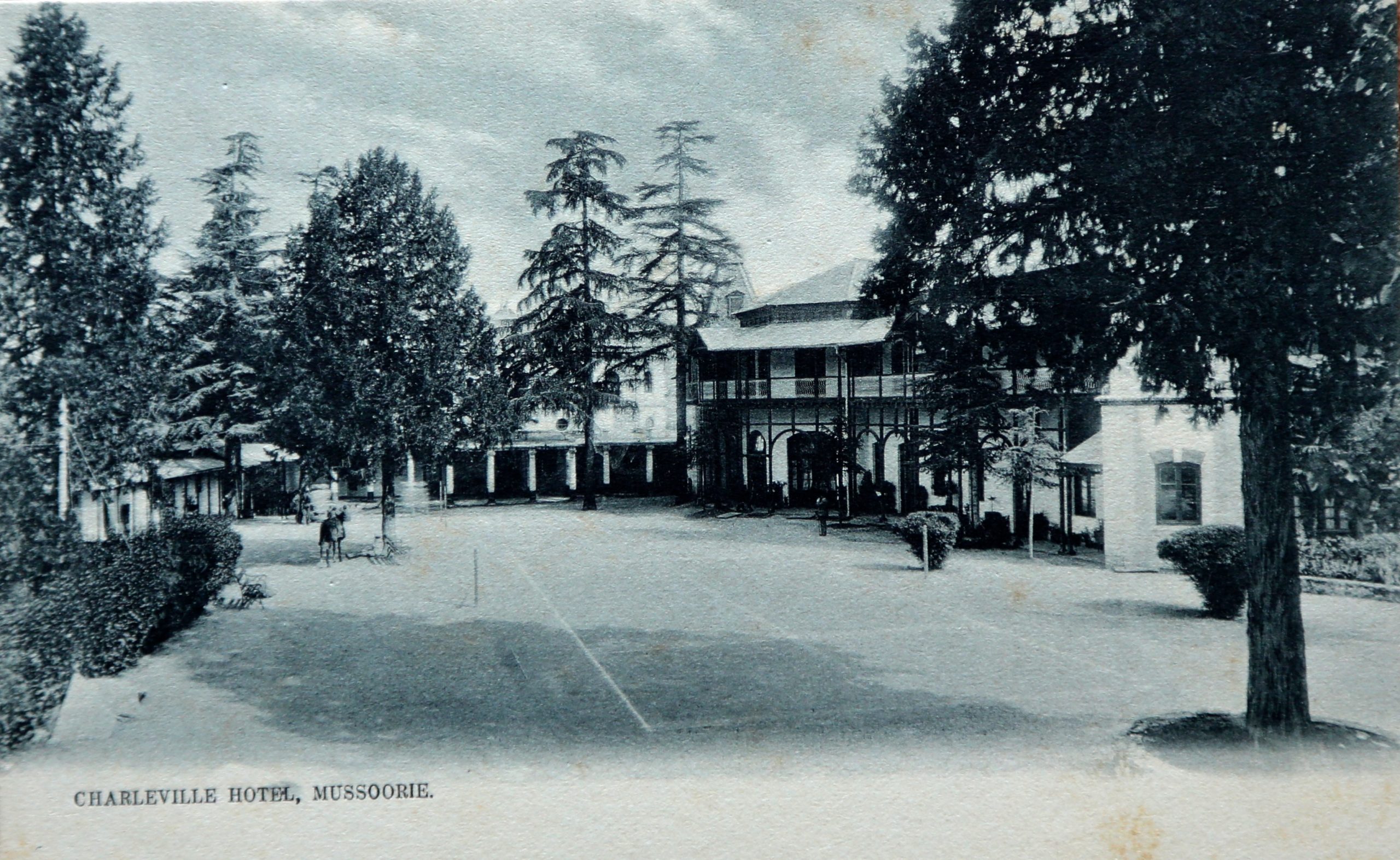
What did not die though was the renaming of properties. Take the old Charleville Hotel, built on the lands of Chaijuli patti. While in the rest of the world the correct pronunciation was ‘Sharly-ville’, but in this instance, this famous hotel (now housing the Lal Bahadur Shastri National Academy of Administration) would be incorrect. It was named after the two sons of Mr.Hobson: Charlie and Willie, and the locals, to this day, call it Charlie-Billie.
Hawthorne’s poems were written a hundred and twenty-five years ago, when this hill station was barely able to walk Take a walk with Mr Hawthorne through a sampling of these lines of r history:
VI
There are hues a fair one wore, Whom I saw standing at the door Of the Mussoorie Library
Is he an angel, O! Then, if he be, He’s one “unawares” to Mussoorie and me.
For he’s always dressed nicely and looks too well-fed,
To be either an angel or a ghost from the dead.
XI
I followed the round Camel’s Back
A spoony-looking couple
The girl was short and very fair
The man was tall and supple.
It was witching time of eve
When fond ones love to dally And vow they “never will forget”
And never shilly- shally.
XII
The hero of my song today shall be one who, the Mall you very often see ways equipped in a coat of glossiest black,
Fitting without a wrinkle to his shapely back.
Nineteen square miles ~ think of it, that is all this magic mountain shows for size. That’s all it boils down to. It makes up the rest with fun and frolic, chatter and gossip, truth and lies, handed down to us.
Ganesh Saili, born and home-grown in the hills, belongs to those select few whose words are illustrated by their own pictures. Author of two dozen books, some translated into twenty languages, his work has found renown worldwide.