Culinary Chronicles
 By Yasmin Rahul Bakshi
Amidst the Pir Panjal and Himalayan ranges rests Kashmir, the heaven on earth. The cuisine is highly influenced by Persian culture. The Kashmiri food is classified into Wazwaan and Butta. Wazwaan cooking has immense use of onions or pran and garlic or ruhan, and Butta way of preparation exempts the use of both. Yet, both the types share the love for lamb. Kashmiriyat is rich in itself thus requires no frills around. The cuisine is intense. So, it requires no decorations or garnish.
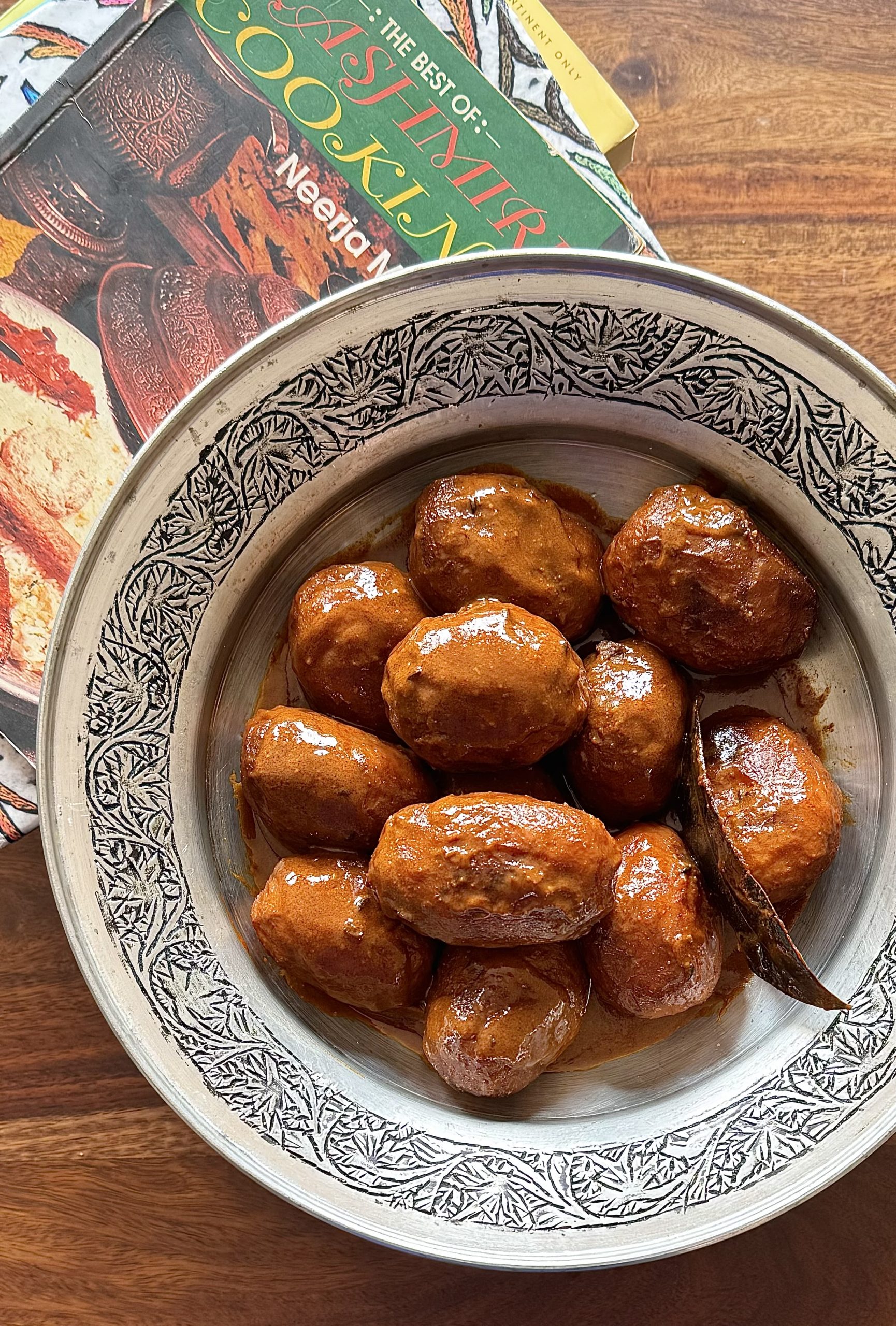
Dum Aloo, the real Kashmiri Dum Aloo, are void of any extra condiments or nuts. Selected dry spices and curd make the flavours deep. No heavy or additional gravy around the infused potatoes. Just a little red oil around.
Kashmiri cuisine in itself is well balanced with most elements and traditionally served in bowls – “Thaal baan” and “Kaenz” or “Trami”, platters with little high rims.
Traditionally a meal is devoured in “Thalbaan” by the men folk, while “Kaenz” are used by the fairer sex. Both are hand crafted copper bowls usually with intricate engravings of maple (Chinar) leaves, raised on a fixed small pedestal of the same, yet the shape and size varies.
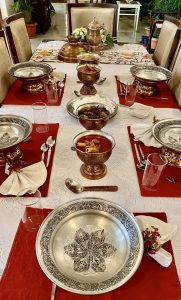
What I presume about the raised levels of these bowls is that the Kashmiris dine on the floor even in cold climates. Perhaps the base in between the ground and the bowl acts as a barrier for heat to be retained in food and not get conducted out on the floor. Plus, while sitting cross legged and dining, it becomes easier to pick and eat from a raised surface.
It pinches when anyone terms a regular mutton curry as Rogan Josh. Similar feelings overtake in case of Kashmiri Dum Aloo when these are produced with overpowering onion-tomato, ginger-garlic curries, and often potatoes tucked in with nuts.
There are just two ways to cook Kashmiri Dum Aloo, either the Pandit way, or the Kashmiri Muslim style with a few chosen whole and powdered spices. Unpardonable sin is to use tomatoes and pan fried masala (bhuna masala) in both methods.
The vibrant hues are emitted by the special red chilli and cockscomb powders. Flavours further escalate with the generous use of saffron in mutton.
Ingredients:
- Potatoes – ½ kg (equal and medium sized)
- Curd – ½ cup
- Green cardamom – 4
- Black cardamom – 2
- Cinnamon – 2 inch
- Cloves – 4
- Black cumin (shah zeera) – ¼ tsp
- Bay leaves – 2
- Dry ginger powder – 1 tsp
- Fennel powder – 2 tsp
- Kashmiri red chili powder – 2 tsp
- Turmeric powder – ½ tsp
- Salt – according to taste
- Asefoetida – 2 big pinches
- Cockscomb powder (mawal) – 2 Tbsp (optional)
- Oil – for frying
Method:
- Boil the potatoes until tender. Cool and peel them. With the help of a thin bamboo skewer or a toothpick, pierce them through all ends.
- Heat oil in a pan and deep fry the potatoes until brown. Keep aside.
- In a small bowl beat the curd and dissolve dry ginger powder, fennel powder, salt, turmeric, and Kashmiri red chili powder. Keep aside.
- In another pan, heat 2 Tbsp of oil (I prefer mustard oil) and add all the whole dry spices. Let them crackle.
- Pour in the curd and powdered spices paste. Stir well and cook until the oil surfaces.
- Add the fried potatoes, mix well.
- Add 2 ½ cups of water and boil on low flame for 15 minutes.
- Meanwhile, boil the cockscomb powder in ¾ cup water for 5 minutes.
- Strain and pour the cockscomb powder in the potato curry and cook further for 5 minutes.
- Serve hot with rice.
(Yasmin Rahul Bakshi is an accomplished senior consultant Chef and a food historian. A widely travelled Army wife from the Mussoorie hills with exposure to international cuisines & preserving recipes with the medium of food photography and digital content creation in the form of stories.)