 By Ganesh Saili
This blow came without warning. A dull numbness stills my heart as I read reports that Landour is about to be renamed. Five generations of my family have spent their lives here, and soon the only thing we will have left will be memories of the place. To some of us, like me, who were born here, it is nerve-shattering to say the least.
Barely have we grappled with the new age, then the mad rush of tourists follows, resulting in crowds who gaze at the setting sun from Lal Tibba, make a reel or two and head home to post on Insta. Later, in droves, they came roaring around on rental scooters in the thousands. They are creating humongous traffic jams. You might as well forget peaceful walks under the deodars. It is nigh impossible.
As Alok Jain, a former Chief Secretary of Uttarakhand, living in quiet retirement, puts it: ‘The name itself is like an umbilical bond with the historical past.’
Pic courtesy: Bruce Skillicorn
Unless this whole exercise is abandoned forthwith (being imposed on us without rhyme or reason), I can quite see myself lounging around the post office getting fresh Aadhaar cards, PAN cards, postal addresses, land records, and LPG connections. Anything linked to Landour shall require a name change. Together, we must halt this insanity. The time is now.
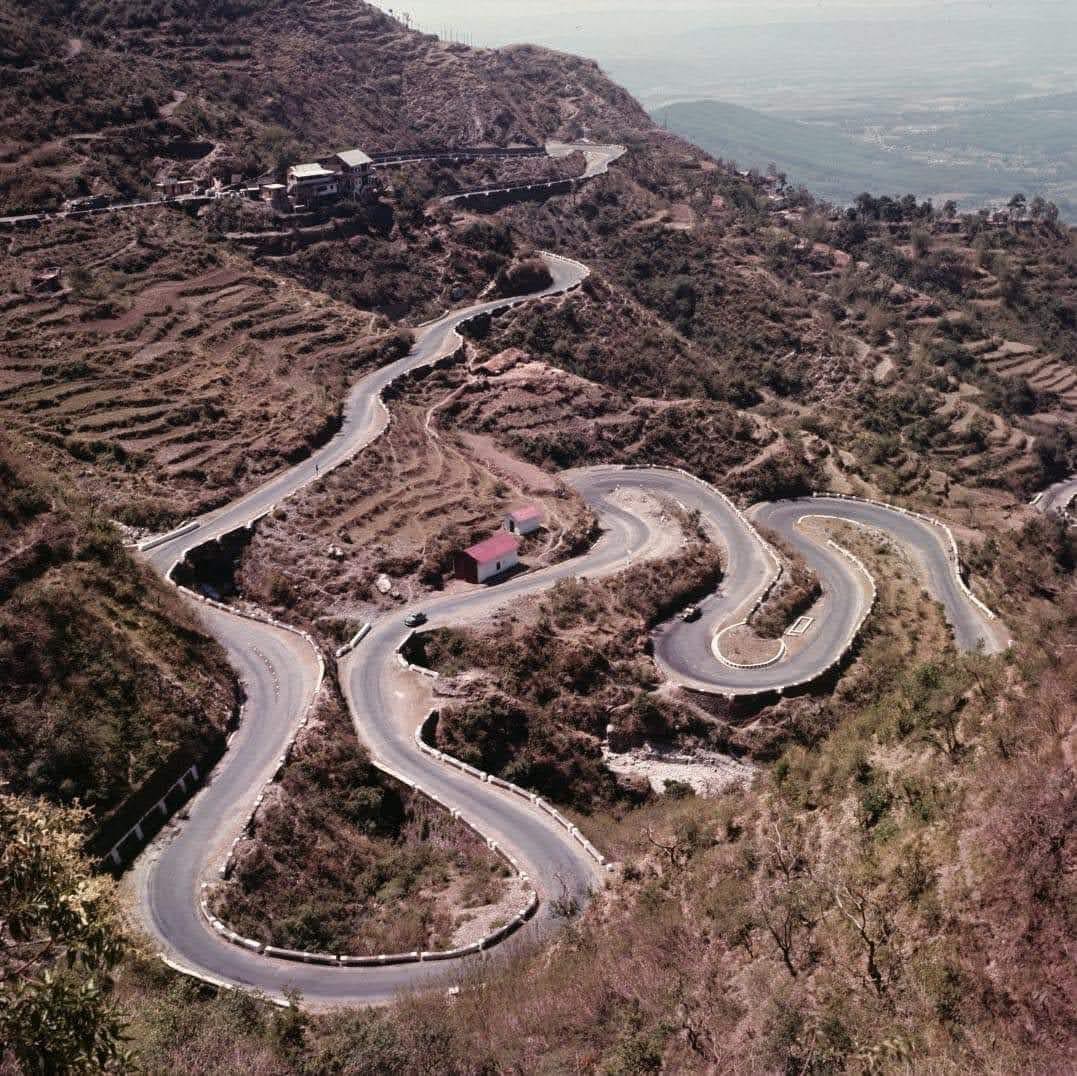
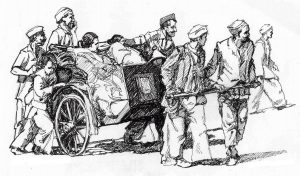
Our tale of conjoined twins dates back two hundred years. It began with the forging of a road to the hills. The Mackinnon Cart Road skirts the earlier approach bridle path from Rajpur; there it swung right, winding its way through the low hillocks of sal trees; it crosses a viaduct (now buried under loose shale) and climbs up the scarp, slithering past the haunted paani-wala bend. Five hairpins and four culverts later, it deposits you at Kolhukhet. The road was so well built that, in the recent cloud burst, the old road survived.
Pic courtesy: Nilanjana Singh Roy
Inch by inch, gaining a grip, the road snaked up, making it is the most easily negotiated road to any hill station in India. It was originally built for bullock carts and has a gentler gradient. In 1929-30, motor travel began both ways, resulting in fare slumps. Except at the height of the ‘season’, folk were ready to bargain down to the last paise and motored down to Dehra from two to four annas. For under a rupee, you could end up in Saharanpur.
The road indeed brought more business! Remember it was the gentle Queen Madelsa of Nepal, living in Failawn Palace, who thoughtfully had watering-troughs placed to quench the thirst of man and beast at intervals on the old bridle path or the Kipling Trail.
To get further, in 1926, a loan from the United Provinces Government helped the road get to Bhatta, until the terminus crept to Douglas Dale Spring. Six years later, in 1936, it reached Kingcraig.
Of course, the two ends of the Mall Road had to wait much longer because of land acquisition issues: the road to the Library was completed in 1954, and reached Picture Palace in 1957, when Ram Krishna Verma was heading the city board.
The first buses between Dehra and Mussoorie were owned by the Gwalior and Northern India Transport Company. They carried the Royal Mail – a tall order, as the bullock and horse traffic had littered the road with animals’ shoes and nails, which was a real nuisance for the tyres. This was resolved by hand-sweeping the entire road using magnets.
Two hundred years later comes this senseless exercise of renaming that will cause irreparable damage. We already have a name that was given to us by the workers who came from the abutting plains. Landour is an essential part of our collective memory, at least it is so, for those who have grown up and live in the peaceful climes of 1040 acres of Landour Cantonment.
Mercifully, no one can erase home because it involves a sense of belonging, heritage and emotions. All these go to make you who you are.
‘Can’t we just padlock the gates and throw away the keys?’ wistfully asks an old timer.
If only I could say ‘Amen.’
(Ganesh Saili, born and home-grown in the hills, belongs to those select few whose words are illustrated by their own pictures. Author of two dozen books, some translated into twenty languages, his work has found renown worldwide.)