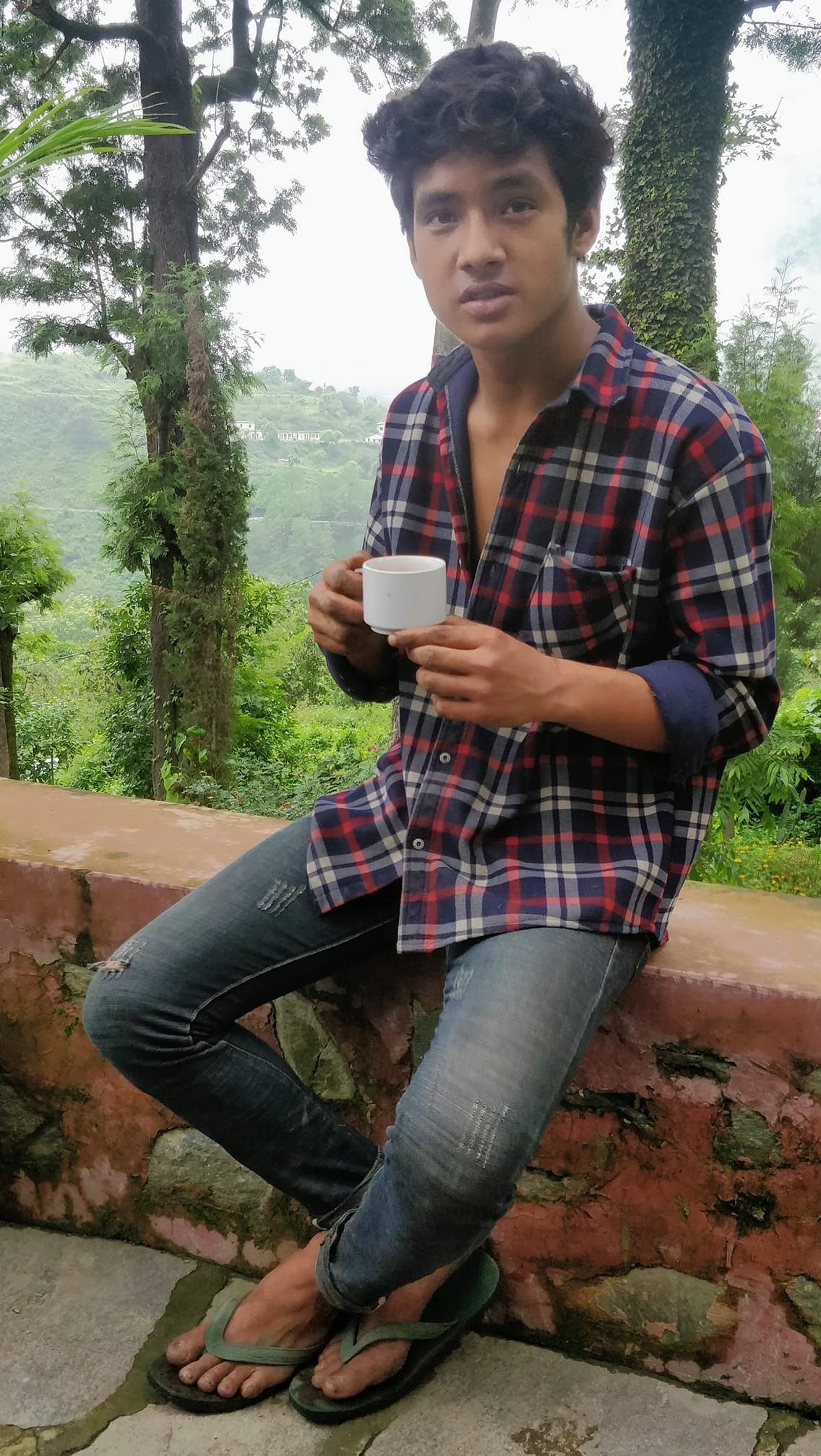
(Before the vice of ambition tightens, there is a horizon without walls. In Tikendra’s world—simple meals, nameless songs, small dreams—that horizon still exists. But how long before the walls begin to close in?)
 By Rajshekhar Pant
His name, he says, is Tikendra—but pronounces it in a peculiar way: “Tikender”. Birth dates, for him, seem an unnecessary detail. Ask his age, and he answers in a muted, evasive tone—as though to keep the conversation from wandering too far—“Must be… sixteen, maybe seventeen.”
There is a quiet innocence on his face, and his eyes—full of unspoken feeling—seem fixed on some far-off horizon. They remind me of the cover of Dickens’ Oliver Twist.
It was during the monsoon. The path leading to my house on a mountain saddle had been claimed by brush and weeds, and I needed a daily-wage worker for five or six days to clear it. A friend, while warning me that the boy had little work experience—“He can manage small odd jobs, but nothing too heavy”—sent Tikendra my way.
My friend was right: the boy had no experience. He pulled at each blade of grass with two fingers, as if uprooting a whole tuft in one swift tug might cause some irreparable loss. I could tell already that the job would take twice as long as I had imagined. So, I knelt down, pulled a handful of grass in one motion, and tried showing him how the work could be done faster and better.
By midday on the first day, he came to me asking for a different task, complaining that the mosquitoes were unbearable. I handed him some Odomos cream for his hands, feet, and face, and sent him back. I was a little surprised—Bhimtal, though a hill town, does have mosquitoes, but not in such numbers as to halt work entirely.
Later, I wandered over to where he was working, thinking that if I sat with him a while, perhaps he would accept the mosquitoes as part of the job. Perched on a large stone, I struck up a conversation. He was delighted with the cream—“A very fine aushadhi (medicine). From tomorrow, I’ll use it every day,” he murmured without lifting his face.
Around noon, I sent for tea—two cups, one for him.
Tikendra comes from a small village in Nepal, where a river flows past fields of rice and wheat. He has a younger brother; his father works as a porter in Shimla. He himself studies in Class IX at a school with a long, fancy English name.
Why, at this tender age of sixteen or seventeen, was he here working as a labourer? Perhaps poverty. His years are meant for playing, for learning. Yes, flash-floods and erosion might have closed schools, but learning is never confined to school alone. Despite my repeated questions, his replies remained measured—often reduced to a mere “yes” or “no.” After tea, he returned to work, still marvelling at the “aushadhi”.
A few days in, he asked me for Rs 800—“for expenses”, meaning food. He owns no watch or mobile phone; I have to tell him when it is lunch or when work ends. Evenings he eats, sleeps, and begins again. He knows nothing of the GenZ revolt, Kalapani-Lipu Lekh dispute, hundred-point reform agenda of Balen Shah, the Treaty of Sigauli, or Nepal’s political figures. China is a distant name; India feels like home. He had been to India once before, with his grandfather—still sprightly for his age.
Tikendra’s presence left me with an unsettling cascade of questions. Looking at him, I think of the world he does not see—one of unimaginable wealth and comfort, and also of grotesque hunger for more: sports-stars earning in crores, pornography rackets, six-crore’s cars, parliamentarians brawling over hundreds of years old history, justice strangled for profit, leaders wearing the mask of service while squeezing those they rule.
And then there is Tikendra—earning Rs 400 a day, humming songs in his language, dreaming of visiting one day “big” cities like “Simla & Gujarat”. He knows nothing of pizza, butter chicken, or Hakka noodles; dal, rice, and roti are enough.
Will he remain this way? Will the world allow it? Wordsworth once wrote: The shades of the prison-house begin to close upon the growing boy.
Kafka spoke of an infinite horizon in every direction—until walls began to rise, drawing nearer, until they formed the shape of a vice. Perhaps these walls are made of knowledge, ambition, and expectation. In the boundless horizon there was contentment; in the narrowing vice, our greed grows. This is how we arrive at restlessness, exploitation, corruption—driven, ironically, by the very knowledge that once expanded our world.
Yuval Noah Harari has suggested that humanity’s troubles may have begun when some distant ancestor first tilled the soil—a reminder of the strange paradox at the heart of civilisation.
The Prometheus within us remains chained to the rock; vultures of ambition and greed tear at him endlessly. He has stolen more than just fire from nature’s vault, and the punishment—eternal, unbroken—may be his fate.
Tikendra! Even if I wished, I simply cannot say that you stay as you are. We all, perhaps unknowingly, await the day when the nearing walls close in… and the horizon turns into a vice.
(The author is an amateur filmmaker, a photographer, and a writer, who has written over a thousand writeups, reports, etc., published in the leading newspapers and magazines of the country. He can be reached at pant.rajshekhar@gmail.com)