
 By Rajshekhar Pant
It must have been the early seventies. A tourist’s car had plunged into the lake at Bhimtal, a small hill station near Nainital, taking with it the lives of two children. A few years later, an evening bus from Haldwani met a similar fate, sinking into the same waters and claiming many lives. I was in class nine or ten then. I had seen the bodies brought out, and heard the grief of those left behind.
Sensitive by temperament, I was deeply affected. From childhood I had heard that the Bhagavad Gita could lift one out of the sorrow associated with death. In an attempt to steady myself, I began to read it.
I had already read the Hindi version of the Mahabharata by C Rajagopalachari, borrowed from the school library, and knew that the Gita was a collection of teachings given by Krishna to Arjuna on the battlefield of Kurukshetra. Yet I could not quite understand why, when Arjuna hesitated to fight and kill his own kin, Krishna urged him toward battle. To refrain from harming one’s own seemed, after all, a natural and moral instinct. It was with this quiet confusion that I began reading the Gita.
My mother knew many of its verses by heart—the entire eighteenth chapter, in fact. I would often discuss it with her as I read. Yet, in truth, I understood little beyond a few simple ideas: that the soul is immortal and one should not grieve over death; that worldly attachments are illusory; that a wise person remains untouched by them. Perhaps only this much…
Around that time, one evening, a young man in his early twenties came to our house. His father was known to my father. When asked about his father’s health, he replied in a flat, almost indifferent tone: his father was on the verge of death, unable even to move; it would be better if he simply passed on; medicines had been stopped. There was no trace of emotion in his voice—no sorrow, no tremor of impending loss.
In that moment, I remember thinking that he must be a man of rare wisdom—detached, beyond all worldly ties, untouched even by the prospect of his father’s death.
When I shared this thought with my father, he laughed. He said the young man was not wise, but merely irresponsible—unaware of his duties and obligations. Life, he added, might yet teach him otherwise.
With time, I read about the transient nature of the cremation ground spirituality and the deceptive detachment caused by the sighting of burning pyres. I experienced it myself in due course. In my early youth, I would wander through graveyards, tracing their histories, collecting the melancholic lines inscribed on tombstones. These strange engagements, in their own way, helped me understand death and the sorrow that follows in its wake. The Gita, too, began to open itself gradually.
My father later gave me books on the Gita by Sarvepalli Radhakrishnan and Shakuntala Rao Shastri. Meanwhile, life—with its struggles, its small triumphs and quiet failures—continued to instruct in ways no text quite could.
After my mother’s death from cancer, in trying to emerge from the heaviness of grief, I turned to the writings of Brian Weiss. I realise now that I was not merely reading him—I needed to believe him. I wanted to hold on to the possibility that I might meet her again, somewhere beyond this world, or in another birth.
Within a few years, my father too was gone. It was then, perhaps, that ideas like duty, responsibility, detachment, and action began to take shape—not as abstractions, but as lived necessities.
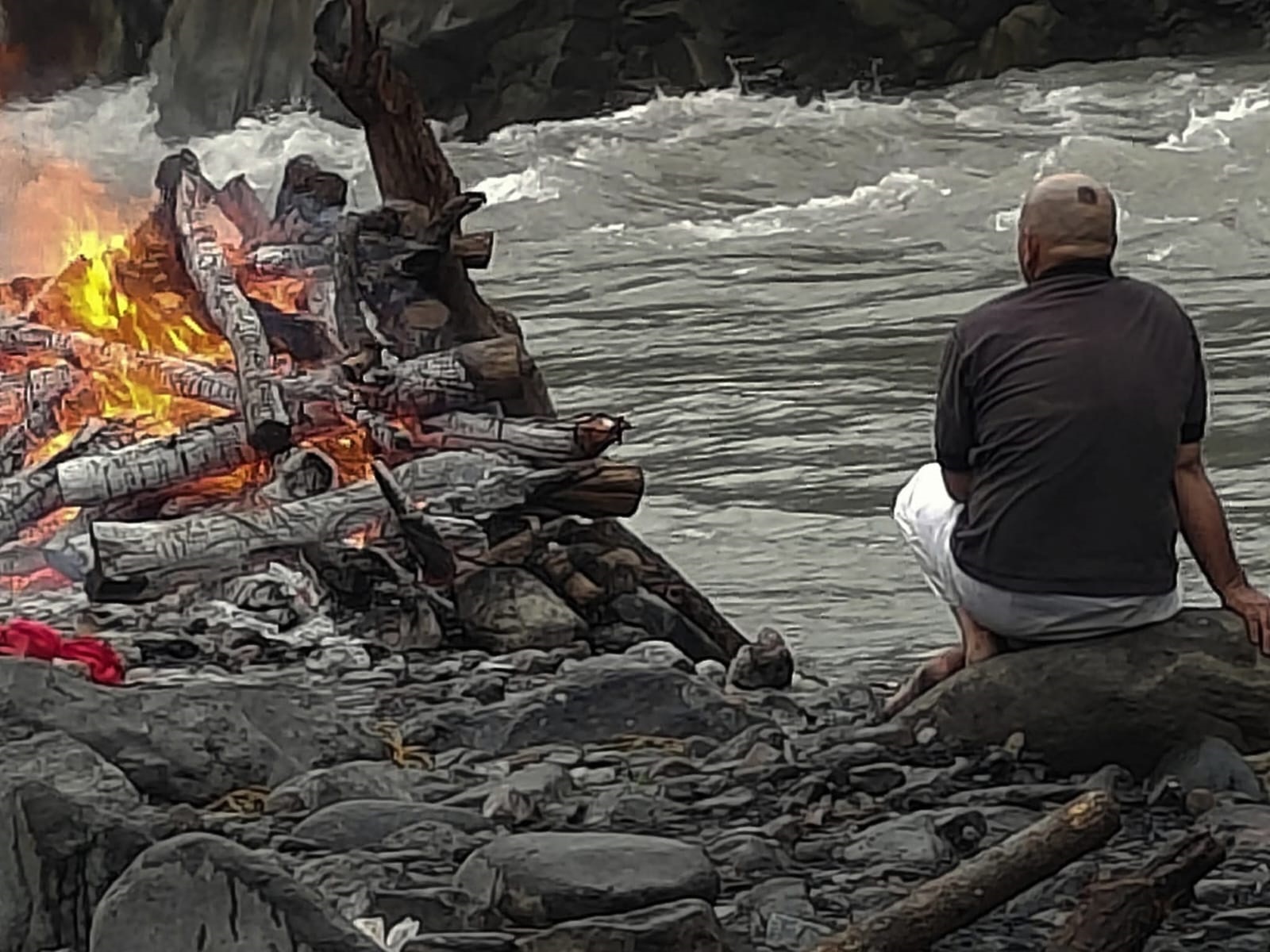
Of late, I had gone in a funeral procession to the cremation ground at Ranibagh, a foothill settlement on the banks of the Gaula River. Somewhere amidst the endless stretch of sand and scattered stones, a pyre was burning. Behind it, the river flowed on, carrying with it a quiet, mournful resonance.
The detachment that arises from such a sight—how fleeting, how shallow it is, I have begun to understand. It is, in truth, a detachment born of attachment itself, and therefore cannot endure. Perhaps it is not detachment at all, but merely an alluring evasion—a subtle desire to withdraw from action, from responsibility, from the burdens of living.
True detachment does not turn one away from action; it asks instead that one remain steady within it. The young man who had come to our house—his seeming indifference may not have been wisdom but ignorance. And my own turning to Brian Weiss was not detachment either, but attachment in another form.
Knowledge, perhaps, is not something one acquires merely by reading. It is a truth that must be experienced. One may read much and remain untouched; one may read little and yet come to understand. The book of experience, too, instructs—quietly, insistently. What matters is how deeply one is able to absorb what life offers.
And yet, at times it seems—without attachment, how arid, how burdensome life would become.
The closing lines of The Royal Ascetic and the Hind by Toru Dutt offer a striking re-reading of the story of Jada Bharata from the Vishnu Purana—who, ensnared by affection for a fawn, forgets the austerities of a lifetime:
Not in seclusion, not apart from all,
Not in a place elected for its peace,
But in the heat and bustle of the world,
’Mid sorrow, sickness; suffering and sin,
Must he still labour with a loving soul
Who strives to enter through the narrow gate.
Is it not better to live life with these natural emotions—attachment, love, compassion, and the pain of separation—than to shatter all attachment with the cold edge of knowledge?
I do not know if this question will ever find an answer.
(The author is an amateur filmmaker, a photographer, and a writer, who has written over a thousand write-ups, reports, etc., published in the leading newspapers and magazines of the country. He can be reached at pant.rajshekhar@gmail.com)


