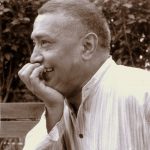
By Ganesh Saili
Gravely, by common consent, the doctors at the Landour Community Hospital announced their verdict: ‘Epistaxis!’
An ordinary nosebleed during a trek in the high mountains spiralled out of control, and friends rushed me here. Next morning, opening my eyes from a drug-induced stupor, I thought to myself: ‘This is it! I must have died!’ For there at the end of the bed stood what I took to be St Peter himself, with a flowing grey beard, white skullcap, brown hooded cassock and rosary, chanting a prayer.
In my mind, I was at the pearly gates of heaven.
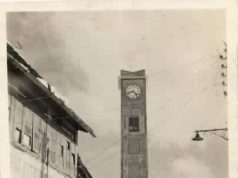
It was the heavy Italian drawl that gave the game way. Slowly it dawned upon me that this was none other than old Father Aloysius, who, in the 1970s, was looking after the spiritual needs of St Emilian’s Church near Clock Tower. As he got older, he took to wandering through the hospital saying prayers for anyone who looked too far-gone.

The most significant Italian presence in Mussoorie were the Capuchin Friars in Barlowganj. In 1853, they built our second oldest school – St George’s College – and ran it for forty-one years, till one fine winter’s morning they gave it over to the Irish Patrician Brothers and went back to pursue their religious calling.
Come to think of it, the Second World War saw the Doon valley awash with an influx of Italian and German prisoners-of-war brought in after the African campaign.
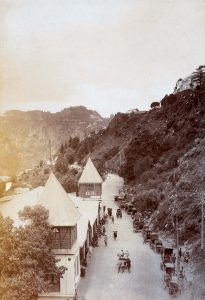
Among the internees at the Premnagar Detention Centre was the Austrian mountaineer, Heinreich Harrer, who escaped on April 22nd 1944, crossing the Park Estate ridge, and then the Aglar River. He was arrested at Bhatwari, but escaped through the skylight, crossing over the Mana Pass in winter to arrive in Lhasa on the 15th of January 1946. Befriending the 14th Dalai Lama, he turned employee of the Tibetan Government. Years later, his book Seven Years in Tibet became a bestseller.
‘Wherever I live,’ he wrote later, ‘I shall feel homesick for Tibet. I often think I can still hear the cries of the wild geese and cranes and the beating of their wings as they fly over Lhasa in the clear cold moonlight.’
Another Italian priest, Father Clement, had in 1936 been busy putting together a housing colony for Anglo-Indians in Clement Town. With over 80,000 enemy aliens on its hands, the government temporarily acquired this land.
Exclusive arrangements were made to house five Italian generals in a bungalow in Dilaram Bazaar, as befitted their rank and status.
But what happened to Father Clement?
‘I do hope to come back and see you all once again in the spot which is dear to my heart,’ he wrote to a friend on July 24, 1952.
But it was not to be. Three days after reaching Italian shores, he passed away. And Clement Town’s temporary camps were never returned to their owners. Father Clement’s dream lay in tatters.
‘Father Luke, the Catholic chaplain thoroughly deserves the grateful thanks of his flock,’ writes author AR Gill in his slim volume Valley of the Doon (1952). He persuaded an Italian painter, Nino La Civita, interned at the Premnagar camp, to paint the interior of the Church of St Francis of Assisi off Parade Ground. This he did Michelangelo-style, perched atop scaffolding, rubbing paint by hand on to the columns supporting the roof so that it resembled veined marble. On the upper portions of the walls he made four panels depicting stories from the life of St Francis of Assisi, adorning the wall behind the main altar with a tapestry. At the bottom, he put the medallions of the four evangelists.
But where’s the Landour connection?
It’s there, but only for those determined to find it. Hidden from public view, tucked away on a slope below Landour’s Upper Chakkar, with cenotaphs made of slate and mortar, their chimney-like flues piercing the pristine air of the Himalaya, you’ll find a cluster of graves that are beginning to crumble.
This quiet corner of the Landour Cemetery holds the remains of our early Catholic priests and a few Italian internees where they rest forever, in sight of the eternal snows.
(Ganesh Saili, born and home-grown in the hills, belongs to those select few whose words are illustrated by their own pictures. Author of two dozen books, some translated into twenty languages, his work has found renown worldwide.)