Discussion held on Decline of Hindu Civilisation at Doon Library
Garhwal Post Bureau
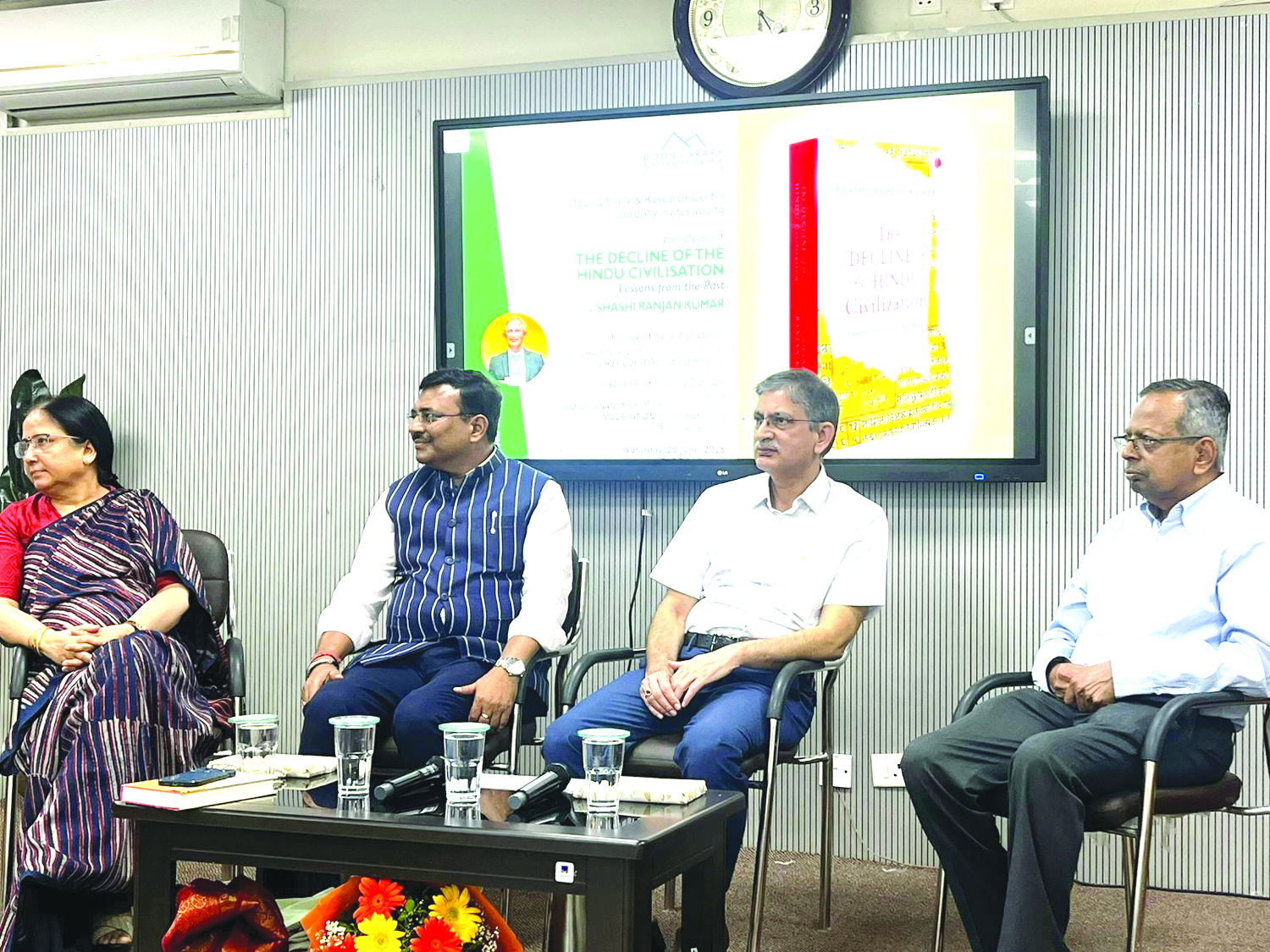
DEHRADUN, 20 Jun: A detailed discussion on the book ‘The Decline of Hindu Civilization: Lessons from the Past’ was held at the Doon Library and Research Centre here on Saturday. During the discussion, the author Shashi Ranjan Kumar emphasised on the need for an honest and balanced understanding of history and asserted that “the past cannot be avenged, it can only be understood”.
It may be recalled that the author Shashi Ranjan Kumar is an IAS officer currently serving as Secretary of the Union Public Service Commission (UPSC). Addressing the gathering, he said that the past continues to live on in collective memory, in ruins and in the ways it continues to shape contemporary existence. He observed that the only way forward is to confront both the achievements and failures of the past with complete honesty.
Explaining the premise of the book, Kumar said it is divided into four major sections, The Zenith, The Decline, The Defeats and The Reasons, and is based on extensive research and a comparative historical approach. The work attempts a serious analysis of how Hindu civilisation weakened across several domains, including culture, politics, society and intellectual thought.
Advocating a balanced perspective towards history, he said history should neither be viewed merely as a source of nostalgia nor as a repository of grievances. Interacting with the audience, he remarked that while the past cannot be changed or avenged, it can and must be understood in order to derive meaningful lessons for the future.
Kumar said the book draws extensively upon primary historical sources, including Chachnama by Ali Kufi, Tabaqat-i-Nasiri by Minhaj-i-Siraj, Kitab al-Yamini by Al-Utbi, Futuh al-Buldan by Al-Baladhuri, Kitab-ul-Hind by Al-Biruni and the travel accounts of Al-Istakhri.
Speaking on the intellectual foundations of ancient India, he said the roots of Hindu mathematics could be traced back to the Rg Veda, where a well-developed decimal system was used to express quantities extending up to at least one trillion. He explained that attempts to comprehend the vastness of the universe required increasingly sophisticated calculations, which eventually led to the development of an efficient decimal notation system and the recognition of zero as an independent number.
Turning to life sciences, Kumar drew comparisons between Indian, Greek and Chinese medical traditions. He observed that while general surgical procedures were known across several civilisations, sophisticated techniques such as plastic surgery evolved uniquely in India. The book also examines Hindu aesthetics and musical traditions, highlighting the depth and diversity of Indian knowledge systems.
Referring to the final chapter of the book, titled War is Deception, Kumar expressed regret that many local rulers had forgotten the teachings of Kautilya. He said there was little evidence of the strategic use of kutayuddha or covert warfare against Turkish invaders. According to him, warfare among many contemporary Indian rulers gradually became more a matter of individual valour than of coordinated military strategy.
He described ‘The Decline of Hindu Civilization: Lessons from the Past’ as an effort to initiate a serious and evidence-based discourse on history, identity and intellectual self-renewal. The book, he said, invites readers to engage honestly with the past in order to better understand the present and shape the future.
The programme was chaired by former Chief Secretary N Ravi Shankar, IAS and currently the Director of the Doon Library and Research Centre.
Chief Secretary Anand Bardhan, who was present as the chief guest, described the book as an important historical document for both the present and future generations. He said the work would serve as a valuable record of history and contribute to informed discussions on the evolution of Indian civilisation.
The keynote address was delivered by Prof Dr Surekha Dangwal, Vice-Chancellor of Doon University, who reflected on the historical frameworks presented in the book. She observed that after Independence, India’s history had often been presented in a selective manner. She said contemporary discourse had increasingly begun focusing on civilisational history, historical transformations and the structural lessons that could be drawn from the past.
The event was coordinated by KK Mishra, PCS, of the Uttarakhand Government. Historians, literature enthusiasts, journalists, senior government officials and a large number of interested citizens attended the programme and participated in the discussion on history, civilisation and intellectual traditions.